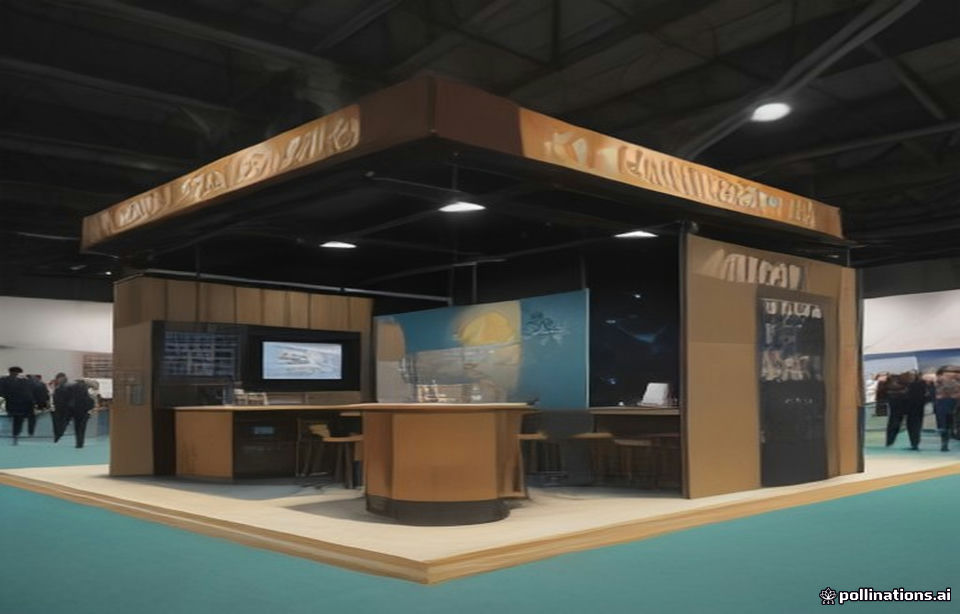
Booth-critical display packaging must be validated to ECT-32 minimum (ECT-44 for stacked pallet displays) and produced via dieless CAD cutting with digital print within 24-48 hours, per ASTM D642 and ISTA 3A protocols. Digital printing with zero plate tooling eliminates mold fees and compresses the traditional 3-4 week sampling cycle into a 48-hour floor-ready deliverable.
1. The 72-Hour Booth Deadline: Why Conventional Sampling Fails Exhibitors
As Pack Expo International (PMMI) exhibitor counts climb and booth setup windows shrink to 48-72 hours, conventional sampling workflows — offset plate making, die tooling, and ocean-freighted samples — are structurally incapable of meeting show deadlines. The engineering solution is a fully digital pipeline: CAD dieline generation, dieless plotter cutting, and HP PageWide/industrial digital print, delivering retail-grade prototypes in 24-48 hours with zero tooling fees.
The failure mode is not print quality — it is structural under-specification. A booth sample box that looks perfect on Day 1 but arrives warped, delaminated, or crushed after air freight destroys the demo. Every exhibit sample shipped to Chicago (McCormick Place) is a shipping container first and a marketing asset second, and must therefore comply with the same physics as production transit packaging.
2. Material Selection for Booth Samples: Flute Calipers and Print Surface Physics
Exhibitor prototypes fall into three structural classes, each with distinct dieline and board requirements:
| Application | Board / Caliper | Key Spec | Governing Standard / Test Protocol |
|---|---|---|---|
| Retail VIP / luxury rigid box (short run) | 1.5-2.5mm grayboard wrapped in 157gsm art paper | Warp ≤1.5mm/m; wrap adhesive bond ≥180° peel without fiber tear | ISO 186:2020 conditioning; ASTM D903 peel |
| Corrugated product showcase shipper | B-flute (2.5-3.0mm) or E-flute (1.5mm) kraft/white-top | ECT-32 minimum; Mullen burst ≥200 psi for international POs | TAPPI T810 (2026 Revision); TAPPI T811; ASTM D642 |
| Pallet display / stacked booth unit | BC-double wall (7.0mm) | ECT-44; BCT ≥ safety factor 4-5x stacked load | ASTM D642; McKee formula verification; ASTM D4169 |
| Fragile glass/ceramic demo pieces | Molded pulp inserts + BC outer | Insert compression deflection matched to ±0.5mm; PFAS-free barrier coating | ISTA 3A General Simulation; ISO 2247 vibration; EU PPWR (2024/1991) |
Print surface matters at booth distance of 1-2 meters: coated white-top kraft or CCNB (350gsm) laminated liners deliver digital toner/inkjet adhesion with ΔE color drift under 2.0 against brand Pantone targets. Per FTC Green Guides (16 CFR Part 260), any recyclability claim printed on booth samples must be substantiated — PFAS-free and mono-material structures are the defensible default under EU PPWR (2024/1991) recyclability grading.
Q: If the McKee formula derives BCT from ECT, why do overseas enterprise POs still mandate Mullen burst testing?
A: A typical PO clause requires Mullen burst ≥200 psi (TAPPI T810) alongside ECT-32 (TAPPI T811). The mechanical reason: McKee assumes uniform liner quality; burst testing independently verifies fiber bonding and liner puncture resistance, which ECT cannot detect — a high-ECT, low-burst board fails pallet-corner impact and forklift puncture scenarios. Practical recommendation: accept ECT as your structural design input, but pre-qualify board lots to both tests before committing booth quantities, and demand supplier mill certificates per lot.
3. The 24-48 Hour Rapid Prototype SOP (Engineering Checklist)
Dieless cutting and digital print remove tooling from the critical path, but structural integrity depends on disciplined process control. The verified TadaPack workflow:
Step 1 — CAD Dieline & Structural Sign-off (Hour 0-6): Generate the dieline in ArtiosCAD/Esko format; verify slot-to-crease registration tolerance at ±0.15mm and caliper compensation for the selected flute. Simulate compression using the McKee relationship (BCT ≈ 5.87 × ECT × √(t × Z)) against the stacked booth load with a 4-5x safety factor.
Step 2 — Board Conditioning & Substrate Prep (parallel): Condition all substrates to 23°C ± 1°C, 50% ± 2% RH per ISO 186:2020 for minimum 24 hours (accelerated 4-hour cycle acceptable for coated boards) to prevent post-print warp and dimensional drift exceeding ±0.3mm/m.
Step 3 — Digital Print & Dieless Cut (Hour 6-30): Print at 1200 dpi digital with primer-coated liners; cut on flatbed dieless plotter with 45-durometer creasing matrix for sharp E/B-flute creases — crease depth set to 60-70% of caliper to avoid liner cracking on fold-back tests.
Step 4 — Verification & Protection Pack (Hour 30-48): Perform fold-back endurance test (10 cycles without liner fracture), gluability check, and apply transport packaging: double-wall outer, molded pulp or EPS-alternative cushioning, corner blocks. For fragile demo units, validate against ISTA 3A drop sequences (76cm drop height for ≤9.1kg packages) before air-freight tender.
Conditioning: 23°C ± 1°C, 50% RH (per ASTM D685).
Instruments: Mitutoyo 547-400S digital caliper (±0.01mm), Lansmont compression tester, TAPPI T810 Mullen burst tester.
Sample plan: 10-specimen statistical average, tolerance ±0.15mm, illustrative Lot #TP-2026-B4. Example acceptance criteria for a BC-wall booth shipper: ECT ≥44 lb/in, BCT ≥ 5.87 × 44 × √(7.0 × Z), Cobb 60 ≤ 35 g/m². Note: all figures are illustrative specification targets, not reported test results.
4. Transit Protection & Multi-Regional Logistics Landing Matrix
Exhibit samples face three freight stress points, and each demands an explicit derating decision:
Ocean/air corridor moisture: 30-day Pacific or Atlantic container transit exposes board to container sweat cycles; per ISO 535, boards with Cobb 60 above 35 g/m² can lose 20-30% effective ECT. Specify water-resistant (non-PFAS) barrier coating or wax-alternative liners for any sea-freighted booth stock, and vacuum-seal wrapped VIP rigid boxes with desiccant (≥50g per m³ of void).
Intermodal hub tolerance: US-bound exhibitors landing at California Inland Empire hubs (FBA ONT8/LGB3 node region) face forklift clamp and conveyor shock — design to ASTM D4169 Distribution Cycle 13 rather than basic ISTA 1A. Texas DFW triangle distribution adds 3-5 road transfers; Port of Rotterdam multimodal rail/road connections introduce repeated vibration bands — ISO 2247 random vibration profiles (5-100 Hz) should govern insert design for EU-bound samples.
Stacking derating by ambient: High-humidity coastal ports (Long Beach, Rotterdam) justify a 0.7 stacking derating factor on ECT-based BCT calculations; dry inland warehouses (Dallas-Fort Worth, Chicago suburbs) permit 0.85. Interactive verification of these deratings is available via TadaPack’s free calculation tools at https://tadapack.com/tools.
5. Defect Diagnostics & Troubleshooting Matrix
| Defect | Root Cause | Corrective Action | Governing Standard / Test Protocol |
|---|---|---|---|
| Top-flap popping open after assembly | Crease depth <60% of caliper; moisture loss in dry cargo holds shrinking flute | Reset creasing matrix to 45-durometer, 60-70% caliper depth; re-condition board to 50% RH pre-fold | TAPPI T811; ISO 186:2020 |
| Grayboard warp on rigid VIP boxes | Asymmetric one-side wrap adhesive; RH gradient across board | Balance-wrap both faces; condition to 23°C/50% RH; hold warp ≤1.5mm/m before print | ISO 186:2020; ASTM D685 |
| Adhesive debonding under ocean humidity | Hot-melt softening point below container interior peak (60°C+); Cobb ingress | Upgrade to ≥110°C softening-point hot-melt or PVA; add PFAS-free barrier and desiccant | ISO 535 (Cobb 60); ASTM D642 post-conditioning |
For every defect class, quarantine-and-retest at 10 specimens per lot; do not accept single-piece retests, as corrugated strength distributions are not normally distributed at low n.
6. Cost Logic: Zero Tooling Fees vs. Offset Economics (Hypothetical Worked Example)
Illustrative scenario: 50 units of a printed B-flute booth shipper plus 10 luxury rigid VIP boxes. Conventional offset would quote a hypothetical plate/die tooling charge of $350-900 and 12-18 days; digital dieless production removes that tooling line item entirely and compresses to 24-48 hours at a modest per-unit premium that is immaterial at quantities under ~300 units. The break-even shifts at roughly 500-1,000 identical units, where offset plates amortize. For trade show quantities, the digital route is unambiguously optimal — and TadaPack’s online calculators let procurement teams model freight, stacking loads, and unit cost trade-offs before committing.
In summary: treat every booth sample as a validated shipping container, specify to TAPPI/ASTM metrics, and run a digital pipeline with zero tooling exposure — that is how exhibitors win demos instead of losing them to crushed cartons at the loading dock.
Recommended Engineering Reading
[TOOLS] Featured Engineering & Calculation Tools
Explore 70+ Packaging Tools ➔Box Compression (BCT) Calculator
Predict box compressive limit and stacking safety factors via McKee formula.Edge Crush Test (ECT) Calculator
Calculate linerboard ring crush and composite ECT ratings for optimal board specs.
