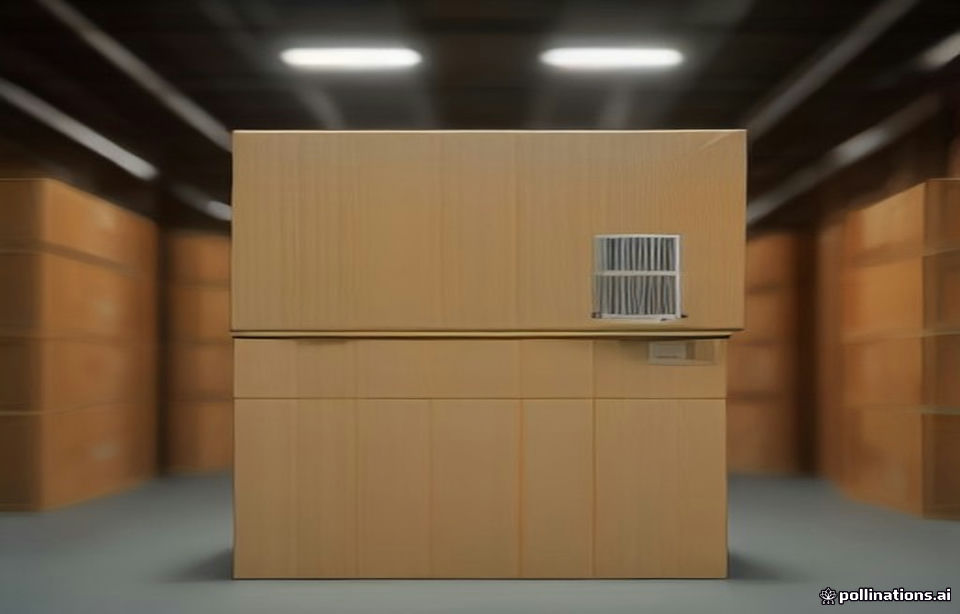
The Packsize EFI X5 Nozomi is positioned as the world’s first full-colour, right-sized, on-demand corrugated box system, merging digital printing, cutting, creasing, folding, gluing and labelling into a single workflow that erects a printed box in as little as six seconds, with no plates, make-readies or tooling via EFI CMYKO extended-gamut printing, Packsize Smart Scaling/PackNet software and the Fiery NZ-1000 digital front end. Reported early results: 34% less corrugated, 84% less filler, 30% less energy, 5% lower shipping cost, exceeding $1.3 million in annual savings at 1.5 million boxes per year.
- Right-sizing on demand eliminates void fill physics and dimensional-weight penalties at the structural design stage, not the freight-audit stage.
- Reported fleet-level savings (34% corrugated, 84% filler, 30% energy, 5% shipping) exceed $1.3M/year at 1.5M boxes/year — but the business case collapses if box compression strength is under-engineered.
- Any downsized box must still pass the McKee-derived BCT target and ISTA 3A sequences; verify with ASTM D642 compression testing before switching SKUs.
- Digital CMYKO printing removes plate/tooling costs, shifting the economic break-even from ~5,000+ units per SKU to single-unit runs — a structural change in MOQ strategy.
- Use TadaPack’s free calculators (https://tadapack.com/tools) to model ECT derating, dimensional-weight thresholds and per-SKU box proliferation before committing to a system.
1. Why Six-Second, Right-Sized Production Rewrites the Box Economics
E-commerce packaging costs have traditionally been fixed at three layers: board, air, and freight-class surcharges. The X5 Nozomi system attacks all three simultaneously. Because each box is produced to the exact footprint of its contents — printing, cutting, creasing, folding, gluing and labelling in one automated pass — the effective cardboard-to-product volume ratio falls dramatically. The source data quantifies this: a 34% reduction in corrugated materials and an 84% reduction in filler across early installations.
For procurement directors, the pivotal change is the removal of plates, make-readies and tooling via EFI’s CMYKO extended-gamut digital process and the Fiery NZ-1000 digital front end. In conventional flexo, a four-colour job with two plates per SKU carries a per-SKU tooling amortization that forces long runs. With tooling eliminated, the break-even between preprinted inventory and on-demand production moves to essentially zero — meaning seasonal refreshes, retail micro-runs, and Amazon SIPP-compliant graphics can be produced without inventory risk.
2. 【Core Engineering Definition】Right-Sizing Is a Compression-Design Problem, Not a Cutting Problem
The engineering discipline for right-sizing: derive the required BCT from pallet column load (unit weight × stack height ÷ number of supporting panels), apply the humidity derating (typical industry practice derates ECT by 30–50% under sustained >80% RH conditions), then confirm the selected ECT grade — typically ECT-32 for single-wall e-commerce, ECT-44 for BC double-wall heavy goods — with ASTM D642 testing on production samples.
Q: If the McKee formula derives BCT from ECT, why do enterprise POs still mandate Mullen burst testing?
A: Many legacy procurement specs specify 200# burst (TAPPI T810) as a contract baseline. Mechanically, McKee is a buckling model valid for regular slotted containers with sane aspect ratios; for tall, narrow right-sized boxes the side-panel buckling mode dominates and McKee over-predicts strength, so burst remains a board-quality gate independent of geometry. Recommendation: accept ECT-based specs (ASTM D642 verification) for right-sized geometries, but require the supplier to document McKee assumptions — perimeter, caliper, and derating factor — in the packaging spec sheet.
3. The Five-Process Consolidation: What a Single-Workflow Cell Changes on the Floor
A conventional right-sized box line is a chain: printer → die-cutter → folder-gluer → erecting/sealing station, with WIP buffers and registration errors accumulating between stations. The X5 Nozomi collapses printing, cutting, creasing, folding, gluing and labelling into one automated sequence. Practically, this eliminates:
- Inter-station registration drift — print-to-cut registration tolerance is a single-machine control loop (typical digital web registration reference: ±0.5 mm versus ±1.5–2.0 mm across a multi-machine flexo chain).
- WIP inventory — blanks no longer queue between processes, cutting floor space and work-in-progress carrying cost.
- Changeover dead time — no plates, no make-readies, no die swaps; the Fiery NZ-1000 DFE handles job switching digitally.
For 3PL and co-packer workflows, this means a mixed-SKU shift (dozens of box sizes, all printed differently) becomes a scheduling problem rather than a tooling problem. Production planning software (PackNet, Smart Scaling) drives size and artwork per order.
4. Procurement Cost-Down Model: A Hypothetical Worked Example
Using the source-reported results as the benchmark tier (34% corrugated reduction, 84% filler reduction, 30% energy reduction, 5% shipping cost reduction, >$1.3M annual savings at 1.5M boxes/year), here is an illustrative calculation for a mid-volume DTC shipper producing 300,000 boxes/year:
Hypothetical worked example: assume 300,000 boxes/year; conventional box + filler cost of $0.62/unit; dimensional-weight overage averaging $0.18/shipment; corrugated at 34% of box cost. Applying the source’s percentage reductions: corrugated saving ≈ 300,000 × $0.62 × 34% × 0.34 ≈ $21,600; filler saving ≈ 300,000 × $0.62 × 0.20 (filler share) × 84% ≈ $31,250; shipping saving ≈ 300,000 × $0.18 × 5% ≈ $2,700. Indicative gross saving ≈ $55,000/year before energy and labour consolidation — scale this linearly and add energy (30% reduction) to approximate the source’s $1.3M/1.5M-box economics. Model your own SKU mix with TadaPack’s free cost tools at https://tadapack.com/tools.
Caveats procurement must price in: capital lease of the cell, digital ink consumption (higher $/m² than flexo inks, offset by zero plate cost), service contracts, and operator training. The break-even depends on SKU proliferation — the more distinct box sizes and artwork versions you ship, the faster the digital system pays back.
5. Regulatory & Compliance Fit: Where On-Demand Printing Becomes Mandatory
The source explicitly targets Amazon SIPP compliance graphics — and this is where regulation converts convenience into necessity. Under Amazon’s Ships in Product Packaging (SIPP) program, the shipper box must carry compliant carrier-facing markings and pass certification without an overbox. Similarly, EU Directive 94/62/EC Annex II and the EU PPWR (Regulation 2024/1991) push packaging minimization — packaging volume must be limited to the minimum adequate for product protection — and on-demand right-sizing is the direct structural answer. Per FTC Green Guides (16 CFR Part 260), recyclability claims on digitally printed corrugated remain defensible only with substrate-level substantiation; standard corrugated with water-based digital inks typically retains full repulpability, but barrier-coated variants should be verified per ISO 186 sampling practices.
6. Verification SOP Before Switching a SKU to Right-Sized Production
Step 1 — Dimensional audit: measure the product’s actual footprint (L×W×H, ±0.5 mm with calibrated calipers per TAPPI T411 practice for board, ±0.15 mm for product datum tooling); define the minimum internal cube plus any mandated void (ISTA 3A does not permit product-to-wall contact for fragile items).
Step 2 — Strength derivation: compute required BCT from stack height, unit mass, and dwell time; apply the humidity derating factor for your worst-case corridor (coastal ports typically require a 30–50% ECT derate as typical industry reference); select ECT grade accordingly.
Step 3 — Prototype & condition: run sample boxes at 23°C ± 1°C, 50% ± 2% RH conditioning per ISO 186; test BCT per ASTM D642 and burst per TAPPI T810 if the legacy spec retains it.
Step 4 — Transit validation: run ISTA 3A General Simulation (drop, vibration, compression sequences) on the right-sized configuration; only after a clean report does the SKU migrate to on-demand production. TadaPack’s structural prototyping service executes this full validation sequence for DTC and 3PL clients before any line conversion.
7. Defect Diagnostics: Two Failure Modes Unique to Right-Sized, Digitally Printed Boxes
Panel bulge / side-wall collapse on tall narrow geometries: right-sizing often reduces box width while keeping height, increasing the slenderness ratio and triggering buckling below the McKee prediction. Corrective action: switch to a B or C flute with higher ECT, or add an internal corner post; re-run ASTM D642.
Crease cracking on the digital print side during folding: extended-gamut CMYKO lays heavy ink coverage on the crease line; if crease matrix hardness or channel width is mismatched to the caliper, the fold cracks the ink film. Corrective action: verify creasing rule-to-matrix pairing against board caliper (typical reference: matrix channel width ≈ caliper + 0.3–0.5 mm) and check Cobb 60 water absorption of the liner — Cobb values above typical thresholds (>35 g/m² reference) indicate liners prone to fiber raising and delamination in humid transit.
8. Pre-Deployment Checklist for Procurement & Engineering
- □ Confirmed target BCT from stack-height analysis with humidity derating applied
- □ ASTM D642 compression test report on the right-sized prototype at 23°C/50% RH
- □ ISTA 3A transit simulation passed without product-to-wall contact
- □ ECT grade selected (ECT-32 single-wall / ECT-44 double-wall baseline) and documented in the packaging spec
- □ Digital print recyclability substantiation per FTC Green Guides (16 CFR Part 260) for US claims and EU PPWR (2024/1991) minimization mapping for EU SKUs
- □ Amazon SIPP marking layout approved for carrier-facing panels
- □ Cost-down model run per SKU using TadaPack calculators (https://tadapack.com/tools) before committing capital
- □ Moisture strategy defined for ocean transit (Cobb 60 liner verification, container desiccant loading) if importing board or shipping FCL
Wrap-Up: The Strategic Decision
The Packsize EFI X5 Nozomi converts box production from a tooling-constrained inventory decision into a data-driven per-order computation. The reported early results — 34% corrugated, 84% filler, 30% energy, 5% shipping reductions, >$1.3M annual savings at 1.5M boxes/year — represent the upper bound; your realized ROI is governed by SKU proliferation, printed coverage, and whether your structural engineering (McKee, ECT derating, ISTA 3A validation) keeps pace with the downsizing. Start with TadaPack’s free calculation tools to quantify your dimensional-weight exposure and per-SKU board savings before any capital decision.
Recommended Engineering Reading
[TOOLS] Featured Engineering & Calculation Tools
Explore 70+ Packaging Tools ➔Box Compression (BCT) Calculator
Predict box compressive limit and stacking safety factors via McKee formula.Edge Crush Test (ECT) Calculator
Calculate linerboard ring crush and composite ECT ratings for optimal board specs.
