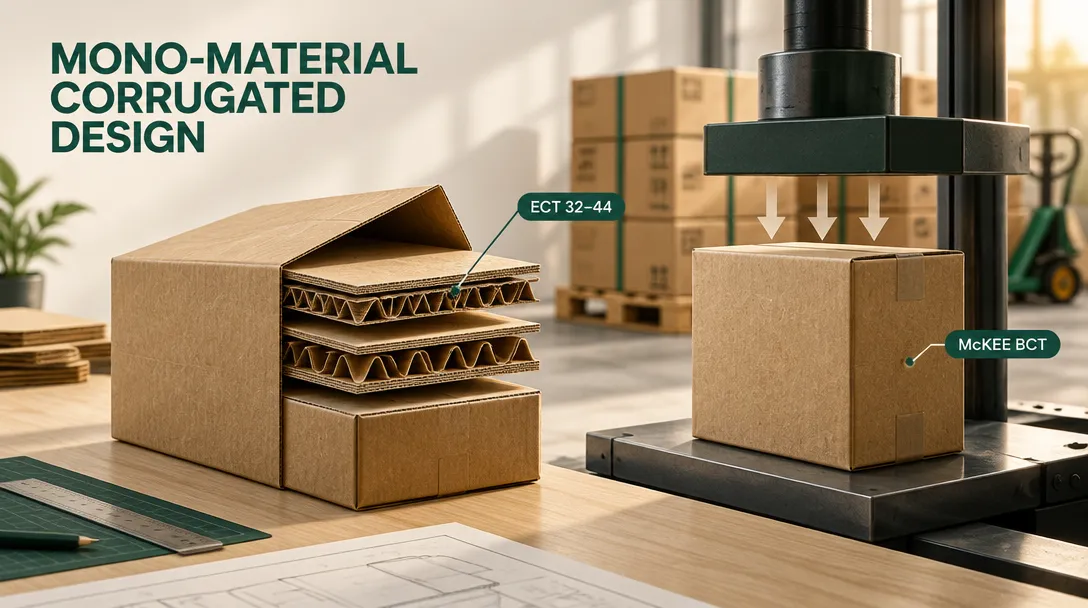
- Mono-material is a design direction, not an automatic recyclability guarantee: fiber components, coatings, inks, closures, and actual local collection and mill practices all matter.
- Use ECT 32 and ECT 44 as illustrative board-grade reference points, then estimate box compression with McKee and verify the converting specification.
- Specify Cobb 60 as a moisture-risk indicator, not a stand-alone pass/fail claim; validate coated and uncoated constructions in the intended distribution environment.
- Test the complete shipping configuration using the applicable ASTM D4169 or ISTA 3A protocol; a paperboard material test cannot replace package-level distribution testing.
Fiber packaging is often selected to support established paper recovery streams, but recyclability depends on the whole package and the receiving system. Sustainable Packaging Coalition (GreenBlue / SPC) provides industry context for evaluating packaging sustainability; this review does not attribute particular acceptance thresholds or proprietary test results to SPC. The engineering analysis below applies recognized paper and distribution-test methods to hypothetical design decisions. ECT, Cobb, and compression values are reference values only; converter specifications, product mass, geometry, climate, and local recycling rules determine the final design.
Start with the recovery pathway and the shipping load
For procurement, “mono-material” should mean reducing incompatible material interfaces while retaining enough structure and protection for the product and its route to market. A corrugated shipper made primarily from paper fiber may still include polymer lamination, plastic tape, a non-fiber window, or a water-resistant treatment that affects sorting or repulping. Confirm the actual bill of materials with the supplier, and check acceptance guidance for the destination market rather than relying on a generic recyclable symbol.
In the US, the Federal Trade Commission’s Green Guides (16 CFR Part 260) require recyclable claims to be appropriately qualified when access to recycling is not broadly available. In the EU, Regulation (EU) 2025/40 on packaging and packaging waste (PPWR) establishes a changing compliance framework, including requirements that are phased in over time. Packaging teams should confirm applicable dates, delegated measures, national collection rules, and the current interpretation for their specific product and market before making a compliance claim.
Design starts with the load case: filled-pack mass, stack height and duration, pallet pattern, warehouse and transport humidity, and whether the shipper is a single parcel or part of a unit load. ECT describes edgewise compression resistance of corrugated board under a specified test; it is not the box’s allowable stacking load. ECT 32 and ECT 44 are common nominal US trade designations, but delivered performance depends on the board combination, moisture, flute condition, converting quality, and test method. A stronger grade may enable a lighter design, but only if the completed box meets performance and damage criteria.
Teardown the fiber structure before choosing a grade
Single-wall corrugated consists of linerboards bonded to a fluted medium; a paperboard carton may instead use a solid sheet such as folding boxboard or recycled chipboard. For shipping cases, select flute profile and board construction against compression, cushioning, print, and dimensional needs. E-flute offers a thinner profile suited to compact presentation and smaller packs; B- and C-flute provide different caliper and cushioning trade-offs; BC double-wall adds a second medium and liner set where stacking or handling demands justify added bulk. Typical caliper varies by supplier and construction, so drawings must specify a controlled board grade and measured acceptance method rather than a flute letter alone.
| Design input | Typical reference value or choice | Engineering use and limitation | Governing standard / test protocol |
|---|---|---|---|
| Corrugated edge crush | ECT 32 or ECT 44, nominal lb/in trade grade | Board-level edgewise compression indicator; not a direct box stacking rating | TAPPI T811 or the supplier’s declared equivalent |
| Cobb 60 water absorptiveness | Reference design range: about 20–35 g/m² for many untreated paper surfaces; verify board and coating | Higher uptake can signal increased moisture sensitivity; no universal acceptance limit applies to every package | TAPPI T441, 60-second test |
| Box compression | Set from calculated load case; McKee is a screening estimate | Allow for creep, humidity, pallet overhang, handling, and safety factor | ASTM D642 |
| Distribution performance | Test the final pack, product surrogate, and closure | Choose the sequence and assurance level to match actual distribution hazards | ASTM D4169 or ISTA 3A, as applicable |
| Paper conditioning | 23°C ± 1°C and 50% ± 2% RH as a stated laboratory target | Condition specimens consistently; document deviations and test atmosphere | ASTM D685; confirm the specified method and laboratory practice |
These table entries are engineering reference values, not SPC limits, a supplier guarantee, or a universal legal specification. Cobb results are sensitive to furnish and surface treatment. A PFAS-free barrier coating may help address a chemical restriction or product-contact requirement, but “PFAS-free” alone does not establish repulpability, recyclability, or adequate water resistance. Request coating chemistry disclosure and mill or repulpability evidence relevant to the target recovery stream. Keep adhesive coverage controlled: excessive adhesive or a non-fiber laminate can complicate fiber separation even where the main substrate is paper.
For a regular slotted container, the CAD dieline should account for internal dimensions, board caliper, score positions, slot width, manufacturer’s joint, and converting tolerances. For example, an internal target of 300 × 200 × 150 mm cannot be translated into a reliable flat blank by simply adding panel dimensions: caliper, fold allowance, and machine direction affect the finished geometry. Prototype the dieline with the intended board, closure, tape or paper-based sealing system, and product fit. A packaging engineer should confirm that the selected closure and any labels do not create avoidable material-separation problems.
Use McKee as a screening calculation, then test the box
The simplified McKee relationship commonly used for preliminary regular-slotted-container estimates is BCT ≈ 5.87 × ECT × √(t × P), with BCT in pounds-force, ECT in lb/in, board caliper t in inches, and box perimeter P in inches. This is an empirical estimate, not a substitute for compression testing. It assumes a suitable box geometry and does not fully represent perforations, hand holes, score damage, humidity, creep, poor joints, or load eccentricity.
Assume a hypothetical 300 × 200 × 150 mm internal RSC, ECT 32 board, and 4.0 mm nominal caliper. The perimeter is 2 × (300 + 200) = 1,000 mm, or 39.37 in; caliper is approximately 0.157 in. McKee screening estimate: 5.87 × 32 × √(0.157 × 39.37) ≈ 1,470 lbf (about 6.5 kN). This is not an allowable payload or a test result. If the pack is stacked four high, the bottom case experiences the weight of three cases above it, but the design must additionally account for duration, humidity derating, pallet and carton alignment, and the chosen safety factor. Verify finished cases to ASTM D642 and validate the distribution configuration.
Use ECT 44 as a candidate when the load case, geometry, or route calls for more board strength, not as an automatic upgrade. The higher grade may increase material cost and shipping mass; alternatively, redesigning the footprint, reducing unsupported panels, improving pallet alignment, or eliminating unnecessary void can produce better system performance. A procurement comparison should quote the complete construction, box dimensions, print coverage, joint, order quantity, and delivery terms. Compare cost per protected shipment and damage exposure—not sheet price alone.
Conditioned paper testing and box testing answer different questions. ISO 186 addresses sampling for paper and board; ASTM D685 covers conditioning paper and paper products for testing. For distribution, ASTM D4169 provides a performance testing framework, while ISTA 3A applies to packaged products prepared for parcel delivery systems. Select the protocol with the test laboratory and customer based on package mass, handling profile, and distribution route; do not combine or describe a test sequence as compliant unless it was actually conducted under the stated protocol.
Control converting, moisture, and cost at the factory
Manufacturing variation can erase the margin calculated on a CAD screen. Control board caliper and ECT by supplier specification and incoming inspection; verify scores, slots, and joint registration on production samples; and confirm adhesive coverage and bond integrity after converting. Cobb 60 can help compare surface water uptake, but finished-pack exposure and post-conditioning compression are more directly relevant where moisture is a credible hazard. For e-commerce parcels, also assess drop and vibration risks in the final pack. Amazon FBA dimensional-weight and fee rules can change, so use the current marketplace tariff and packed dimensions rather than an assumed penalty threshold.
For a cost-down exercise, model at least three alternatives: current construction, a lighter grade with revised geometry, and a paper-forward alternative with reduced coating or accessory content. For each, include board price, conversion yield, print and tooling charges, freight cube, damage/return cost assumptions, and any market-specific compliance or recovery constraints. Keep assumptions visible and sensitivity-test paper price, order quantity, and damage rate. Lower mass is not a saving if it increases transit failure or forces protective components that undermine the material objective.
TadaPack’s structural packaging and prototyping service can help convert a CAD concept into a production-ready dieline and coordinate sample review with the intended board and closure. Use TadaPack’s packaging calculation tools to check dimensions and preliminary structural estimates; treat online outputs as screening aids and confirm critical designs through supplier data and physical testing.
Borrow the decision discipline, not a nominal grade
The transferable lesson is to specify a system, not just “recyclable corrugated” or ECT 32. Define the fiber components and exclusions, the target recovery market, the filled-package geometry, the stack and distribution conditions, and the verification plan. Then compare candidate constructions on functional performance and total delivered cost. A paper-based design can be a strong recyclability candidate when coatings, adhesives, inks, and attached components are compatible with local collection and mill processes; no single material label establishes that outcome.
Decision rule: use McKee to rank early concepts, ECT and Cobb data to characterize board inputs, and ASTM D642 plus the applicable ASTM D4169 or ISTA 3A test to validate the finished distribution package. Record the tested configuration, conditioning, closure, and acceptance criteria so procurement changes do not silently invalidate the evidence. Where US or EU claims are made, have regulatory and sustainability teams verify current guidance and market-specific qualification.
Recommended Engineering Reading
[TOOLS] Featured Engineering & Calculation Tools
Explore 70+ Packaging Tools ➔Box Compression (BCT) Calculator
Predict box compressive limit and stacking safety factors via McKee formula.Edge Crush Test (ECT) Calculator
Calculate linerboard ring crush and composite ECT ratings for optimal board specs.
