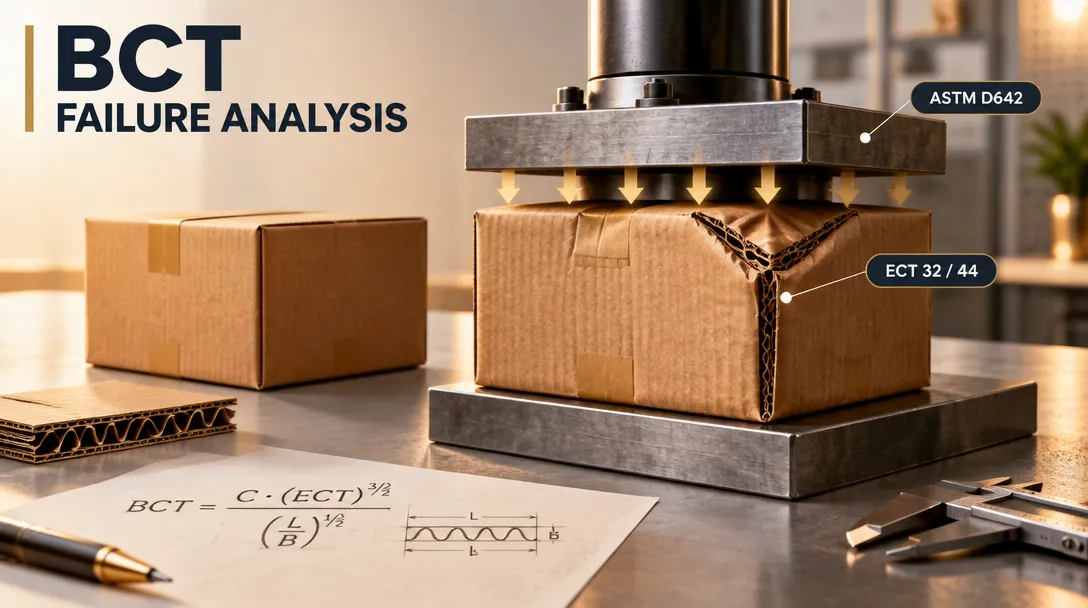
For procurement and structural teams, the practical question is not whether a box has a nominal ECT rating, but whether its converted, conditioned construction retains enough compression capacity through distribution. McKee calculations help screen designs; ASTM D642 compression testing and an appropriate ISTA 3A distribution simulation establish whether a particular packaged product is fit for its shipping hazards. The worked numbers below are hypothetical engineering examples, not laboratory results or supplier guarantees.
Why does a box fail BCT when the McKee estimate looks adequate?
The commonly used simplified McKee relation is BCT (lbf) ≈ 5.87 × ECT (lbf/in) × √(perimeter (in) × board caliper (in)). It provides an estimate for a regular corrugated box, not a universal pass/fail prediction. Box dimensions, panel proportions, scores, slots, joints, print coverage, board construction, conditioning, and test setup all influence actual compression performance.
Hypothetical worked example: a regular slotted container with a 12 × 10 inch footprint has a perimeter of 44 inches. With ECT-32 board and an assumed 0.16-inch caliper, the estimate is 5.87 × 32 × √(44 × 0.16), or approximately 499 lbf. This is a comparative design estimate only. It does not mean that the box will sustain 499 lbf in warehouse stacking or that its safe working load is 499 lbf.
For an illustrative safety-factor calculation, dividing that estimate by 5 gives about 100 lbf as a preliminary load-screening value. A factor of 5 here is an explicit hypothetical assumption, not a prescribed universal factor. Actual stacking demand and derating must account for storage duration, pallet pattern, overhang, humidity, vibration, and package contents. ECT-44 in the same assumed geometry raises the estimate proportionally, to approximately 686 lbf, but does not remove the need to test the converted box.
Common failure signatures point to different mechanisms: rapid panel buckling can indicate inadequate board or unsupported panel span; corner collapse can indicate poor load alignment or damaged corners; low, inconsistent results can indicate moisture, variable converting, or test setup differences. Record box dimensions, caliper, ECT certificate values, board orientation, joint and closure method, conditioning, and failure mode. Compare like with like: an unprinted laboratory board result is not equivalent to a finished, scored, glued shipping box.
Q: If McKee estimates BCT from ECT, why do enterprise POs still specify burst testing?
ECT and burst measure different properties. ECT measures edgewise compression resistance, which is more directly related to column strength; burst resistance measures resistance to hydraulic rupture and does not directly predict box compression. Specify the property that matches the risk: use ECT and assembled-box compression for stacking design, and specify burst only when the product or contract requires that separate performance measure.
Which root causes explain low or variable BCT results?
| Symptom | Cause | Fix |
|---|---|---|
| BCT is consistently below the McKee estimate | Moisture-softened board, long unsupported panels, weak scores, or the estimate’s assumptions do not match the box construction | Condition samples consistently; verify caliper and ECT; review panel proportions, flute direction, scores, and joint; run ASTM D642 on the finished box |
| Corner collapse or early localized buckling | Misaligned load, pallet overhang, crushed edges, or uneven box geometry | Check pallet footprint and load centering; inspect incoming cases; confirm squareness and compression platen alignment |
| Large result spread between samples | Board or moisture variation, inconsistent closures, specimen conditioning, or test setup variation | Standardize the sample population, closure, conditioning, and test method; document individual failure modes rather than relying only on an average |
| Flaps lift or glued seam opens in transit | Insufficient adhesive coverage, poor compression during bonding, or moisture exposure | Check adhesive application and bond set; verify closure geometry; evaluate the package under the intended distribution and humidity conditions |
Moisture is a major source of apparent design failure. Cobb 60, determined using TAPPI T 441, characterizes short-duration water absorptiveness; it is useful for comparing paper or board surface response, but it is not a direct predictor of BCT or a universal pass/fail threshold. Do not claim a specific Cobb 60 acceptance limit without a product-specific specification and correlation data. For humid distribution, qualify the actual construction and consider suitable PFAS-free barrier options where protection is needed, while checking recyclability claims against applicable market rules.
For test control, ASTM D685 provides standard atmospheric conditioning of paper and paperboard; use the conditions and duration required by the applicable method and product specification. ASTM D642 is a relevant compression test method for shipping containers, and ISTA 3A is a packaged-product test procedure for parcel delivery hazards. Neither a McKee estimate nor a single compression result establishes ISTA compliance: the packaged product must be tested to the selected procedure and acceptance criteria.
How should engineers turn an ECT-32 or ECT-44 specification into a validated box?
Start with demand, not a board grade. Calculate the expected static stacking load from loaded cases above the bottom case, then set a documented design margin for time, humidity, palletization, and handling. ECT-32 and ECT-44 are board performance designations, not guarantees of a particular box BCT. Verify the supplied board and the finished package; a change in flute, liner, caliper, or conversion can alter performance even if the grade label appears similar.
Flute selection affects caliper, cushioning, print surface, and panel behavior. E flute is comparatively thin; B and C are thicker alternatives, while BC double-wall combines two flute layers. Exact caliper varies by board construction and supplier, so use measured, specification-controlled values rather than a generic flute chart in a McKee calculation. ECT-44 may be appropriate where stacking demand or distribution severity warrants it, but unnecessary strength can add material cost and dimensional weight. Check the finished external dimensions against parcel and fulfillment constraints, including Amazon FBA dimensional freight charges where applicable.
Use CAD dielines to keep structural assumptions connected to production: capture internal and external dimensions, manufacturer’s joint, flap geometry, score positions, grain/flute direction, and closure. Prototype the actual converting method. A structurally promising blank can lose capacity after die-cutting, scoring, printing, folding, and gluing. TadaPack can support custom structural packaging and short-run prototyping to compare dieline options before committing to production quantities.
What production and procurement checks prevent repeat BCT failures?
Use a controlled release sequence rather than upgrading board grade by reflex. First confirm that the test represents the shipping configuration. Then identify the failure mechanism and cost the smallest corrective change that resolves it. Procurement should compare total delivered cost: board weight and grade, conversion yield, damage exposure, storage footprint, and freight dimensional weight. A heavier board can increase material and transport cost without fixing an overhang, weak seam, or moisture problem.
- ☐ Confirm box dimensions, flute direction, board caliper, and ECT specification against the approved CAD dieline and purchase order.
- ☐ Condition representative finished boxes consistently; record method, closure, sample identification, and visible defects.
- ☐ Test compression using ASTM D642 and document peak load, failure location, and relevant setup details; compare against a pre-agreed acceptance criterion.
- ☐ Validate packaged-product distribution hazards using the applicable ISTA 3A procedure; requalify material or geometry changes that could affect performance.
- ☐ Review moisture risk, pallet alignment, case overhang, and dimensional freight impacts before approving a cost-down change.
For cost-down, compare a geometry improvement, a flute or caliper adjustment, and a board-strength change using the same product, closure, and test conditions. Where lower material use is proposed, verify both compression and transit performance rather than assuming an ECT increase compensates for reduced caliper. Applicable sustainability and recyclability claims require market-specific substantiation; EU PPWR (Regulation (EU) 2025/40) sets packaging and packaging-waste requirements in the EU, so assess the current requirements and implementation timing for the destination market.
Engineering decision: use McKee to rank candidate designs, not to certify them. Confirm the board inputs, validate the converted box under ASTM D642, and test the packaged product under ISTA 3A when parcel distribution is the relevant hazard. TadaPack’s online calculation tools can support preliminary comparisons; pair calculations with custom structural design, production-representative prototypes, and a defined test plan.
Recommended Engineering Reading
[TOOLS] Featured Engineering & Calculation Tools
Explore 70+ Packaging Tools ➔Box Compression (BCT) Calculator
Predict box compressive limit and stacking safety factors via McKee formula.Edge Crush Test (ECT) Calculator
Calculate linerboard ring crush and composite ECT ratings for optimal board specs.
