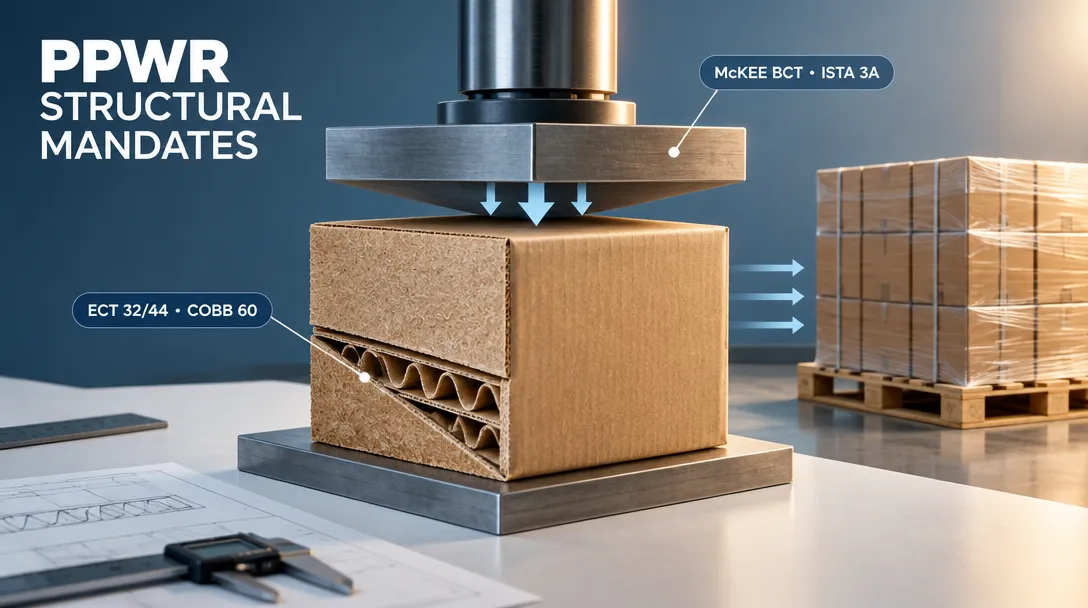
- Regulation (EU) 2025/40—the Packaging and Packaging Waste Regulation (PPWR)—generally applies from 12 August 2026; confirm the specific requirement and implementation timetable relevant to each packaging format and market.
- Use ECT-32 and ECT-44 as board-selection reference grades, not as proof of finished-box performance; screen compression with McKee, then validate the actual pack.
- Design out avoidable material while retaining protective performance: Cobb 60, flute construction, inserts, closure geometry and distribution testing all affect the result.
- Use ISTA 3A for applicable parcel-delivery simulations and ASTM D642 for container compression testing; choose the protocol to match the intended shipment.
PPWR makes packaging minimisation, recyclability and compliance evidence direct engineering concerns, not just artwork or procurement declarations. Packaging World (PMMI Media Group) provides industry reporting and testing context; this review does not attribute unprovided test data or a specific laboratory result to that publisher. The engineering analysis below is a practical framework for converting regulatory objectives into CAD decisions, material specifications, verification tests and purchasing controls.
PPWR turns the package brief into a measurable design constraint
Regulation (EU) 2025/40 entered into force on 11 February 2025 and generally applies from 12 August 2026, subject to its provision-specific dates and transitional arrangements. It replaces the prior EU packaging-waste framework over time. Do not translate that summary into a blanket claim that every packaging obligation starts on the same date: legal teams should map the relevant article, delegated or implementing acts, product category and market placement date for each SKU.
For engineering and procurement, the practical teardown begins with a packaging bill of materials (BOM): primary pack, secondary pack, transit case, labels, coatings, adhesives, void fill and any attached components. Record mass, material identity, dimensions, function and supplier evidence. A material substitution is not automatically a compliance solution if it increases pack size, damages recovery compatibility or causes a higher damage rate. Likewise, “recyclable” claims need substantiation for the relevant collection and sorting context; US-facing claims should also be reviewed against the FTC Green Guides, 16 CFR Part 260.
Translate the brief into measurable acceptance criteria. Define the maximum outside dimensions and packed mass; the allowable product movement; stacking and parcel hazards; moisture exposure; and the performance needed after conditioning. Amazon FBA dimensional freight charges can make excess package volume a commercial penalty, but dimensional limits and fees vary by program and market: check the current seller terms rather than hard-coding a historical threshold. A compact design that fails in transit is not a cost-down.
| Design variable | Reference value or decision | Engineering use | Governing Standard / Test Protocol |
|---|---|---|---|
| Corrugated edge crush | ECT-32 or ECT-44; grade designation, not a finished-box guarantee | Board selection and McKee screening estimate | ISO 3037 or TAPPI T811 |
| Board construction | E flute about 1.5 mm; B about 3 mm; C about 4 mm; BC double-wall about 6–7 mm; typical reference ranges | Balance print surface, cushioning and compression | ASTM D685 conditioning; measure caliper by TAPPI T411 |
| Coated paperboard | 350 gsm CCNB is a representative specification, not a universal grade | Evaluate print, stiffness, coating and recovery compatibility | Supplier specification and applicable package tests |
| Moisture uptake | Cobb 60 reported in g/m²; set a product-specific limit from exposure and bond risk | Compare board or coating water absorptiveness; do not infer transit life from this test alone | ISO 535 or TAPPI T441 |
| Distribution performance | Build the test profile around parcel size, mass and route | Assess shock, vibration and compression against failure criteria | ISTA 3A; ASTM D4169 as applicable |
Board, geometry and moisture determine the structural trade-off
ECT measures the force required to crush a corrugated specimen edgewise under a specified method. It is useful for comparing board, but box compression strength (BCT) also depends on box dimensions, perimeter, caliper, score quality, joint integrity, humidity and load duration. A McKee estimate is therefore a screening tool, not a substitute for finished-case testing. A common simplified form relates BCT to ECT and box perimeter, with a coefficient and caliper term that depend on the selected equation and units. Keep the equation, units and assumptions attached to every calculation.
For a regular slotted container, CAD should specify inside dimensions around the product and protective components, then derive the blank using the converter’s board caliper, score allowances and joint geometry. Confirm that the erected internal dimensions—not just the nominal CAD model—meet fit requirements. A die-line tolerance is a manufacturing control set with the converter, not a universal PPWR tolerance. As a starting discussion value, teams may request approximately ±1 mm on converted carton dimensions and verify feasibility by process, board and box style; establish final limits through supplier capability and sampling.
Moisture changes the structural margin. Cobb 60 measures water absorptiveness over a defined 60-second contact, but it does not directly predict compression retention after prolonged humidity. Use it as a material-screening metric alongside conditioned compression testing. For humid distribution, review coating chemistry, adhesive compatibility, exposed edges, ventilation and the actual route. PFAS-free barrier options may be appropriate, but qualify their barrier performance, repulpability or recycling implications and food-contact status where relevant; do not assume a coating is compliant merely because it is PFAS-free.
BCT is the peak compressive load a finished box withstands under a defined test setup, commonly assessed using ASTM D642; there is no universal pass threshold because acceptance depends on the load case, safety factor and package system.
Q: If McKee estimates BCT from ECT, why do enterprise purchase orders still specify burst testing?
Metric: ECT, burst and BCT are distinct measurements; none can be substituted for another without a validated specification.
Mechanics: ECT characterises edgewise compression of board, burst evaluates resistance to rupture, and BCT evaluates the assembled box under compression; material construction and failure mode change the relationship.
Procurement: Specify the test method and acceptance range that match the failure risk, identify whether board or finished case is tested, and require the supplier to report conditioning and sample basis.
Assume a hypothetical regular slotted case with ECT 32 lbf/in, 0.16 in board caliper and a 40 in box perimeter. Using one common simplified McKee form, BCT (lbf) ≈ 5.87 × ECT (lbf/in) × √[perimeter (in) × caliper (in)]. The screening estimate is approximately 474 lbf: 5.87 × 32 × √(40 × 0.16). This is not a test result or design approval. Confirm units and equation applicability, then test the converted case under ASTM D642 and the distribution pack under a shipment-appropriate protocol.
Verification must connect the dieline to the shipment
Do not treat a passed board test as proof of a compliant distribution system. ISTA 3A is a general simulation test for packaged products shipped through parcel-delivery systems; select the applicable package category and follow the full procedure. ASTM D4169 provides distribution-cycle performance testing for shipping containers and systems. Neither standard should be reduced to a generic “drop and shake” claim: test sequence, assurance level, hazards, sample configuration and pass/fail criteria matter.
Use a controlled qualification sequence. First freeze the product, packing method and package BOM. Second, verify dimensions, closure, adhesive coverage and insert fit on production-representative samples. Third, condition specimens consistently; ASTM D685 provides standard atmospheric conditioning for paper and paperboard, while laboratory conditions should be recorded because moisture affects results. Fourth, run the selected compression and distribution tests, inspect product and pack damage, and document deviations. For board caliper, TAPPI T411 is an applicable method; for water absorptiveness, use ISO 535 or TAPPI T441 as appropriate.
Engineering reference values belong in the specification as ranges only when they reflect actual supplier capability and the required function. E-flute, B-flute, C-flute and BC double-wall calipers listed above are typical industry reference ranges, not guaranteed values. A molded-pulp insert likewise needs supplier-specific dimensional and cushioning tolerances. Qualify molded pulp against cavity fit, variation, moisture response and damage performance rather than specifying an unsupported universal tolerance. Make the acceptance plan explicit: sampling frequency, test method, conditioning, measurement location and corrective-action trigger.
Factory controls and procurement choices create repeatable savings
Use a four-step verification SOP before approving a cost-down or PPWR-driven redesign:
- Step 1 — Lock the use case: record packed mass, distribution route, stack load, storage humidity, product fragility and target outside dimensions; define measurable damage and fit criteria.
- Step 2 — Control the CAD release: identify flute, board caliper, score locations, glue flap and insert geometry; agree dimensional tolerances with the converter and check first articles against the released dieline.
- Step 3 — Qualify materials and process: verify ECT grade, caliper, adhesive bond and any Cobb 60 requirement using named methods; record conditioning and supplier documentation. Set tolerances from capability studies, not invented universal limits.
- Step 4 — Validate the packed system: run ASTM D642 compression and the applicable ISTA 3A or ASTM D4169 distribution protocol; inspect after each sequence and retain the approved BOM, test conditions and change-control record.
Cost-down should compare landed cost per successfully delivered unit, not board price alone. Build a model with unit material cost, conversion and print cost, pack-line labor, cube-related freight, damage and replacement cost, and disposal or recovery constraints. A lighter board can reduce material spend but increase failure risk; a smaller case can lower dimensional freight but require tighter packing tolerances. Model scenarios with supplier quotes and actual carrier terms. TadaPack’s online tools at tadapack.com/tools can support preliminary calculations; use converter dieline review and physical prototyping before production release.
For a PPWR program, make each design decision traceable: the requirement addressed, the component changed, the evidence retained and the test confirming protection. TadaPack’s custom structural packaging and prototyping services can help teams iterate CAD dielines, compare board and insert options, and prepare production-representative samples. That is the practical bridge between regulatory intent and a pack that can be manufactured, shipped and verified.
Recommended Engineering Reading
[TOOLS] Featured Engineering & Calculation Tools
Explore 70+ Packaging Tools ➔Box Compression (BCT) Calculator
Predict box compressive limit and stacking safety factors via McKee formula.Edge Crush Test (ECT) Calculator
Calculate linerboard ring crush and composite ECT ratings for optimal board specs.
