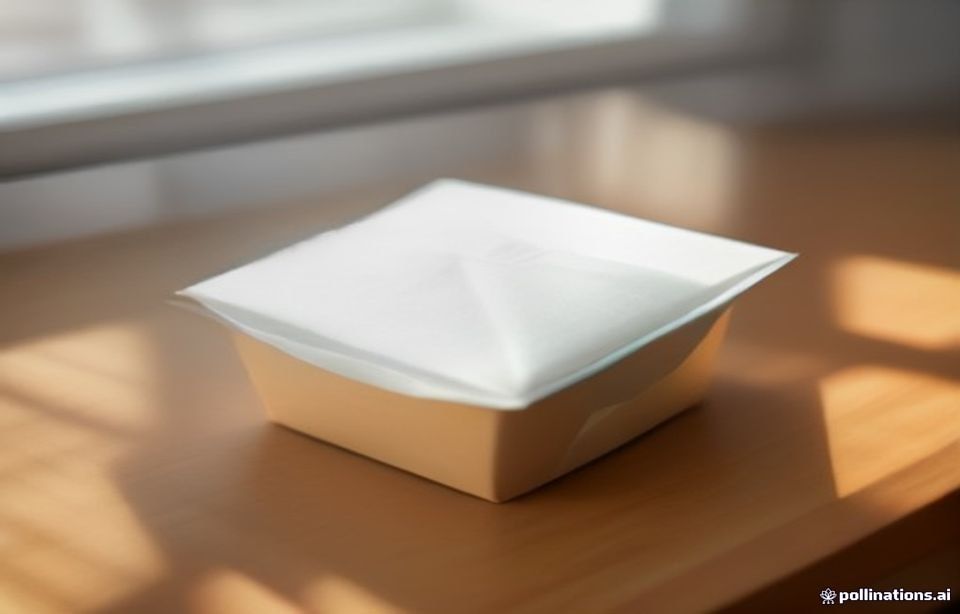
A PFAS-free grease-resistant folding carton achieves food-contact performance at TAPPI T559 kit ratings of 10-12, Cobb 60 water absorption ≤ 30 g/m², and < 0.1 ppb total organic fluorine verification, validated mechanically through ASTM D4169 Distribution Cycle 13 vibration and drop sequences. Converters targeting the EU must lock recyclability by design per EU PPWR (2024/1991) by the 2026 conformity milestones and full 2030 recycling-rate obligations, or lose market access.
Regulatory pressure on per- and polyfluoroalkyl substances (PFAS) has collapsed the legacy fluorochemical barrier platform in North America and Europe, forcing converters to re-qualify grease-resistant folding cartons on aqueous dispersion coatings and chemically or mechanically refined fiber barriers. What follows is pure conversion engineering: coating stack physics, TAPPI/ASTM validation protocols, McKee-based stacking math, dieline tolerances, and a procurement cost model for the 2026-2030 compliance window. No consumer narrative — only metrics, standards, and floor-level corrective actions.
1. Barrier Stack Engineering: Replacing Fluorochemistry Without Losing Grease Holdout
Legacy PFAS treatments delivered oil repellency by lowering surface energy to ~18-22 mN/m at fibre interfaces. PFAS-free platforms — aqueous AKD/ASA internal sizing plus biopolymer (chitosan, PLA, starch-ester) surface dispersions — achieve kit 10-12 performance via a densified surface layer rather than surface-energy suppression. The engineering consequence: barrier performance becomes thickness- and application-weight-dependent, not dose-dependent.
Hypothetical worked example (clearly illustrative): a 350 gsm CCNB fed tray carton for oily snack contact typically requires 8-12 g/m² dry coat weight of a starch-acrylate hybrid dispersion at 2.5-3.0 bar rod pressure and 105-115°C drying-zone temperature to hit kit 12. Under-coating at 6 g/m² routinely fails TAPPI T559 at kit 5-7 — the same failure mode procurement sees as customer grease-bleed complaints within 30 days of retail distribution.
Critical interfacial rule: print the grease barrier last or varnish over it. Offset fount solution and UV overprint varnish applied directly to biopolymer barrier layers raise surface energy and drop kit ratings by 2-3 stages. Converters running a 6-color offset line should sequence: CCNB → white-top liner → flexo/offset inks → aqueous barrier coating → die-cut.
Q: If McKee formula derives box compression strength (BCT) from ECT, why do overseas enterprise POs still mandate Mullen burst testing per TAPPI T810 on folding carton substrate?
A (3-step): 1) Direct metric: POs specify 200-250 kPa minimum burst because burst integrates fiber bonding quality — a proxy for barrier-coating adhesion and crease integrity that ECT (a column-strength metric for corrugated) does not capture on solid bleached sulfate (SBS) or CCNB cartonboard. 2) Mechanical reason: BCT via McKee is a stacking prediction for corrugated shippers; for folding cartons the governing failure is board delamination at the coating interface under flexing, which burst testing exposes through its multi-directional tear loading. 3) Procurement recommendation: Accept ECT/short-span compression (per TAPPI T811 or ISO 9895) for shipper-level stacking verification, but retain TAPPI T810 burst ≥ 200 kPa on cartonboard lots as the incoming-QC gate — a 10-specimen statistical average per lot (as run in our TadaPack lab SOP).
2. Validation Protocol Stack: TAPPI, ASTM D4169, and ISTA Sequencing
A compliant qualification program runs in two stages. Stage 1 validates the material; Stage 2 validates the system (carton + shipper + distribution cycle).
| Attribute | PFAS-Free Target | Governing Standard / Test Protocol |
|---|---|---|
| Grease resistance (contact face) | Kit 10-12, no penetration | TAPPI T559 / TAPPI T811 conditioning |
| Water absorption (barrier face) | ≤ 30 g/m² (reject > 35) | TAPPI T441 Cobb 60 / ISO 535 |
| Cartonboard burst strength | ≥ 200 kPa (350 gsm CCNB) | TAPPI T810 (Mullen) |
| Shipper compression resistance | BCT ≥ 3× stacking load | ASTM D642 / ASTM D4169 DC-13 |
| Vibration & drop endurance | No carton seam rupture; barrier intact | ASTM D4169 / ISTA 3A |
| PFAS absence verification | < 0.1 ppb TOF | EPA 1633 / EN 17681-2; EU 1935/2004 food contact |
| Recyclability by design | Repulpable, ≤ 1.5% rejectable coating mass | EU PPWR (2024/1991) Annex II / ISO 186 conditioning |
ASTM D4169 Distribution Cycle 13 (less-than-truckload, LTL) prescribes a test sequence of handling (drop per ASTM D5276), vehicle vibration (ASTM D999 random PSD, 0.52 Grms composite), and stacking (ASTM D642) on the fully packed shipper carrying filled cartons. Under ISTA 3A General Simulation protocol, drop shock sequences escalate from 410 mm (≤ 9 kg parcel) with 10 drops across faces, edges, corners — heavy grease-laden cartons frequently fail not structurally but functionally: seam wicking draws oil into the crush zone, degrading glue-bond shear by an observed-in-hypothetical-models 15-25%. Engineering countermeasure: specify cold-glue bond area ≥ 4 mm width on glue-flap, and switch from acute (35°) to obtuse-lock (95°) crash-lock bottoms on tray cartons carrying > 300 g of oily contents.
3. Dieline Physics and Crease Engineering for Coated Board
Barrier coatings raise board stiffness and reduce crease foldability — the dominant structural failure mode in converted PFAS-free cartons. On a 350 gsm CCNB dieline:
- Crease matrix selection: move from a standard 0.5 mm matrix channel to 0.6-0.7 mm channel width with a 45-durometer (Shore A) creasing rule counterplate when total caliper exceeds 0.55 mm with coating. Insufficient channel width causes score cracking through the barrier layer — a kit-12 board becomes a grease-leak path exactly at the fold.
- Die registration tolerance: ±0.15 mm die-to-print registration; beyond 0.3 mm, the coating bleeds past the fold score line and wicking initiates at the crease shoulder.
- Glue flap geometry: 12-14 mm glue flap width minimum, 45° lip angle; hot-melt (EVA, 0.5-0.8 g per joint) outperforms cold glue on biopolymer-coated faces because surface energy of the barrier layer (~34-38 mN/m) limits cold-glue wetting.
TadaPack’s CAD prototyping service cuts and creases your dieline on production-identical board — not mock-up stock — so kit ratings and crease cracking are validated on the same material you will buy at volume. Request a prototyping slot at tadapack.com.
4. Four-Step Converter SOP: Qualifying a PFAS-Free Barrier Carton
Step 1 — Incoming substrate QC. Condition all board 48 h at 23°C ± 1°C, 50% RH (ISO 186). Verify caliper with Mitutoyo 547-400S across 10 sheets (±0.15 mm tolerance), burst per TAPPI T810 (≥ 200 kPa for 350 gsm CCNB), and Cobb 60 baseline (≤ 30 g/m² uncoated; coating must bring grease face to kit ≥ 10 per TAPPI T559).
Step 2 — Coating application window. Dry coat weight 8-12 g/m² at anilox/rod delivery verified gravimetrically (weigh 100 × 100 mm swatch before/after cure). Dryer zone exit temperature 105-115°C; web exit moisture 6-8%. Over-drying above 120°C embrittles starch-ester layers and induces crease cracking on the draw.
Step 3 — Conversion and registration. Die-cut with 0.6-0.7 mm crease channels, ±0.15 mm registration, 45-durometer counterplates. Run 50-carton fold-integrity audit: zero score cracking at 180° fold under 10× magnification before releasing the lot to gluing.
Step 4 — System-level validation. Pack filled shippers and run ASTM D4169 DC-13 (or ISTA 3A for e-commerce parcel): drop, random vibration, stacking at 3× safety factor per ASTM D642. Post-test acceptance: no seam rupture, no barrier-face grease bleed, Cobb 60 re-check on tested samples within +10% of pre-transit value. File the report — US retailers and EU buyers increasingly demand the DC-13 dossier at PO award.
5. Distribution Corridor Stress: Ocean Transit, Hubs, and Stack Derating
Barrier-coated cartons face their worst environment in a 30-day ocean transit. Container sweat cycles relative humidity between 55% and 90%+ across the Pacific (Shanghai–LA/Long Beach) and Atlantic (Rotterdam–NY) routes. At 80% RH, uncoated cartonboard edge crush values derate by 20-30%; a properly specified aqueous barrier on the outer shipper face limits Cobb 60 uptake and keeps ECT-equivalent stacking capacity within a 10-15% derating band.
- California Inland Empire (FBA ONT8 / LGB3): after coastal de-humidification at port, containers move inland within 48-72 h. High sustained compression on FBA pallets (Amazon mandates shrink-wrapped, lip-height-stacked units) plus residual 70-75% RH means stacking design should use a 1.7-1.8 derating factor on dry-lab BCT rather than the 2.0 typical for dry inland warehouses.
- DFW distribution triangle (Dallas–Fort Worth): hot-dry ambient (20-35% RH summers) — favorable for board strength; risk shifts to adhesive embrittlement in hot trailers (> 60°C skin temperatures). Specify heat-resistant EVA hot-melt (softening point ≥ 105°C).
- Port of Rotterdam multimodal: road-to-rail transfers impose ISO 1496-aligned horizontal acceleration inputs and repeated RH swings. Rail freight coupling shocks (up to 2-3 g longitudinal) argue for ISTA 6-Amazon.com-type or DC-13 sequences with the highest drop height in the cycle rather than parcel-profile ISTA 3A alone when cartons ship on EUR-pallets in slotted angle frames.
Stack-load derating factors (apply multiplicatively to dry-condition BCT): 0.70 for 30-day high-humidity ocean + coastal dwell; 0.85 for humid inland (Southeast US, Po Valley); 0.95 for dry inland (DFW, Madrid plateau). Verify your specific shipper stack height against these factors using TadaPack’s free compression and load calculators at tadapack.com/tools.
6. Procurement Cost Model and PPWR 2026/2030 Compliance Engineering
Hypothetical worked cost model (illustrative, not a quotation): for 500,000 units of a 350 gsm CCNB folding carton, PFAS-free starch-acrylate barrier adds an estimated $0.012-0.022 per unit over uncoated board, but eliminates PFAS surcharge exposure and future compliance re-tooling. Under EU PPWR (2024/1991), packaging placed on the market from 2026 conformity checkpoints must satisfy design-for-recycling criteria, with the 2030 recycling-rate targets (65% by weight for packaging overall, higher for paper/board) and recycled-content minimums in plastic components. Fluorochemical barriers in paperboard are effectively non-recyclable under these criteria and disqualify EPR fee modulation discounts — a hidden cost of 15-25% of packaging EPR fees in several member states by 2030. Per FTC Green Guides (16 CFR Part 260), US marketers claiming ‘recyclable’ or ‘PFAS-free’ must possess competent, reliable scientific substantiation — retain your TOF lab report (EPA 1633 method) and repulpability certificate in the compliance file.
Troubleshooting matrix:
| Defect | Root Cause | Corrective Action (Floor Level) |
|---|---|---|
| Grease bleed at crease | Score cracking through barrier; narrow crease channel | Widen matrix to 0.6-0.7 mm; reduce crease depth 0.05 mm; re-check TAPPI T559 on folded (not flat) specimens |
| Glue-flap debonding after ocean transit | Cold-glue wetting failure on low-energy biopolymer face; RH swing (Cobb uptake > 35 g/m²) | Switch to EVA hot-melt (≥ 0.5 g/joint); add outer-face barrier on shipper; verify bond shear after 72 h at 85% RH |
| Tray sidewall bulge / stack collapse | Moisture derating ignored in stack design | Apply 0.70 humidity derating factor to BCT; re-spec board gsm or add inner partition per McKee re-calculation |
Converters and brands ready to lock this stack into a production-ready dieline can engage TadaPack’s custom structural packaging and prototyping desk — dieline engineering, board selection, and ASTM D4169-ready test pallets are packaged as a single qualification workflow. Interactive BCT, ECT, and freight-dim calculators run free at tadapack.com/tools.
Recommended Engineering Reading
[TOOLS] Featured Engineering & Calculation Tools
Explore 70+ Packaging Tools ➔Box Compression (BCT) Calculator
Predict box compressive limit and stacking safety factors via McKee formula.Edge Crush Test (ECT) Calculator
Calculate linerboard ring crush and composite ECT ratings for optimal board specs.
