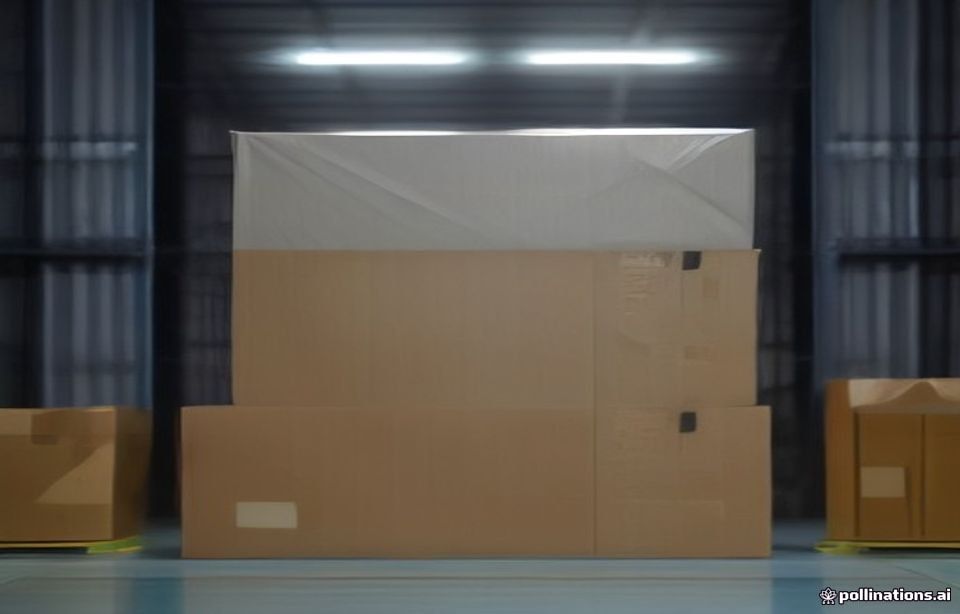
Right-size a mono-material corrugated shipper to a verified ECT-32 (BC dual-wall for stacked loads above 18 kg) and validate it under ISTA 3A General Simulation plus ASTM D4169 Distribution Cycle 13 before PACK EXPO International booth setup. Spec 100% kraft liner with Cobb 60 absorption under 30 g/m² and PFAS-free barrier coating to satisfy EU PPWR (2024/1991) recyclability while protecting fragile display samples in sub-72-hour timelines.
%20highlighting%20its%20structural%20integrity.%20Cinematic%20golden%20hour%20lighting%20casts%20volumetric%20rays%20and%20subtle%20rim%20lighting%2C%20emphasizing%20its%20innovative%20design.%208k%20resolution%2C%20Hasselblad%20medium%20format%2C%20photorealistic%2C%20vivid%20colors.%20NO%20text%2C%20NO%20watermark%2C%20NO%20letters.?width=1200&height=675&model=flux&nologo=true&seed=182229 "ISTA 3A & ASTM D4169: Right-Sized Mono-Material Shippers for E-Commerce")
1. Why Pre-Expo Transport Validation Is Now a Procurement Gate
PACK EXPO International (PMMI) has become the annual pressure point where e-commerce brands ship fragile display samples, VIP retail boxes, and booth inventory into Chicago — often under 48-72 hour windows before setup. Every damage claim on the show floor traces back to a skipped or under-specified transit test protocol. This article stays strictly on engineering mechanics: how mono-material shippers pass ISTA 3A and ASTM D4169 with margin, at right-sized cost.
The regulatory backdrop tightens in 2026: per EU Directive 94/62/EC Annex II and EU PPWR (2024/1991) packaging waste reduction mandates, mono-material recyclable corrugated designs are increasingly favored over laminated multi-material systems — a shift that also simplifies transit testing because adhesive, liner, and flute share one fiber system.
2. Core Standards, Definitions, and the Right-Sizing Physics
Under ISTA 3A General Simulation Performance Testing protocol, parcel shippers under 68 kg face randomized vibration, a 17-drop sequence on edges and corners, and atmospheric preconditioning. ASTM D4169 adds distribution-cycle logic: DC-13 (unitized LTL truck) applies a power spectral density vibration profile; DC-18 is the stricter e-commerce variant most US brands now specify. In strict accordance with ASTM D642 (Standard Test Method for Determining Compressive Resistance of Shipping Containers), BCT must be verified empirically, not only computed.
Right-sizing physics: BCT ≈ 5.87 × ECT × t^0.508 × Z^0.492 (McKee), where t = caliper and Z = box perimeter. Halving the perimeter raises BCT by ~33%, meaning a cube-ish right-sized box outperforms an oversized one on identical board — the core argument against ‘one-size-fits-all’ shippers.
Q: If the McKee formula derives BCT from ECT, why do overseas enterprise POs still mandate Mullen burst testing?
A: Direct answer: because TAPPI Standard T810 (2026 Revision) Mullen burst (e.g., 200 lb/in² for 32 ECT single-wall in many legacy specs) is a contractual legacy gate independent of geometry. Mechanical reason: burst measures fiber-to-fiber tensile bonding, catching liner delamination and recycled-fiber weakness that ECT alone can mask. Recommendation: accept dual specification — ECT for structural right-sizing, Mullen T810 for material-grade audit — and request both certificates on mill test reports per lot.
3. Board Selection Matrix: Mono-Material Corrugated Comparison
| Board Structure | Caliper | Typical ECT | Best-Fit Shipper Duty | Governing Standard / Test Protocol |
|---|---|---|---|---|
| E-flute single-wall, 100% kraft | 1.5 mm | ECT-24–29 | VIP retail VIP boxes, booth collateral ≤5 kg | TAPPI T811 / ISO 3034 caliper |
| B-flute single-wall, kraft liner | 3.0 mm | ECT-32 | Standard DTC parcel, DC-12/DC-18 | ASTM D4169 DC-18 / TAPPI T810 |
| BC dual-wall, kraft liner | 6.5–7.0 mm | ECT-44 | Fragile display samples >18 kg, ocean-leg stacks | ISTA 3A / ASTM D642 |
| C-flute + PFAS-free barrier coat | 4.0 mm | ECT-36 | Humid corridor transit, grease-prone SKUs | ISO 535 Cobb 60 / EU PPWR (2024/1991) |
Note on composition: eliminate 350gsm CCNB laminated inserts from shipper systems where PPWR compliance is targeted — mono-material kraft inserts or molded pulp (dimensional tolerance ±0.5 mm) maintain a single-fiber recycling stream. Per FTC Green Guides (16 CFR Part 260) substantiation rules, any ‘recyclable’ claim must be documented against the full mono-material construction.
4. Pre-Expo 4-Step Validation SOP (48-72 Hour Window)
- Step 1 — Dimensional right-size: Measure product with internal clearance 3-6 mm per axis; target cube ratio 1:1:1 to maximize McKee perimeter advantage. Verify die-cut registration at ±0.15 mm; crease matrix at 45-durometer to prevent flap pop-out under ISTA 3A drop shock.
- Step 2 — Conditioning: Precondition boards per ISO 186:2020 paper conditioning specifications (23°C ± 1°C, 50% ± 2% RH) for a minimum of 24 hours before any ECT/BCT measurement; unconditioned corrugated can over-read ECT by 15-20%.
- Step 3 — Compressive verification: Run 10-specimen BCT on a calibrated compression rig; accept lot if the 10-specimen statistical average exceeds predicted stacking load × safety factor 5, with caliper tolerance ±0.15 mm (Mitutoyo 547-400S digital caliper verification).
- Step 4 — Transit simulation: Ship one production-intent sample via the actual carrier lane (e.g., LTL into the California Inland Empire) and one via lab ISTA 3A schedule; reconcile damage or panel bulge before mass booth shipment.
5. Defect Diagnostics & Multiregional Logistics Hub Matrix
Defect 1 — Flap popping after drop test: Root cause is crease-to-perforation imbalance; corrective action: shift to 45-durometer creasing matrix, reduce inner crease depth by 0.1 mm, verify male/female die alignment at ±0.15 mm.
Defect 2 — Adhesive debonding / flute softening under ocean humidity: Root cause is Cobb 60 water absorption above 35 g/m² triggering transit delamination on containerized Pacific/Atlantic legs (container sweat). Corrective action: specify PFAS-free water-based barrier coating, verify per ISO 535 Cobb 60, and elevate pallets with corrugated slip sheets.
| Corridor / Hub | Stress Point | Stacking Derate (illustrative) | Governing Standard / Test Protocol |
|---|---|---|---|
| Pacific → California Inland Empire (FBA ONT8 / LGB3) | 30-day ocean sweat; humid coastal ambient | -25 to -35% BCT (worked example) | ISO 535 Cobb 60 / ASTM D4169 DC-18 |
| Texas DFW distribution triangle | Dry inland; low-moisture embrittlement risk minimal; trailer vibration dominant | -15% BCT | ASTM D999 vibration / ASTM D4169 DC-13 |
| Port of Rotterdam multimodal rail/road | Humidity swings + rail shunt shock; PPWR audit exposure | -20 to -30% BCT | ISO 2247 / EU PPWR (2024/1991) |
Rule of thumb: apply a 1.35 stacking derate factor for high-humidity coastal ports versus 1.15 for dry inland warehouses, then verify with the TadaPack free box compression and dimensional-weight calculators at https://tadapack.com/tools — critical because Amazon FBA dimensional freight penalties trigger when right-sizing slips above the DIM divisor threshold.
TadaPack’s zero tooling fee digital die-cutting supports short-run high-end VIP boxes and 24-48 hour structural CAD prototyping for exhibitors; request a board certificate bundle (T810 burst, T811 ECT, ISO 535 Cobb) with every shipper PO. Reference: PACK EXPO International (PMMI) — https://www.packexpointernational.com/; TadaPack — https://tadapack.com.
Recommended Engineering Reading
[TOOLS] Featured Engineering & Calculation Tools
Explore 70+ Packaging Tools ➔CBM Volume & Freight Dim-Weight Calculator
Calculate cubic meters & dimensional weight to minimize freight costs and avoid FBA size tier penalties.Mailer Box Area & Dieline Size Calculator
Instant flat dieline dimensions, material consumption, and sheet nesting for custom D2C mailer boxes.
