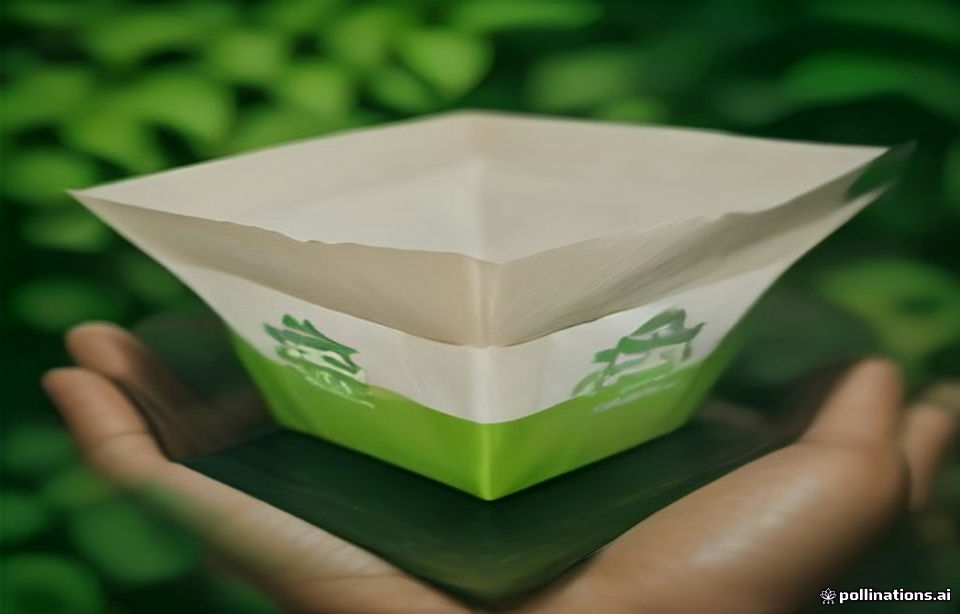
The awarded material is a heat-sealable, bio compostable metallized bleached kraft paper whose compostable barrier layer plus thin vacuum-deposited aluminum delivers high barrier against oxygen, moisture, and light while remaining fully biodegradable into water, CO₂, and biomass. It is direct-food-contact compliant, runs on existing FFS lines, and targets portion packs for sugar, salt, tea, coffee, and formulated powders as a drop-in replacement for plastic-laminated structures.
What Exactly Won the WorldStar 2026 Award, and Why Does It Matter to Buyers?
At interpack 2026 in Düsseldorf, Safepack Industries Ltd. received a WorldStar Packaging Awards 2026 trophy in the ‘Innovations leading to Sustainability’ category — selected by 48 international judges of the World Packaging Organization (WPO) from 481 total entries. The winning substrate is a bio compostable metallized bleached kraft paper engineered specifically for single-serve portion packs.
For procurement directors, the significance is structural, not ceremonial. Portion packs have historically required plastic laminate structures (typically PET or PP film laminated to paper or foil) to achieve oxygen, moisture, and light barrier. That construction locks the pack out of composting streams and creates EU PPWR (Regulation (EU) 2024/1991) recyclability and recyclability-at-scale exposure. The awarded material replaces the plastic film layer with a bio compostable barrier layer plus a thin vacuum-deposited aluminum layer, so the entire pack can break down into water, CO₂, and biomass under composting conditions — while claiming compliance with direct food contact standards.
Typical industry reference values for comparable metallized-paper structures: deposited aluminum layers are commonly specified in the tens of nanometers range (an illustrative figure, not a source claim), and moisture barrier performance for kraft-based portion-pack structures is typically quoted in the single-digit to low-teens g/m²/day WVTR range depending on gauge — always verify against the supplier’s per-lot certificate rather than design assumptions.
Which Applications and Compliance Claims Does the Awarded Material Cover?
Per the interpack announcement, the material’s qualified use cases are portion packs for sugar, salt, tea, coffee, and formulated powders. Its stated compliance and performance claims are:
- Heat sealable — enabling standard FFS (form-fill-seal) stick-pack and sachet lines without new sealing jaw tooling.
- High barrier against oxygen, moisture, and light — via the bio compostable layer plus thin vacuum-deposited aluminum.
- Direct food contact compliant — a critical claim for dry-blend and instant beverage brands; buyers should still obtain the supplier’s Declaration of Compliance referencing the applicable EU Framework Regulation (EC) No 1935/2004 contact conditions for their specific fill product.
- Fully compostable and biodegradable — breaking down into water, CO₂, and biomass; for marketing claims, substantiate compostability per EN 13432 / ASTM D6400 certification pathways and FTC Green Guides (16 CFR Part 260) substantiation rules before printing any environmental claim on-pack.
- Superior printability — bleached kraft base supports flexo and gravon decoration typical of tea, coffee, and sugar stick branding.
Note the boundary: the source does not publish quantitative OTR/WVTR figures, seal-strength windows, or shelf-life data for this specific grade. Treat all numeric performance as supplier-COA territory, and structure your qualification accordingly (see checklist below).
What Are the Key Dates and Award Timeline Buyers Should Know?
- 2026-05-08 — WorldStar Packaging Awards 2026 ceremony held in Düsseldorf during interpack.
- 2026-05-07 to 2026-05-13 — interpack 2026 trade fair, Messe Düsseldorf, where the winner was showcased.
- 2026-05-13 — interpack publishes the exhibitor news announcing Safepack Industries Ltd.’s WorldStar win for the bio compostable barrier kraft paper.
Procurement implication: WorldStar-winning grades typically see rapid OEM and co-packer adoption within 12–18 months of the award (typical industry pattern). Locking trial allocations and qualification windows early avoids queueing behind competitors converting the same FFS assets.
Q: Our FFS machine is validated for PET/PE laminate stick film — can we really run a compostable metallized kraft without requalification chaos?
A: The material is explicitly heat sealable and FFS-runnable per the award announcement, so the mechanical architecture is compatible in principle. First, verify seal window: paper-based structures seal at a narrower temperature/pressure band than PE sealant films — run a seal-strength matrix (typical reference: seal tensile targets ≥ 3 N/15 mm per common industry practice; validate per ASTM F88) across your jaw profile. Second, verify reel feed dynamics: kraft stiffness and caliper differ from film laminates, affecting web tracking and former wrapping — expect a supervised changeover, not a drop-in swap. Third, run first-article ISTA 3A or ASTM D4169 distribution testing on the filled stick in your master case (validate the case itself at the appropriate ECT grade, e.g., ECT-32 for ≤ 9 kg unit loads under typical reference practice) before releasing the PO.
How Should Procurement Teams Qualify and Switch — a Practical SOP?
Treat the conversion like any structure change: qualify the material against your product’s barrier need and your line’s mechanics, then validate the system. Recommended 4-step SOP with typical tolerances:
- Step 1 — Barrier gap analysis. Map your fill product’s sensitivity (hygroscopic sugar/salt vs. volatile coffee aroma) and define required OTR/WVTR with the supplier COA; require per-lot certification rather than datasheet averages, with caliper variance typically held within ±0.05 mm (typical industry tolerance for paper reel stock).
- Step 2 — Seal & FFS line trial. Build a jaw-temperature matrix (typical reference window: ±10 °C around supplier recommendation, sealing pressure per machine spec) and audit seal integrity per ASTM F88; check fin and lap seals for fiber-tear characteristics inherent to paper substrates.
- Step 3 — Print & registration validation. Confirm flexo/gravon registration within ±0.15 mm across the reel (typical industry tolerance) and verify the metallized surface’s ink adhesion with tape testing; bleached kraft supports high-opacity branding, but confirm scuff resistance for stick-on-stick abrasion inside shipper cases.
- Step 4 — Distribution & compliance sign-off. Run ISTA 3A (parcel) or ASTM D4169 (palletized DC distribution) on filled cases; document compostability and food-contact Declarations of Compliance; align on-pack claims with FTC Green Guides and EU PPWR before artwork release.
TadaPack supports steps 1–4 with short-run structural prototyping and free calculation tools (tadapack.com/tools) for case ECT, stacking load, and freight-cost modeling during the transition.
What Should Buyers Do Now — Action Checklist and Risk Watchpoints?
- ☐ Request the supplier’s WorldStar 2026 grade datasheet, per-lot COA format, and Declaration of Compliance for direct food contact for your specific fill product.
- ☐ Obtain compostability certification documentation (e.g., EN 13432 or ASTM D6400 pathway) and confirm claim wording with legal before printing ‘compostable’ on-pack.
- ☐ Schedule an FFS line trial with defined seal-matrix acceptance criteria; budget one supervised changeover day (typical reference planning figure).
- ☐ Re-run your master-case spec: switching stick material changes unit weight and cube slightly — revalidate ECT grade and stacking derating at your coastal vs. inland DCs via TadaPack’s calculators.
- ☐ Model total cost: an illustrative calculation (not a source figure) — if plastic laminate film runs $X/kg vs. compostable paper grade at a premium, savings from PPWR-driven EPR fee modulation and plastic-tax avoidance can offset the premium; model with your actual volume before committing.
- ☐ Watch for the common conversion defect: delamination/seal-crease cracking at the fin seal fold under high-humidity ocean transit — mitigate with desiccant-lined master cases and Cobb 60 (TAPPI T441-style) water absorption checks on the outer case liner (typically ≤ 35 g/m² as a common reference threshold).
The WorldStar 2026 verdict is a market signal: fully compostable barrier kraft for portion packs has moved from concept to award-validated commercial substrate. Buyers who qualification-test now — rather than after competitor conversions saturate co-packer capacity — will capture both the sustainability narrative and the regulatory headroom.
Recommended Engineering Reading
[TOOLS] Featured Engineering & Calculation Tools
Explore 70+ Packaging Tools ➔Box Compression (BCT) Calculator
Calculate box compression and stacking strength for transit safety.All-in-One Packaging Engineering Hub
Explore 70+ professional packaging calculators and prepress engineering tools.
