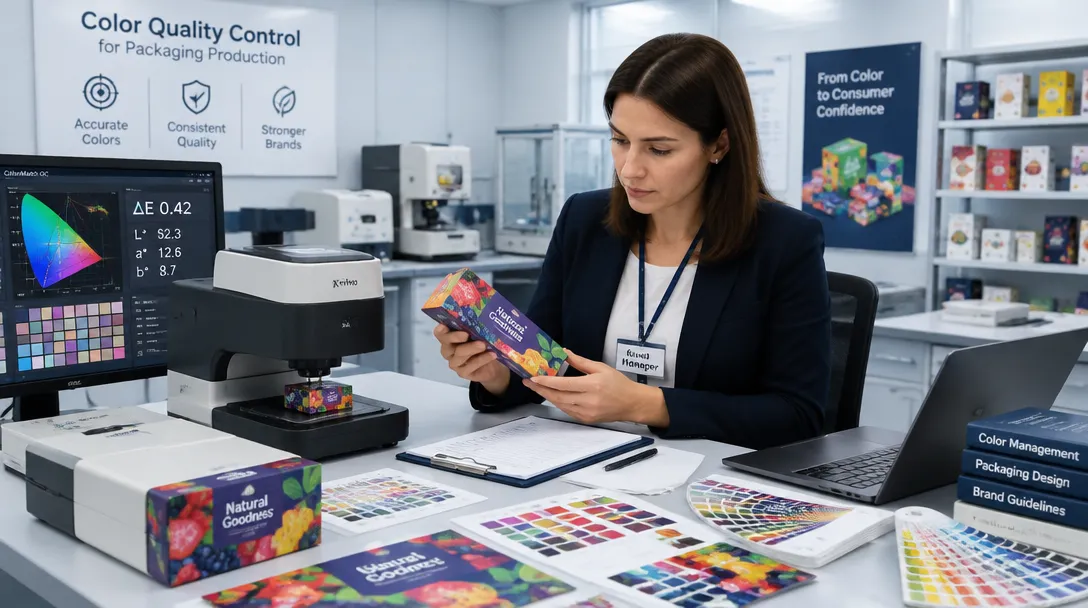
Digital color standards replace physical masters and subjective visual checks with spectral data (CIELAB, ΔE00) to eliminate error stacking across pack types and suppliers. Specify a ΔE00 ≤ 2.0 tolerance, enforce ISO 12647-2 process control, and use ASTM D2244 for color-difference calculation to lock brand equity on shelf.
- Error stacking in traditional workflows—physical standards and visual evaluation—causes visible color shifts across pack types and suppliers, akin to a copy of a copy.
- Digital standards set identical references for all suppliers, removing subjectivity and strengthening brand equity.
- Specify ΔE00 ≤ 2.0 for brand colors; require ISO 12647-2 process control and ASTM D2244 measurement.
- Substrate, ink film weight, and lighting geometry are the three largest contributors to drift; control them with spectral data and standardized viewing.
- Procurement should embed color tolerances into POs and use TadaPack’s prototyping and calculation tools for validation.

Why brand color drifts across pack types and suppliers
Shoppers make purchase decisions in 2–7 seconds—the First Moment of Truth—and all packaging elements, including flexible pouches, labels, cartons, and displays, must match on shelf. X-Rite identifies error stacking from traditional workflows that use physical standards and visual evaluation, comparing the effect to making a copy of a copy, which causes visible color shifts across pack types and suppliers. The proposed fix is replacing physical standards and subjective checks with digital standards to set identical references for suppliers, remove subjectivity, and strengthen brand equity.
From an engineering standpoint, color drift is a multivariate tolerance stack-up. Each process—ink formulation, substrate absorption, print gamut, and lighting—introduces a shift. When a physical master is passed from one supplier to the next, that master degrades and the interpretation of “match” varies. The result is a ΔE that compounds with every handoff. The only robust countermeasure is a digital reference that every supplier measures against with a spectrophotometer under controlled conditions.
Structure and material teardown: where color error enters the BOM
Color is not a single specification; it is a system property of substrate, ink, and process. The table below summarizes typical industry reference ranges for the main packaging formats and their color-critical parameters. These are illustrative values for engineering design, not measured data from any specific production run.
| Pack format | Typical substrate / ink system | Color-critical parameter | Governing standard / test protocol | Typical reference tolerance |
|---|---|---|---|---|
| Folding carton | 350 gsm CCNB, offset CMYK + spot | Ink film weight and substrate brightness | ISO 12647-2; ASTM D2244 | ΔE00 ≤ 2.0 |
| Flexible pouch | PET/PE or PET/ALU/PE, rotogravure | Surface energy and ink adhesion | ASTM D2244; ISO 12647-2 | ΔE00 ≤ 2.5 |
| Label | Pressure-sensitive paper or film | Opacity and adhesive bleed | ASTM D2244; ISO 12647-2 | ΔE00 ≤ 1.5 |
| Corrugated display | ECT-32 B-flute, litho-lam or direct print | Flute caliper and liner absorption | TAPPI T411; ASTM D2244 | ΔE00 ≤ 3.0 |
The material stack matters because each layer changes the apparent color. A 350 gsm CCNB carton with a coated surface will render a spot color differently than a PET/PE pouch with a glossy film. Even the same ink formulation shifts when film weight varies by ±0.1 g/m² or when the substrate’s Cobb 60 water absorption changes the ink holdout. The digital standard must therefore be tied to a specific substrate and ink system, not a universal swatch.
Process highlights: building a digital color control loop
The control loop has four stages: reference definition, measurement, tolerance decision, and corrective action. First, define the digital reference in CIELAB under D50/2° observer and store it in a shared color database. Second, measure production with a spectrophotometer per ASTM D2244. Third, compare ΔE00 against the agreed tolerance. Fourth, if out of tolerance, adjust ink formulation or process parameters before the run continues.
Q: If we have digital standards, why do suppliers still ask for a physical master?
A: A physical master is a crutch for suppliers without spectral measurement capability. The direct metric answer is that a digital standard measured as CIELAB with ΔE00 ≤ 2.0 is more reproducible than any physical chip. The underlying reason is that physical masters degrade and are subject to observer metamerism; spectral data is absolute. The procurement recommendation is to require suppliers to submit measurement reports per ASTM D2244 and reject any supplier that cannot provide them—this is a capability filter, not a negotiation point.
Process control also requires standardized viewing conditions. ISO 12647-2 defines the printing process parameters for offset lithography, including ink film thickness and dot gain, which directly affect color. For flexographic and rotogravure, the same principle applies: control ink viscosity, anilox volume, and substrate tension. When these parameters drift, ΔE drifts with them. A digital standard without process control is just a number; the two must be deployed together.
What procurement and brand owners can borrow from this teardown
The most transferable lesson is to treat color as a specification with a tolerance, not a subjective expectation. Embed ΔE00 tolerances in purchase orders and require measurement reports. Use a shared digital reference so that every supplier—carton, label, pouch, display—measures against the same CIELAB target. This removes the copy-of-a-copy effect and prevents the slow drift that erodes brand equity on shelf.
Second, align the tolerance to the pack format. A label can hold ΔE00 ≤ 1.5, while a corrugated display may accept ≤ 3.0 due to liner variability. These are typical industry reference values; the exact tolerance should be agreed with the supplier based on capability. Third, audit lighting. Retail environments vary from 3000K to 6500K, so specify D50 for measurement and evaluate the pack under the actual retail lighting to catch metameric failure.
Suppose a brand color has a target L*=45.0, a*=68.0, b*=52.0. Supplier A delivers L*=46.2, a*=67.1, b*=53.4; Supplier B delivers L*=44.1, a*=69.3, b*=50.8. Using CIEDE2000 (ASTM D2244), the computed ΔE00 are approximately 1.6 and 1.9 respectively. Both pass a ΔE00 ≤ 2.0 tolerance, but the visual difference between A and B is a ΔE00 of about 2.5—enough to be visible side by side on shelf. This illustrates why a single tolerance per supplier is insufficient; the digital standard must be the same reference for all, and the brand owner should monitor inter-supplier ΔE00 as a separate KPI.
Finally, connect color control to structural prototyping. TadaPack’s custom structural packaging and prototyping services can produce short-run samples on the actual substrate and ink system, measured against the digital standard before mass production. Use TadaPack’s online calculation tools at https://tadapack.com/tools to validate caliper, ECT, and dimensional tolerances that interact with print registration.
Engineering benchmark and testing protocol reference
Conditioning protocol: 23°C ± 1°C, 50% RH per ASTM D685 standard atmospheric conditioning. Standard test equipment: spectrophotometer with D50/2° geometry per ASTM D2244; digital micrometer per TAPPI T411 for substrate caliper; compression test systems per ASTM D642 for structural validation. Engineering reference metrics: ΔE00 ≤ 2.0 for brand colors, substrate caliper variance ±0.15 mm, and ECT-32 or ECT-44 for corrugated displays. All values are typical engineering design ranges, not measured data.
For regulatory context, EU PPWR (2024/1991) and EU Directive 94/62/EC Annex II impose packaging waste reduction and recyclability mandates that increasingly require digital documentation, including color specifications, to be shared across the supply chain. Under FTC Green Guides (16 CFR Part 260), recyclability claims must be substantiated; digital color records support traceability. ISTA 3A general simulation performance testing remains the benchmark for transit validation, and color drift under vibration and humidity should be included in the test protocol.
To operationalize this, require suppliers to submit a color measurement report per ASTM D2244 with each lot, using the same digital reference. Store the reports in a shared database and trend ΔE00 over time. When a supplier exceeds tolerance, trigger a corrective action before shipment. This is the digital equivalent of the physical master, but without the degradation and subjectivity. TadaPack can support the structural and material side of this program with prototyping and tooling validation.
Recommended Engineering Reading
[TOOLS] Featured Engineering & Calculation Tools
Explore 70+ Packaging Tools ➔Box Compression (BCT) Calculator
Predict box compressive limit and stacking safety factors via McKee formula.Edge Crush Test (ECT) Calculator
Calculate linerboard ring crush and composite ECT ratings for optimal board specs.
