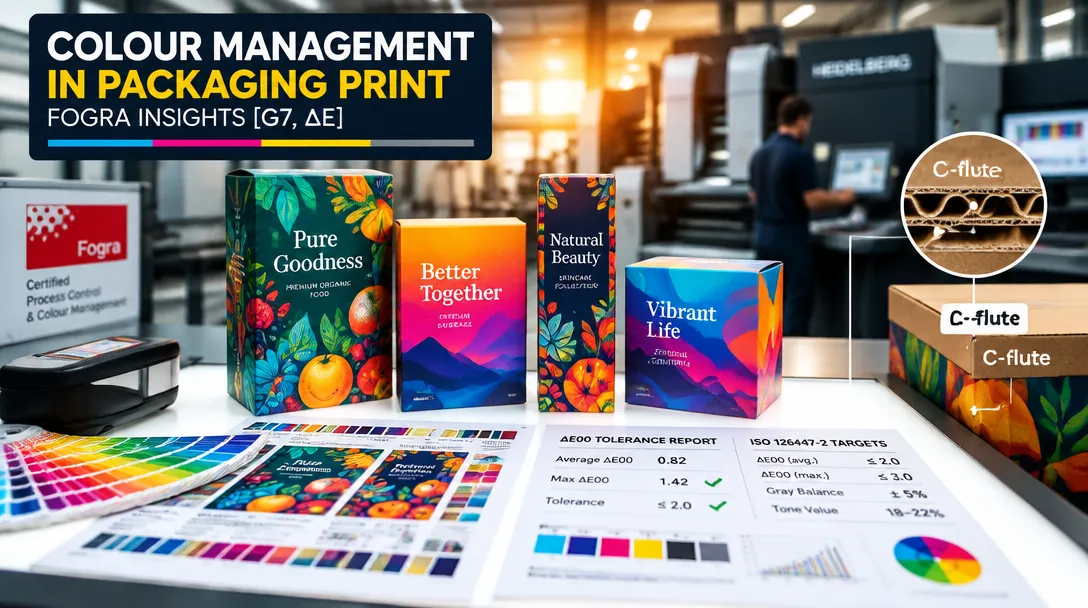
Fogra’s Colour Management Symposium 2026 (tenth edition, Munich, 25–26 February 2026) explicitly lists colour management in packaging printing and proofing, colour consistency on complex industrial-print materials, and HDR printing as core agenda topics — a clear signal that buyers should specify quantified colour tolerances, not vague ‘match to sample’ language. Engineers should contract ΔE00 targets per substrate class, require ISO 12647-2-aligned characterization data, and verify colour fastness on E/B/C-flute and solid bleached board after conditioning at 23 °C ± 1 °C, 50% ± 2% RH per ISO 187, before committing to tooling.
What Did Fogra Announce, and Why Does It Matter to Packaging Buyers?
According to the Fogra press release, the Colour Management Symposium 2026 takes place on 25 and 26 February 2026 at the Holiday Inn Munich City Centre, marking the tenth edition under the motto ‘Matching Colour–Matching People’. The programme features 21 user presentations and 16 exhibitors, with topics including colour management in packaging printing and proofing, colour consistency for complex materials in industrial printing, customer expectations in the digital age, and high dynamic range (HDR) in printing technology. A live AI battle will compare human expertise against AI-supported design, with the audience judging the visual results.
For procurement directors, the packaging-specific agenda tracks are the signal: Fogra — the institute that maintains characterization data and process standards long referenced across European print workflows — is dedicating its flagship colour event to industrial and packaging substrates. That aligns with what TadaPack sees structurally: colour disputes are rarely an ink problem. They are a substrate, measurement, and specification problem — an unbleached kraft liner, a 350gsm CCNB, and an F-flute laminated board all render the same CMYK build differently because their optical brightener content, surface energy, and Cobb 60 absorption differ.
The AI battle segment is also worth engineering attention. If AI-supported design output is being judged against human output live, the underlying requirement is a robust, instrument-measured colour pipeline — exactly what brand owners should demand from suppliers: spectral measurement (M0/M1/M2 conditions), ΔE00 tolerances, and controlled proofing substrates rather than subjective press-side sign-off.
Who Should Act on This: Which Roles and Which Substrates Are in Scope?
Three buyer profiles should treat the Fogra symposium agenda as a specification trigger:
- Procurement directors (US & EU): Your supplier QA clauses should reference instrument-based acceptance — ΔE00 limits, measurement illuminant (D50/M1 per ISO 13655), and a defined proof-to-print tolerance ladder — instead of ‘approved physical samples’ that yellow, fade, or vary by lot.
- Structural packaging engineers: Colour consistency on ‘complex materials in industrial printing’ (per Fogra’s agenda) means your laminated litho-lam, direct-flexo E-flute, and corrugated preprint structures each need their own colour acceptance path. A litho label on SBS at 400gsm and flexo-printed C-flute cannot share one tolerance without joint specification of anilox line screen, ink film thickness (typically 1.0–2.5 g/m² dry film, reference range), and substrate whiteness (CIE L* targets).
- DTC brand owners: ‘Customer expectations in the digital age’ (Fogra agenda topic) translates to e-commerce: your unboxing colour is judged against calibrated screens and camera-white-balanced reviews. Contracting proofing in ISO 12647-2-aligned characterization protects brand equity as rigorously as ECT protects the product.
Substrate classes most exposed to colour drift, ranked by TadaPack field experience as typical industry reference: uncoated kraft (highest ΔE variance, no optical whitening), CCNB (recycled fibre lot-to-lot grey shifts), coated folding boxboard, and litho-laminated SBS (most stable). On kraft, plan spot-ink underprint or white ink base layers rather than expecting four-colour process builds to match coated references.
Key Dates and Programme Milestones: What Is Actually Happening When?
Only the dates below are stated by the Fogra source; use them to time your specification and supplier-QA revisions around the event’s outputs.
- 2025-12-11 — Fogra publishes the symposium announcement, confirming the tenth edition, venue, and programme highlights.
- 2026-02-25 — Day 1, Holiday Inn Munich City Centre: user presentations on colour management in packaging printing and proofing, colour consistency for complex materials, and the live AI-vs-human design battle.
- 2026-02-26 — Day 2: continued presentations including HDR in printing technology, exhibitor showcase (16 exhibitors), and the Bavarian evening keynote by Alexandra Gerhardy, CEO of Muster-Schmidt, on 100 years of colour standards.
Note the discount mechanics the source confirms: team and Fogra member discounts are available — procurement teams sending QA and engineering staff together should register as a group.
What Should You Do Now: An Engineering-Grade Colour Specification SOP
Do not wait for symposium proceedings to harden your POs. The following four-step SOP converts the symposium’s agenda themes into contract language:
- Step 1 — Define substrate-specific tolerances. For each SKU/board combination (e.g., 350gsm CCNB, E-flute litho-lam, BC-flute preprint), specify ΔE00 acceptance against a certified standard: ≤2.0 coated, ≤3.0 uncoated/kraft (typical industry reference values). Anchor measurement to ISO 13655 M1 (D50) illumination and ISO 12647-2 process control references for offset preprint; flexo runs should reference the relevant ISO 12647-6 process targets.
- Step 2 — Contract proofing discipline. Require contract proofs on simulation-grade substrate within one whiteness class of production stock, with a measured verification strip (Fogra Media Wedge V3 or equivalent control wedge) — do not accept uncalibrated inkjet proofs printed on copy paper.
- Step 3 — Verify colour stability under transit-relevant humidity. Condition printed samples per ISO 187 (23 °C ± 1 °C, 50% ± 2% RH) before measurement, and additionally check post-conditioning colour and Cobb 60 water absorption (per ISO 535) on barrier-critical SKUs: Cobb 60 above ~35 g/m² on liner risks delamination and concurrent ΔE drift during ocean transit.
- Step 4 — Build colour checks into structural validation. Insert a colour-acceptance gate into your existing ISTA 3A / ASTM D4169 pre-shipment workflow: measure Lab values pre- and post-transit simulation, log abrasion-induced ΔE on rub-prone faces, and release tooling only when both structural (ECT/BCT) and colour criteria pass.
Q: If our brand standard specifies one Pantone solid, why does the same ink deliver different results on our folding carton vs. our mailer box?
A: First, the metric: identical ink over different substrates produces ΔE00 spreads commonly in the 2–5 unit range between coated SBS and uncoated kraft (typical industry reference range) because substrate whiteness, gloss, and absorption dominate over-ink colour rendering. Second, the physics: uncoated and recycled liners absorb vehicle and pigment differently, scattering light and shifting chroma, while recycled grey fibre content reduces L*. Third, the recommendation: specify the spot colour with a substrate-class-specific Lab target and ΔE00 tolerance per stock — TadaPack’s structural prototyping service (https://tadapack.com) produces draw-down boards on your actual production substrate before tooling release, so colour is locked to real material, not a coated swatch book.
How Do You Procure Against Colour Risk Without Guesswork: Cost, Compliance and Verification?
Colour failures are quantifiable procurement risk. A hypothetical worked example: a 50,000-unit CCNB mailer run rejected at goods-in for ΔE drift costs a reprint plus expedited freight — frequently modelled at 15–25% of original unit cost (illustrative calculation, not measured data). Against that, the preventive controls cost basis points: contract-proof verification, a draw-down on production stock, and post-humidity Lab measurement are all first-article activities, not recurring costs.
Compliance interlocks matter too. Under EU PPWR (Regulation 2024/1991) recyclability mandates, barrier coatings specified to protect colour (moisture-barrier overprints) must remain recyclable-compatible — PFAS-free barrier treatments are now the default specification. Per FTC Green Guides (16 CFR Part 260), any colour-stability claim tied to ‘eco’ positioning must be substantiated. And your colour verification conditioning (ISO 187) should be identical to the conditioning protocol used for compression testing per ASTM D642 and ISTA 3A sequences, so one conditioned sample population serves both structural and colour sign-off — a small change that removes days from the validation calendar.
- ☐ ΔE00 tolerance written per substrate class in every print PO (≤2.0 coated / ≤3.0 kraft, reference)
- ☐ Measurement condition specified: ISO 13655 M1, D50, spectrophotometer geometry stated
- ☐ Contract proof with control wedge verification attached to first article
- ☐ Draw-down or digital prototype produced on actual production board before tooling release
- ☐ Cobb 60 (ISO 535) limit stated on barrier-critical SKUs (≤35 g/m² liner, reference threshold)
- ☐ Colour gate added to ISTA 3A / ASTM D4169 release checklist with pre/post Lab log
- ☐ Barrier coatings specified PFAS-free and PPWR-compatible
TadaPack supports Steps 1–4 end-to-end: custom structural packaging and short-run prototyping on production-intent substrates, plus free engineering calculators at https://tadapack.com/tools for ECT/BCT stacking loads and freight dimensional modelling — so your colour specification ships inside a structure that is equally quantified.
Recommended Engineering Reading
[TOOLS] Featured Engineering & Calculation Tools
Explore 70+ Packaging Tools ➔Foil Stamping Area & Cost Calculator
Estimate hot foil stamping area, foil consumption, and die tooling costs.Imposition & Sheet Utilization Optimizer
Optimize parent sheet imposition layouts to minimize off-cut paper waste.
