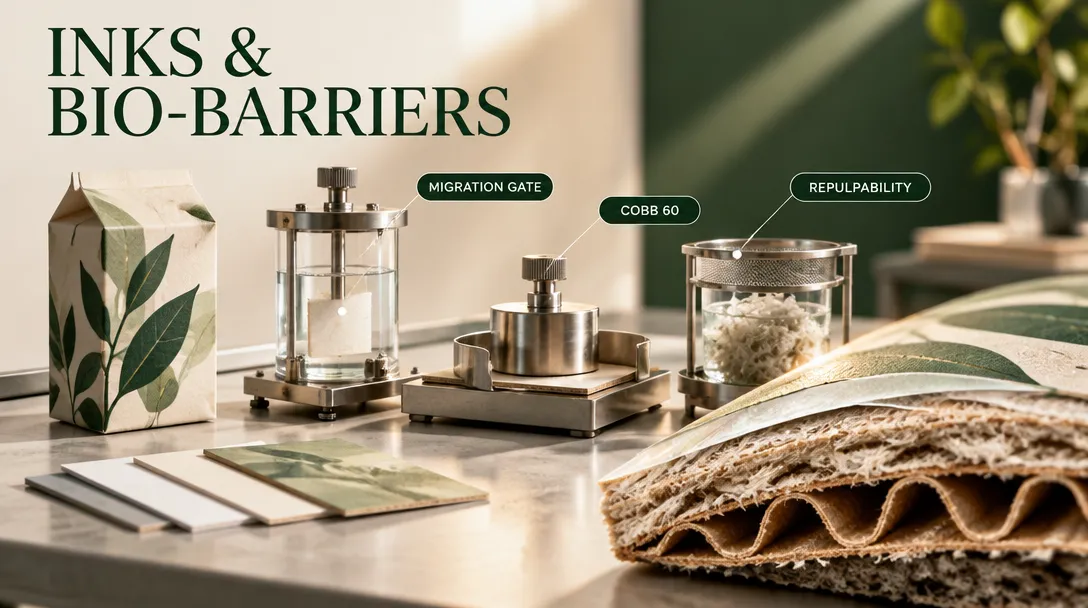
SPC does not issue a universal compliance protocol for water-based inks or bio-derived barrier coatings; qualification must match the package, use and market. Control migration and claims, validate coating performance with Cobb 60 and converting trials, and verify the finished shipper through a risk-based distribution test such as ISTA 3A or ASTM D4169.
For procurement teams, “water-based,” “bio-derived” and “recyclable” describe different attributes—not proof of regulatory compliance or package performance. The practical engineering question is whether the ink and coating meet the intended-use rules, run reliably on the chosen substrate and preserve the package’s protection and end-of-life pathway. SPC/GreenBlue provides packaging sustainability resources; its public website should not be represented as issuing a universal ink or coating approval.
What changed in compliance expectations for water-based inks and bio-derived barriers?
The change is primarily a shift from material-label purchasing to evidence-based qualification. A water-based formulation can still contain substances subject to restrictions, and a bio-derived coating can still impede repulping, recycling or food-contact suitability. “Bio-based” identifies feedstock origin, not biodegradability, compostability, non-toxicity or regulatory clearance. Require suppliers to state the exact formulation identifier, intended use, applicable restrictions, test method, conditions and date of supporting declaration.
For food-contact packaging in the United States, assess the finished article and each component against the applicable FDA food-contact provisions and conditions of use; do not infer that an indirect-contact ink is suitable for direct contact. In Europe, Regulation (EC) No 1935/2004 establishes the general food-contact framework and Regulation (EC) No 2023/2006 addresses good manufacturing practice. These are not blanket approvals for every ink or coating. Obtain supplier declarations and evaluate set-off, migration and contamination risk for the actual structure, printing side, food type, time and temperature.
For environmental claims in the US, the FTC Green Guides (16 CFR Part 260) require claims to be adequately substantiated and appropriately qualified. In Europe, Regulation (EU) 2024/1991—the Packaging and Packaging Waste Regulation (PPWR)—sets packaging requirements and application dates; confirm current obligations and implementing guidance for the specific market and package. Neither “water-based” nor “bio-derived” alone establishes recyclability under either regime.
Who and what does an ink-and-coating qualification cover?
Qualification applies to the complete converted package, not merely the coating drum or ink technical data sheet. Scope the printed face, board grade, coating weight, coverage pattern, adhesive, folding geometry, product contact, secondary packaging and distribution environment. A change from E-flute to B-flute or from uncoated kraft to 350 gsm CCNB can alter drying, adhesion, crease cracking, moisture response and end-of-life compatibility. Capture those items in the specification and change-control process.
Separate the verification plan into five gates: (1) regulatory and supplier-document review; (2) print adhesion, rub and set-off assessment; (3) barrier and moisture performance; (4) converting and structural integrity; and (5) end-of-life and environmental-claim substantiation. For paperboard, Cobb 60 water absorption under TAPPI T 441 is a useful comparative screen, but there is no universal pass value for all coatings or end uses. Establish the acceptance limit from the product’s moisture sensitivity, contact duration, board construction and pack-out. A higher Cobb result may signal greater water uptake, but it does not alone prove transit failure.
Record coat weight, coverage, cure or drying conditions, substrate moisture, print registration and crease behavior. Inspect for pinholes and edge holidays where barrier continuity matters. Run fold-and-crack checks on the actual dieline: coating bridging at scores can expose fibers, while excessive coat build can cause brittle cracking or adhesive interaction. Prototype the production-intent geometry and finishing sequence before freezing the bill of materials.
Which tests and structural calculations should buyers require?
Condition paper-based specimens consistently before comparing lots. ASTM D685 provides standard atmospheric conditioning for paper and paperboard; use the applicable conditioning procedure and record actual temperature and relative humidity rather than treating a lab result as an unconditional field guarantee. Use TAPPI T 441 for Cobb water absorption where appropriate, and select migration, rub, adhesion or barrier methods based on the application and supplier’s validated method. Confirm that each report identifies specimen construction, side tested, exposure, replicates and acceptance criteria.
For shipping cartons, ECT is a board-strength input, not a finished-box performance guarantee. ECT-32 and ECT-44 indicate nominal edge-crush classes; actual supply specifications and test results must be confirmed with the converter. The McKee relationship is commonly used for preliminary box-compression estimates: BCT ≈ 5.876 × ECT × √(perimeter × caliper), using consistent customary units and the formula’s assumptions. Treat it as a screening estimate, not a certification: dimensions, score damage, humidity, print coverage, stacking duration and pallet pattern can materially reduce realized compression. E/B/C/BC flute choice changes caliper and geometry; use the selected board’s measured inputs and verify with ASTM D642 compression testing.
For e-commerce, choose ISTA 3A for applicable packaged-products distribution simulation or ASTM D4169 for a distribution-cycle approach. These protocols are not interchangeable shortcuts: select the schedule and assurance level to represent the actual parcel or distribution hazards, then test the final package configuration. A coating can pass a water-uptake screen yet fail after vibration or drop exposure because a crease, glued seam or exposed edge becomes the weak point.
Use a hypothetical comparison rather than a supplier guarantee: if a design moves from ECT-32 to ECT-44, the nominal ECT input rises by 37.5% (12 divided by 32), but the McKee estimate does not promise a 37.5% increase in usable stack life. Caliper, perimeter, humidity and converting damage remain relevant. Conversely, reducing barrier coverage to save cost is only acceptable if the remaining construction meets the defined moisture and package-integrity limits.
What dates and immediate actions matter to procurement teams?
Regulatory timing is market-specific. The PPWR is a current compliance planning item for EU packaging placed on the market; verify the applicable provisions, transitional rules and latest official guidance with counsel and the responsible compliance lead. Avoid applying one region’s food-contact or environmental-claim conclusion to another market.
- 11 February 2025 — Regulation (EU) 2024/1991 entered into force.
- 12 August 2026 — General application date stated in Regulation (EU) 2024/1991, subject to its provisions and transitional arrangements.
Use this procurement checklist to convert a sustainability claim into a controlled engineering decision:
- ☐ Identify destination markets, product contact, food type if relevant, and time/temperature conditions.
- ☐ Obtain current ink and coating composition disclosures, technical data, safety documentation and applicable compliance declarations.
- ☐ Define migration, set-off and contamination controls for the actual printed package construction.
- ☐ Specify Cobb 60 test conditions and a product-specific acceptance limit; do not adopt an unsupported universal threshold.
- ☐ Confirm print adhesion, rub resistance, drying, score cracking, glue compatibility and coating coverage on production-intent board.
- ☐ Document ECT grade, flute, caliper and box dimensions; screen BCT with McKee, then verify the finished shipper using ASTM D642 when warranted.
- ☐ Select ISTA 3A or an appropriate ASTM D4169 distribution cycle based on the real route and package configuration.
- ☐ Substantiate recyclable, compostable or bio-based claims separately, including the relevant collection and processing pathway.
- ☐ Requalify formulation, supplier, substrate, coat weight or dieline changes through documented change control.
Engineering conclusion: approve a water-based ink or bio-derived barrier only when its regulatory evidence, measured package performance and end-of-life claim all refer to the same final construction and intended market. TadaPack’s custom structural packaging and prototyping support can help translate that specification into production-intent dielines and test samples; use the TadaPack packaging calculation tools for preliminary structural and cost comparisons, then confirm with qualified laboratory and supplier data.
Recommended Engineering Reading
[TOOLS] Featured Engineering & Calculation Tools
Explore 70+ Packaging Tools ➔Foil Stamping Area & Cost Calculator
Estimate hot foil stamping area, foil consumption, and die tooling costs.Imposition & Sheet Utilization Optimizer
Optimize parent sheet imposition layouts to minimize off-cut paper waste.
