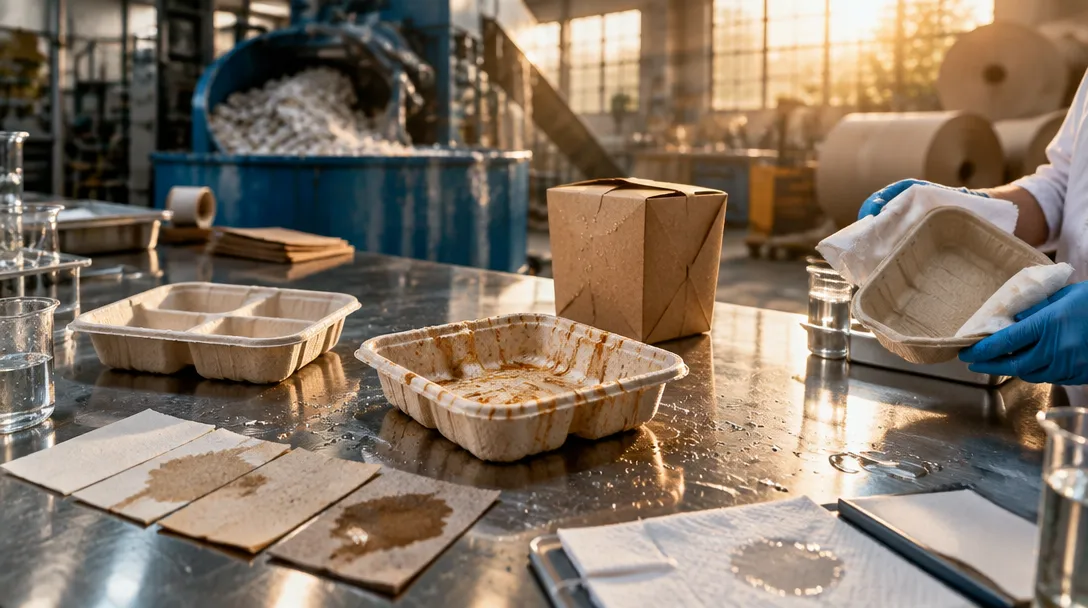
Food residue can be a less significant barrier to recycling many paper formats than previously believed, but recyclers are not willing to accept more residue than they already receive. Specify a cleanability target and validate the package’s moisture and distribution performance separately; Cobb 60 and ECT are engineering measures, not universal recycling acceptance limits.
Food residue is a design and disposal problem, not one universal threshold
Food residue on paper packaging affects two different decisions: whether a consumer will prepare the package for recycling and whether a local collection and mill system can process the material. A package may be technically recoverable as fiber yet perform poorly in practice if grease, sauce or food solids are difficult to remove. Conversely, a small residue mark does not, by itself, establish that every paper format is unrecyclable. Local collection rules and the package’s material construction still matter.
The Sustainable Packaging Coalition study involved more than 100 consumers and interviews with more than 50 companies, including 37 MRF operators running more than 400 MRFs, 12 recycled-fiber mill companies and 6 exporter brokers. Participants who received a How2Recycle label and watched a 90-second educational video were twice as likely to properly recycle items requiring cleaning, removing at least 50% of the original food residue. Printed recycling icons were rated very helpful by 76% of participants. The document also reports that consumers may be willing to recycle clean paper packaging without being willing to clean it; coffee cups, paper plates and frozen meal bowls were among formats many found too inconvenient to clean. These are study findings, not a universal mill specification or a guarantee of acceptance.
For packaging teams, the operational question is therefore not “How much residue is recyclable?” in isolation. It is: what material construction reaches the intended recovery stream, what cleaning action is realistic, and what package performance must remain intact through filling, storage and shipment? Treat those as separate design gates. Do not use a strength or water-absorption result as a proxy for recyclability, and do not make a broad recyclability claim without substantiation for the relevant market.
Separate fiber recovery, cleanability and package performance
Paper packaging is a system of fibers, coatings, adhesives, inks and converting features. A food-contact barrier can protect the board during use, but its chemistry, coverage and bond to the fiber structure can affect repulping and downstream screening. “Paper-based” is not enough information to predict the outcome. Specify the actual substrate and barrier construction, then seek evidence relevant to the intended collection and recycling pathway.
On the consumer side, package geometry can matter as much as the material. A wide opening, smooth interior and limited corner traps may make food removal easier; a narrow cup, deep bowl or folded seam can retain residue. Those are design hypotheses to verify with representative food and use conditions, not findings attributed to the cited study. Evaluate practical cleaning effort as part of usability research, and give concise disposal instructions that distinguish emptying, scraping or rinsing where local guidance supports those actions. Avoid instructing consumers to use excessive water or to clean packaging in a way that conflicts with local rules.
On the manufacturing side, barrier performance must be balanced against fiber recovery and structural requirements. A PFAS-free barrier coating may be a procurement requirement, but “PFAS-free” alone does not establish repulpability, recyclability or food-contact compliance. Request supplier documentation for chemistry and intended use, and validate the finished structure with relevant recyclability evaluation and local stakeholder guidance. For wet or greasy applications, prototype coating weight and coverage rather than defaulting to a full-surface, high-barrier treatment.
Transport performance remains a separate gate. Corrugated shippers may use ECT-32 or ECT-44 board grades as typical design references, but the required grade depends on box dimensions, load, stacking, humidity and handling. The McKee relationship is an estimate of box compression from edge-crush strength, perimeter and board caliper; it is not a substitute for a finished-box test. Verify distribution packaging using the protocol selected for the shipment, such as ISTA 3A for applicable parcel-distribution evaluation or ASTM D4169 for distribution-cycle testing. A consumer-facing paper food pack does not automatically require a corrugated shipper specification; test the actual unit load and shipping configuration.
Use test values as design inputs, not recycling pass limits
The following are typical industry reference values for early design conversations, not source findings, regulatory thresholds or guarantees. Test methods, sample conditioning, board construction and supplier tolerances affect results. A value should be attached to a defined specimen and method in procurement documents; a generic “recyclable” or “grease resistant” claim cannot replace that information.
| Parameter | Typical reference or design use | Governing standard / test protocol | What it does not prove |
|---|---|---|---|
| Cobb 60 water absorptiveness | About 20–60 g/m² is a broad typical reference span encountered across paper and board constructions; specify a tighter target only after product and process trials. | TAPPI T 441 | Does not establish recyclability, grease resistance or food-residue acceptance. |
| Corrugated ECT grade | ECT-32 and ECT-44 are common typical design references; select from load and box geometry calculations. | TAPPI T 811; verify the finished pack under ISTA 3A or ASTM D4169 as applicable. | Does not alone predict finished-box compression or parcel survival. |
| Board caliper | Measure actual construction; corrugated caliper varies with flute and board combination. Treat supplier data as a specification, not a universal nominal. | TAPPI T 411 | Does not directly indicate barrier chemistry or recycling performance. |
| Consumer cleaning target | Use a defined design target such as removing at least 50% of original food residue only where that target is intentionally adopted; this percentage was used in the cited study context, not as an industry acceptance limit. | Document the internal test method and local disposal guidance; no universal residue standard is asserted here. | Does not guarantee acceptance by a particular MRF or mill. |
For a hypothetical structural screening calculation, consider a corrugated shipper with a selected ECT-32 grade and a geometry-derived estimated compression capacity. The McKee estimate can help compare candidate board constructions, but any numeric result depends on the actual box perimeter and measured caliper; do not carry an assumed value into a purchase order as a certified BCT. Confirm compression on representative finished boxes and include distribution conditioning when humidity or cold-chain exposure is material to the use case.
Likewise, Cobb 60 is useful when water exposure threatens board integrity, but it is not a direct model of oily food contact. For grease or sauce, evaluate the relevant barrier test and actual food contact duration, temperature and application method. Keep design records clear about whether a result is a typical supplier reference, an internal target or a verified test outcome. No TadaPack laboratory result or client performance record is implied here.
Choose constructions around the food and the recovery route
Uncoated or lightly treated paperboard can be a reasonable starting point for dry or low-moisture products where product protection permits. For greasy or wet foods, compare localized barrier coverage, dispersion coatings, aqueous treatments and other qualified constructions against functional performance and the intended fiber-recovery pathway. Each option has trade-offs in forming, sealing, printability, moisture resistance and end-of-life processing; supplier claims should be supported by documentation specific to the complete package.
For cups, plates and bowls, geometry deserves early attention. A rim, seam or folded base may capture food and complicate cleaning. A design review should identify residue traps in the CAD model and include representative post-use inspection. If the package is likely to be discarded with significant food still inside, a theoretically recyclable substrate may not resolve the practical disposal problem. Conversely, requiring a rinse that consumers consider burdensome can reduce correct participation, as the cited research indicates.
In DTC and retail shipping, keep the food-contact primary pack distinct from the transit shipper in the bill of materials. A paperboard tray with a barrier lining and an ECT-44 corrugated shipper solve different problems. Structural optimization should account for McKee-estimated compression, actual box testing and the dimensional-weight or dimensional-freight rules applicable to the carrier or fulfillment channel. Do not increase board grade to compensate for a poorly fitted insert or unsupported span without checking the full pack geometry.
Procurement can compare alternatives using a landed-cost model rather than unit price alone. An illustrative model is: annual packaging cost = order quantity × quoted unit price + tooling amortization + freight and storage + expected damage and replacement cost. Compare candidate structures at the same functional specification, and record assumptions such as order volume, board grade, barrier coverage and shipping configuration. This is an illustrative calculation framework, not a live market price benchmark. Current supplier quotes and freight terms should be obtained for the actual order and region.
Validate the finished package before making claims
Build verification around the finished construction rather than a material name. First document the food, fill temperature, contact time, storage conditions and expected consumer disposal action. Next confirm board, coating, adhesive, ink and seam details with suppliers. Then evaluate food protection and cleaning practicality on representative packages. Finally, verify shipping strength on the actual packed configuration using a selected distribution protocol. Keep each result tied to its specimen, method and decision owner.
For recyclable-claim governance, distinguish a design objective from a verified claim. Review local collection access, sorting and mill compatibility, and substantiate the claim for the markets where the package is sold. EU PPWR (2024/1991) is a relevant regulatory framework for packaging placed on the EU market; determine applicable obligations with current legal and technical review rather than assuming that a fiber-based format automatically satisfies them. In the United States, claims should be reviewed against applicable FTC Green Guides requirements and the evidence available for the specific package and market.
Two common engineering errors are worth preventing. A low Cobb result is sometimes treated as proof that an oily food barrier will work; it is not, because water absorption and grease resistance are different properties. A high ECT grade is also sometimes treated as proof of parcel durability; it is not, because box geometry, closure, internal fit and distribution hazards affect the packed system. Corrective action is to specify the relevant performance test and test the finished pack, not simply raise a single material metric.
For a new format, TadaPack can support custom structural packaging and prototyping so teams can compare geometry, barrier coverage and shipping configuration before committing to production tooling. TadaPack’s online calculation tools at https://tadapack.com/tools can support early sizing and engineering checks; treat calculator outputs as screening inputs and confirm the final design with supplier data and applicable physical testing.
Buyer questions about residue and paper packaging
Is paper packaging recyclable if it has food residue?
There is no universal yes-or-no answer for every paper format and recovery system. The cited study reports that residue may be a less significant issue for many paper formats than previously believed, while recyclers are not willing to accept more than they already receive. Follow the relevant local guidance and design for practical emptying or cleaning.
Does removing 50% of the food residue guarantee acceptance?
No. The 50% figure describes the cleaning criterion referenced in the cited study’s participant finding; it is not a universal MRF or mill acceptance threshold. Confirm local collection instructions and avoid presenting that figure as a certification limit.
Can Cobb 60 determine whether a food tray is recyclable?
No. Cobb 60 under TAPPI T 441 measures water absorptiveness. It may help specify moisture performance, but it does not establish grease resistance, repulpability or acceptance by a particular recycling system.
Which tests should we request for a paper food pack and its shipper?
Specify tests by function: evaluate the food-contact barrier using a relevant method, use Cobb 60 where water absorptiveness matters, and verify the packed shipping configuration with an applicable protocol such as ISTA 3A or ASTM D4169. For corrugated strength screening, request ECT data and confirm finished-box performance; no single metric replaces the full evaluation.
Should procurement choose a stronger board grade to reduce damage?
Not automatically. Compare board grade, geometry, internal fit, closure and actual shipping hazards together. ECT-32 and ECT-44 are typical reference grades, not blanket recommendations; use calculation for screening and finished-pack testing to validate the selected design.
Recommended Engineering Reading
[TOOLS] Featured Engineering & Calculation Tools
Explore 70+ Packaging Tools ➔CBM Volume & Freight Dim-Weight Calculator
Calculate cubic meters & dimensional weight to minimize freight costs and avoid FBA size tier penalties.Mailer Box Area & Dieline Size Calculator
Instant flat dieline dimensions, material consumption, and sheet nesting for custom D2C mailer boxes.
