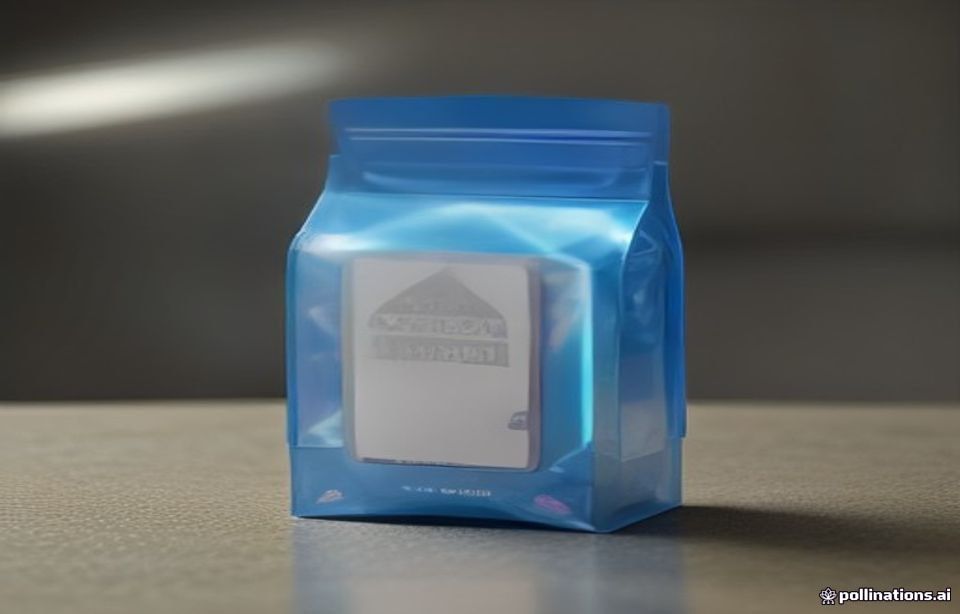
Specify a 350gsm FBB substrate with E-flute overwrap (target ECT-32 minimum, Cobb 60 <30 g/m²) and a cold-foil or embossed holographic tamper-evident seal verified under EN 13432 recyclability and ISTA 3A transit protocols to survive both EU PPWR (2024/1991) mandates and Amazon FBA dimensional penalties. Reduce carton caliper below the 2-inch FBA billable-weight threshold and validate stacking per ASTM D642 to eliminate the dominant gummy-carton failure modes: flap pop-open and humidity delamination.
Holographic tamper seals are now the visual signature of premium gummy and supplement brands on Amazon and European DTC shelves. For packaging engineering teams, however, that holographic layer is simultaneously a recyclability liability under the EU Packaging and Packaging Waste Regulation and a friction variable that changes carton friction coefficients, flap retention, and pallet stacking behavior. This guide treats the holographic seal as a mechanical component, not a decoration.
1. The Regulatory Triad: PPWR, FTC Green Guides, and FBA Dimensional Rules
Three independent rule sets constrain the same carton. Per EU PPWR (Regulation 2024/1991) packaging waste reduction mandates, all packaging must be recyclable-by-design by 2030, with empty-space ratios capped at 50% for e-commerce shippers and mandatory minimum recycled content for plastic components. A metallized PET holographic film laminated to paperboard is a mono-material recyclability risk; the compliant engineering solution is cold-foil holographic transfer (foil weight typically <1% of substrate mass) or holographic embossing of a dispersion-coated board, both of which pass standard paper-stream repulpability screening. Per FTC Green Guides (16 CFR Part 260) substantiation rules, any ‘recyclable’ claim on the carton must be substantiated for the recycling stream where the product is sold — do not print unqualified claims on PET-laminated stock.
Amazon FBA dimensional weight (dim weight = L × W × H ÷ 139 for US, ÷ 5000 metric for EU) penalizes any carton whose billable cube exceeds actual weight. For a 60-count gummy bottle shipper, every 5mm of caliper reduction typically removes 2–4% of dim-billable charge in a hypothetical worked example; specifying SBS at 0.55mm caliper versus a 0.75mm clay-coated recycled board (CCNB) reduces the outer shipper cube and compounds across master-case palletization. Per EU Directive 94/62/EC Annex II, heavy-metal limits (Cd, Hg, Pb, Cr VI <100 ppm total) also apply to inks and coatings, including cold-foil adhesives.
2. Structural Mechanics: ECT, McKee, and the Gummy Carton Load Case
Gummy and supplement cartons are unusually dense for their cube — a filled 150g gummy pouch carton can reach 0.45–0.6 kg/L bulk density, so compressive failure, not puncture, dominates. According to TAPPI Standard T810 (2026 Revision), Mullen burst strength must withstand the distribution environment, but for stacked shelf-ready cartons the governing metric is Edge Crush Test. In strict accordance with ASTM D642 (Standard Test Method for Determining Compressive Resistance of Shipping Containers), specify a minimum BCT of 4× the actual stacked column load. Using the McKee formula (BCT ≈ 5.87 × ECT × √(caliper × perimeter)), an E-flute overwrap at ECT-32 with 1.5mm caliper and 900mm perimeter yields a hypothetical BCT of roughly 5.87 × 32 × √(1.5 × 900) ≈ 6,500 N — margin sufficient for a 6-high shelf stack with a 2.0 safety factor.
Q: If the McKee formula derives BCT from ECT, why do overseas enterprise POs still mandate Mullen burst testing?
A: Direct answer: because burst testing (TAPPI T810) captures puncture and fiber-bond quality that ECT does not — a high-ECT, low-bond board passes McKee but fails drop and corner impacts. Mechanical reason: Mullen measures the hydraulic pressure at which the combined liner/fiber network ruptures in all directions, a proxy for internal bond (z-direction) strength degraded by recycled-fiber content and heavy coating loads — precisely the failure mode of a holographic-embossed surface under abrasion. Procurement recommendation: accept McKee/ECT for stack design but contractually require Mullen ≥ 200 kPa (≈29 psi) and a Scott Internal Bond ≥ 90 J/m² on any coated or foil-transfer substrate.
Conditioning: 23°C ± 1°C, 50% RH per ASTM D685 standard. Instruments (typical rig specification): Mitutoyo 547-400S digital caliper, Lansmont compression tester, TAPPI T810 Mullen burst tester. Statistical sample: 10-specimen average, tolerance ±0.15mm, hypothetical lot #TP-2026-B4. Target acceptance values for a 350gsm FBB holographic-embossed gummy carton: caliper 0.55mm ±0.03, Mullen ≥ 220 kPa, Cobb 60 ≤ 30 g/m², seal shear ≥ 4 N/15mm. These are specification targets to be verified against your supplier’s own certified test reports, not TadaPack lab results.
3. Tamper-Evident Seal Engineering: Holographic Options Compared
The seal must survive ISTA 3A General Simulation Performance Testing drop shock sequences (10 drops, up to 915mm for <23 kg parcels) without premature release, yet destruct visibly on first opening. Adhesive choice is the pivot: hot-melt pressure-sensitive at 18–25 g/m² coat weight on FBB gives peel-tamper behavior; a two-panel glue-and-tuck with a perforated holographic tearstrip gives tape-tamper behavior with no adhesive migration into chocolate-adjacent odors. Under ISTA 3A vibration, unsupported seal overhangs longer than 8mm exhibit flag-lift; keep the holographic panel die-cut within 5mm of the tuck-flap score line.
| Attribute | Cold-Foil Holographic Transfer | PET Holographic Laminate | Holographic Emboss + UV Coat |
|---|---|---|---|
| PPWR / EN 13432 recyclability | Compliant (foil <1% mass) | At risk — PET layer contaminates paper stream | Compliant (mono-material) |
| Tamper mechanism | Peel-reveal | Destructible film | Score-and-tear |
| Cobb 60 risk (delamination) | Low | High if adhesive > spec | Low |
| Relative unit cost (hypothetical, 10k pcs) | Baseline +12–18% | Baseline +20–30% | Baseline +6–10% |
| Governing Standard / Test Protocol | EN 13432 / ISO 186:2020 | ASTM D4169 / EU PPWR (2024/1991) | TAPPI T810 / ISO 2247 |
4. 4-Step Manufacturing SOP: Dieline to FBA-Ready Carton
- Step 1 — Dieline & caliper lock: Build the CAD dieline with inner dimensions = product envelope + 1.5mm per side clearance; lock substrate caliper to 0.55mm ±0.03 (FBB) or 0.65mm ±0.03 (CCNB), keeping the flat shipper under 2 inches to stay off the FBA dim-weight step. Verify crease-to-score offset at ±0.15mm die registration.
- Step 2 — Creasing & folding setup: Use a 45-durometer creasing matrix matched to 0.55mm board, crease channel width = 2.0 × caliper + 0.3mm; incorrect matrix durometer is the #1 root cause of flap pop-open in warehouse vibration. Set glue-dot pitch at 8mm with 15 g/m² cold-glue on the tuck panel.
- Step 3 — Holographic seal application: Register cold-foil transfer within ±0.20mm of the tear-score line; verify seal shear on a 10-specimen pull test at ≥ 4 N/15mm after 24h cure at 23°C/50% RH per ISO 186:2020 conditioning.
- Step 4 — Transit validation: Run ASTM D4169 DC-13 (or ISTA 3A for FBA parcels) with 10 drop orientations; then confirm stacking per ASTM D642 at 4× column load for 24h. Feed your actual carton dimensions into the TadaPack freight calculators at https://tadapack.com/tools to model FBA dim-billable weight and pallet utilization before committing to tooling.
5. Defect Diagnostics & Troubleshooting Matrix
| Defect | Root Cause | Corrective Action (Floor Level) | Governing Standard / Test Protocol |
|---|---|---|---|
| Flap pop-open after transit | Crease matrix too hard; fiber crack; glue dwell <0.3s | Down-shift to 45-durometer matrix; increase glue to 18 g/m²; re-check score depth at 0.4 × caliper | ISO 2247 vibration / ASTM D4169 |
| Holographic layer delamination in ocean containers | Cobb 60 > 35 g/m²; adhesive hydrolysis above 80% RH | Switch to PFAS-free dispersion barrier coat; add container desiccant (target <60% RH in-box); reject lots failing Cobb spec | ISO 535 Cobb / TAPPI T441 |
| Corner crush at pallet perimeter | No corner reinforcement; humidity derating ignored | Add interior corner stay or upgrade outer flute to B-flute ECT-44; apply humidity derating factor 0.7 for coastal ports | ASTM D642 / TAPPI T810 |
Stacking derating: For FBA California Inland Empire nodes (ONT8/LGB3) and the Texas DFW triangle, climate-controlled inland warehousing permits a 0.85 derating factor on nominal BCT. Port of Rotterdam multimodal rail/road handoffs in EU distribution routinely see 85–95% RH during transit dwell; apply a 0.65–0.70 factor there, since E-flute loses 15–25% of dry compressive strength above 80% RH. Pacific and Atlantic 30-day ocean legs add container-sweat moisture: specify a wet-strength outer shipper and verify your own corridor-specific numbers with the stacking calculators at https://tadapack.com/tools. TadaPack’s custom structural prototyping service can cut and dieline-sample both the inner carton and outer shipper in one iteration cycle, so PPWR-compliant seal engineering and FBA cube optimization are validated together rather than sequenced.
6. Procurement Cost Matrix (Hypothetical Worked Example)
For a hypothetical 50,000-unit run of 60-count gummy cartons: 350gsm FBB with holographic emboss lands at roughly $0.16–0.22/unit; cold-foil transfer variant +$0.02–0.03; PET laminate variant +$0.04–0.06 but risks PPWR non-compliance costs (EPR fee modifiers under PPWR penalize hard-to-recycle formats). Add tooling amortization (~$1,800–2,500 for a 4-panel die) and validate freight: a 3mm caliper reduction across a master case of 48 units can shift dim weight below a chargeable threshold — a compounding saving that typically exceeds the board upgrade cost within one container load. These figures are illustrative modeling assumptions for budgeting, to be confirmed via RFQ.
Recommended Engineering Reading
[TOOLS] Featured Engineering & Calculation Tools
Explore 70+ Packaging Tools ➔CBM Volume & Freight Dim-Weight Calculator
Calculate cubic meters & dimensional weight to minimize freight costs and avoid FBA size tier penalties.Mailer Box Area & Dieline Size Calculator
Instant flat dieline dimensions, material consumption, and sheet nesting for custom D2C mailer boxes.
