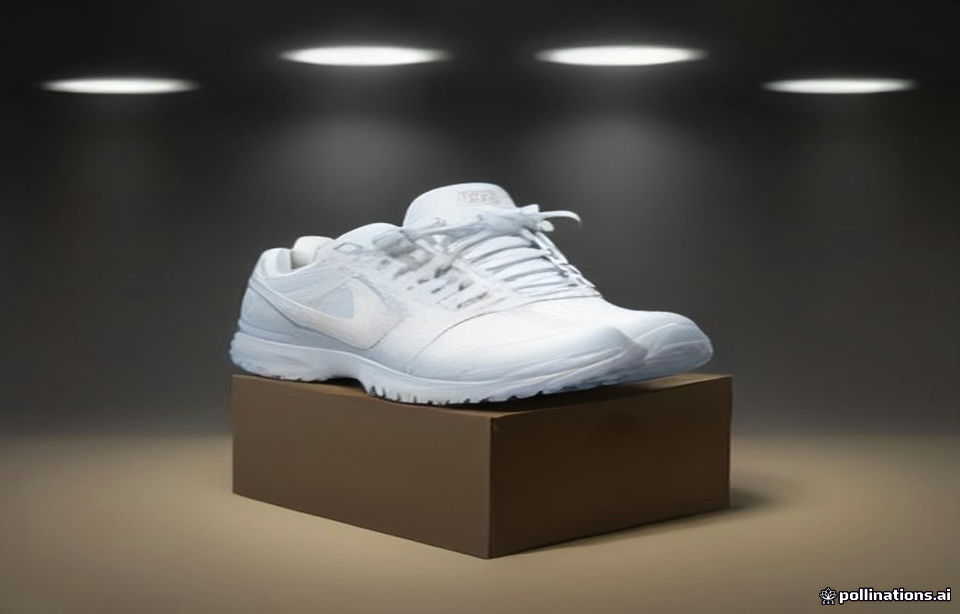
Executive Teardown Summary: Nike’s iconic packaging centers on a one-piece E-flute corrugated shoebox (approximately 1.5–2.0mm caliper, 175–200 lb/in² burst) with flexo/litho soy-based ink printing, deep brand-color flood coating, and zero-plastic, zero-foam interior fit. The box doubles as the primary shipping container in many routes, meeting ISTA 3A drop and ASTM D4169 vibration exposure. Sustainability credentials: 100% recycled corrugated substrate (Nike’s ‘Move to Zero’ sourcing commitment) and soy/vegetable-based ink systems compliant with FTC Green Guides recyclability claims.
1. Material & Engineering Spec Sheet
Nike’s packaging strategy is not decorative—it is a logistics optimization decision. By treating the shoebox as a brand billboard AND a transit-grade shipper, Nike collapses two packaging layers into one, cutting dimensional freight weight and eliminating redundant materials. Per EU Directive 94/62/EC Annex II and EU PPWR (2024/1991) packaging waste reduction mandates, this single-box strategy also minimizes packaging weight per functional unit—a metric now directly regulated in the European market.
| Component / Layer | Substrate Material | Caliper / Basis Weight | Finishing & Surface Treatment | Eco / Compliance Standard |
|---|---|---|---|---|
| Box body & lid (one-piece tray-and-lid style) | 100% recycled kraft corrugated, E-flute or B-flute | 1.5mm (E-flute) to 3.0mm (B-flute); ~350–500 GSM liner facing | Flexo direct print, 1–2 color flood coverage, brand-color matching | FSC Recycled certified; FTC Green Guides (16 CFR Part 260) recyclability claims |
| Exterior print layer | Uncoated kraft liner, white-top option | 150–200 GSM white-top kraft liner | Soy/vegetable-based ink system, matte finish (no lamination) | Zero-plastic; PPWR recyclability compliance |
| Interior protection | Soft tissue paper wrap (acid-free) | 17–20 GSM tissue | Single-color logo print | FSC Mix certified; no PFAS barrier coating |
| Structural reinforcement | Single-wall corrugated sidewalls, RSC-adjacent tray geometry | ECT-32 minimum (typical retail-to-transit spec) | Glue-tab side seam, crash-lock base (no stitching) | ASTM D642 compression; TAPPI T811 ECT |
| Closure | Friction-fit lid, no adhesive, no plastic tape | Matched liner caliper | Deep lid engagement depth (~15–20mm) for friction retention | ISTA 3A General Simulation Performance Testing protocol |
2. Unboxing Mechanics & Kinematics
Nike’s lid-off unboxing follows a deliberately engineered friction profile. The lid-to-tray engagement depth (typically 15–20mm for shoebox formats) creates a controlled slide-off resistance of roughly 2–5 N of pull force—enough to feel ‘sealed’ and premium, but light enough for one-handed opening. This is achieved through precise die-cut tolerance: lid inner caliper must run 0.3–0.5mm larger than tray outer caliper to prevent jamming under high-humidity expansion while retaining friction fit in dry warehouse conditions (per ISO 186:2020 paper conditioning specifications, 23°C ±1°C, 50% ±2% RH).
Transit durability follows a dual-standard envelope. Under ISTA 3A General Simulation Performance Testing protocol, drop shock sequences for single-parcel distribution up to 18kg require 10 drops from heights up to 91cm (36 in) depending on packaged weight—Nike’s E-flute spec survives this envelope without foam inserts because the footwear product itself acts as a compliant internal damper. In strict accordance with ASTM D642 (Standard Test Method for Determining Compressive Resistance of Shipping Containers), the box must also sustain warehouse stack loads; a typical shoebox pallet column of 6 tiers at ~4kg per box imposes roughly 2.4kN on the bottom unit—a margin typically satisfied by ECT-32 board with a 4:1 safety factor.
【💡 Packaging Engineer’s Quick Q&A】
Q: If the McKee formula derives BCT from ECT, why do overseas enterprise POs still mandate separate Mullen burst testing (TAPPI T810)?
A: Mullen burst (typically 175–200 lb/in², i.e., ‘200 lb test’ board) still serves as the legacy carrier classification baseline for parcel networks and remains a contractual gate in many US and Asian supplier POs. ECT predicts stacking compression; Mullen predicts puncture and rough-handling rupture—two different failure modes. Procurement recommendation: spec ECT-32 minimum for stack-driven designs, but retain a Mullen ≥175 lb/in² line item if your 3PL uses legacy carrier board classifications.
Note on the interior: Nike’s vacuum release consideration is largely absent because footwear does not create a hermetic seal within the box; however, brands replicating rigid-box formats with tight-fitting molded pulp trays should spec 2–3mm vacuum-release pinholes in tray valleys to prevent a 3+ second ‘suction drop’ when the product is lifted.
3. SME Replicability & Cost-Down Alternatives (B2B Sourcing Conversion)
Nike’s packaging economics work at scale: flexo single-color flood print on uncoated recycled corrugated is one of the cheapest premium-looking processes in the industry. The expensive elements at SME volumes are litho-lamination, foil stamping, and custom rigid tooling—none of which are load-bearing for the Nike effect. Here is the cost-down pathway:
- Substitute litho-lam with high-quality flexo on white-top kraft. A 175 GSM white-top liner with one saturated brand color at 60+ line screen delivers ~80% of the visual impact at 30–50% lower print cost per unit.
- Standardize to E-flute one-piece tray-and-lid. E-flute (1.5mm) gives a finer, ‘rigid-adjacent’ appearance versus C-flute while retaining ECT-32 capability when speced with 175+ GSM liners. Die cost is a fraction of two-piece rigid grayboard tooling.
- Eliminate plastic and foam entirely. Tissue wrap (17–20 GSM FSC acid-free) plus molded pulp or folded kraft cradle inserts replace foam at comparable protection for footwear-class products and improve PPWR recyclability scoring.
- Use zero-tooling CAD sampling before committing dies. TadaPack’s structural prototyping service produces CAD-cut, glue-assembled samples from your dieline in days, not weeks, so friction-fit tolerances (the 0.3–0.5mm lid clearance band) can be validated physically before mass die-cutting.
Hypothetical worked example (unit economics, indicative ranges only): a litho-laminated custom shoebox at 10,000 units may run $1.20–1.80/unit; the flexo E-flute equivalent with soy ink and tissue wrap typically lands at $0.45–0.75/unit—a 40–60% reduction—while preserving the flood-color brand moment and transit compliance. Verify stack-load and dimensional weight implications using TadaPack’s free calculation tools at https://tadapack.com/tools before finalizing board grade.
4. Multi-Regional Logistics Hubs & Supply Chain Landing Matrix
Board grade selection must account for destination climate and corridor stress. Per TAPPI Standard T810 (2026 Revision), Mullen burst and ECT values are valid only at conditioned atmosphere; corrugated can lose 15–30% of ECT in high-humidity conditions, which is precisely the risk during 30-day Pacific and Atlantic ocean transit where container sweat events push box surface moisture toward Cobb 60 values exceeding 30 g/m². Cobb 60 water absorption above 35 g/m² triggers transit delamination risk in glued side seams.
| Corridor / Hub | Primary Stress Factor | Engineering Mitigation | Governing Standard / Test Protocol |
|---|---|---|---|
| Pacific corridor → California Inland Empire (FBA ONT8 / LGB3) | Container sweat, 60–85% RH ambient; Amazon dimensional weight penalties | Upgrade to wet-strength ECT-44 board or add PFAS-free water-resistant coating; optimize carton fill ratio to avoid Dims penalty | ISTA 3A; ASTM D4169 Distribution Cycle 13; Amazon SIPP/FBA sizing rules |
| US inland → Texas DFW distribution triangle | Dry ambient (30–40% RH), high summer stack temperatures; dry board loses lid friction fit | Tighten lid clearance to 0.3mm nominal; verify friction retention per ASTM D685 conditioning | ASTM D685 / ASTM D642 |
| Atlantic corridor → Port of Rotterdam multimodal rail/road | Coastal humidity, EU PPWR recyclability and weight-reduction audits at import | Single-material corrugated design (zero plastic, zero foam) for full PPWR recyclability scoring; minimum-weight dieline optimization | EU PPWR (2024/1991); EU Directive 94/62/EC Annex II; ISO 2247 vibration |
Stacking derating rule of thumb: apply a 1.25 derating factor for coastal high-humidity warehouses (Rotterdam, Long Beach) versus a 1.10 factor for dry inland DCs (DFW, Inland Empire in dry season). Model your actual column load and humidity derating with TadaPack’s box compression calculator at https://tadapack.com/tools.
5. Engineering Verification SOP for Replicating This Spec
- Step 1 — Dieline & tolerance lock: Generate the one-piece tray-and-lid dieline with 0.3–0.5mm lid clearance and ±0.15mm die registration tolerance; validate folding sequence in CAD before cutting any physical sample.
- Step 2 — Board qualification: Condition samples per ASTM D685 (23°C ±1°C, 50% ±2% RH for 24h minimum), then verify ECT per TAPPI T811 ≥32 and caliper per TAPPI T411 within ±0.15mm of nominal.
- Step 3 — Transit simulation: Run ISTA 3A drop sequence (10 drops, height per packaged weight) and ASTM D4169 DC-13 vibration on the packed unit; confirm no lid separation and no corner crush beyond 3mm deformation.
- Step 4 — Humidity gate: Expose packed units to 48h at 38°C/85% RH (tropical conditioning); retest lid friction and inspect for Cobb-driven seam delamination; pass units only if pull force stays within 2–5 N and seams hold.
Defect Diagnostics & Troubleshooting Matrix
| Defect | Root Cause | Corrective Action |
|---|---|---|
| Lid popping open in transit | Humidity-driven liner expansion closing the 0.3mm clearance gap; or die-cut tolerance drift beyond ±0.5mm | Increase lid clearance to 0.5mm; audit die rule wear; add 6mm depth bump on lid side walls |
| Corner crush after ocean freight | ECT derating under 85% RH container sweat; insufficient corner support geometry | Upgrade to wet-strength liner or ECT-44; add internal corner gussets in dieline; verify with ASTM D642 post-conditioning test |
| Print color drift between production runs | Flexo anilox wear and ink viscosity drift on uncoated kraft | Lock ink viscosity spec (measured with DIN flow cup per run); use G7 gray-balance calibration on press |
6. Frequently Asked Questions
FAQ 1 — What corrugated grade replicates the Nike shoebox feel?
An E-flute (1.5mm) 100% recycled corrugated with 175–200 GSM white-top kraft liner, ECT-32 minimum, flexo-printed with soy-based ink in one flood brand color. This is the closest accessible spec to the Nike unboxing effect at SME volumes.
FAQ 2 — Can the box itself be the shipping carton (single-box strategy)?
Yes, if the board meets ECT-32 minimum and passes ISTA 3A for parcel networks under 18kg. This eliminates the outer master layer, reducing dimensional weight and PPWR packaging mass—but it requires the product to act as an internal damper, which footwear and apparel do naturally.
FAQ 3 — How do soy inks affect recyclability claims?
Soy and vegetable-based inks are accepted as repulpable under standard corrugated recycling streams, supporting FTC Green Guides (16 CFR Part 260) substantiation for ‘recyclable’ claims. Avoid UV coatings and plastic lamination, which contaminate the recycling stream.
FAQ 4 — What is the minimum order quantity for this spec?
Flexo-printed E-flute custom boxes typically start at 1,000–3,000 units for economical die amortization. TadaPack offers zero-tooling CAD prototyping for pre-production validation, then scales to wholesale MOQ production runs.
FAQ 5 — Do I need foam inserts to match the premium feel?
No. Tissue wrap plus molded pulp or folded kraft cradles achieve comparable protection for footwear and apparel class products while keeping the package 100% curbside-recyclable—increasingly important for EU PPWR (2024/1991) compliance and consumer perception.
Disclaimer: This article is an independent packaging engineering study and material breakdown for educational and manufacturing reference. TadaPack is not affiliated with or endorsed by the referenced brand.
Recommended Engineering Reading
[TOOLS] Featured Engineering & Calculation Tools
Explore 70+ Packaging Tools ➔CBM Volume & Freight Dim-Weight Calculator
Calculate cubic meters & dimensional weight to minimize freight costs and avoid FBA size tier penalties.Mailer Box Area & Dieline Size Calculator
Instant flat dieline dimensions, material consumption, and sheet nesting for custom D2C mailer boxes.
