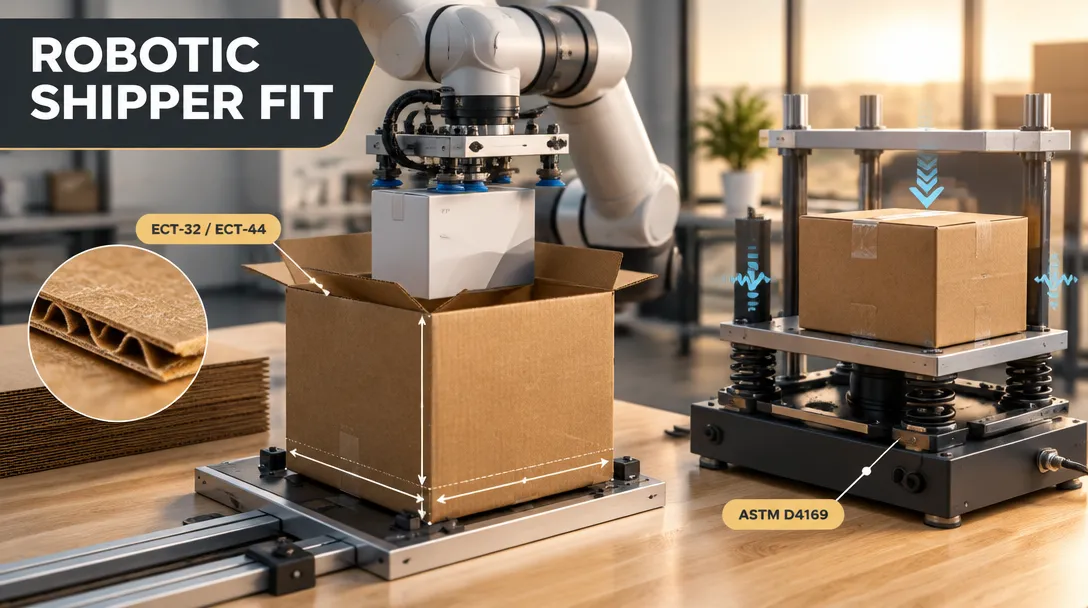
- Design the shipper around the robotic case packer’s permitted inside dimensions, loading path, and closure method; nominal product dimensions do not define a reliable case specification.
- Use ECT-32 or ECT-44 as a starting material specification only. Board construction, case geometry, humidity, stacking, and handling determine whether a packed shipper survives distribution.
- Validate the production-intent case with the actual product or representative mass and cushioning, using a distribution test plan such as ASTM D4169 or ISTA 3A as appropriate.
- For PACK EXPO deadlines under 48-72 hours, prioritize rapid CAD review and functional prototypes; protect fragile booth samples with engineered cushioning rather than relying on a stronger outer box alone.
Robotic packers need a controlled dimensional window
At PACK EXPO, sourcing teams often need a shipper that can move from a supplier conversation to a booth-ready sample on an exceptionally short schedule. That pressure makes dimensional fit and test planning immediate engineering issues: a case that jams a robotic packer or arrives with a damaged display sample can undermine a demonstration as surely as a late delivery. Start with measurable requirements—ASTM D4169 distribution hazards, ECT-32 or ECT-44 board options, packaging dimensions, cushioning, and the packed case’s freight profile.
Collect the machine maker’s permissible case-length, width, and height ranges, dimensional tolerances, blank presentation requirements, pickup and opening method, and sealing configuration. Confirm whether the machine references external or internal dimensions, and record how it detects, squares, and restrains a case. A case can meet a drawing’s nominal dimensions but still misfeed because board caliper, score position, flap spring-back, or squareness falls outside the machine’s actual operating window. Verify fit with a physical blank and a production-representative erected case, not CAD alone.
Translate product dimensions into internal case dimensions with clearance for insertion, protective components, and product variation. Then account for board thickness when deriving external dimensions. E, B, C, and BC flute constructions differ in caliper and stiffness; their actual values vary by supplier and specification, so obtain the converter’s board data rather than assigning a universal caliper. Confirm that the case remains compatible with downstream conveyors, pallet patterns, label placement, and automated scanning. Where molded pulp is used to locate fragile components, specify fit and dimensional tolerance with the supplier and verify that the actual molded part supports the product without excessive preload or movement.
Right-sizing also has a commercial consequence. Reducing unnecessary void can lower shipped cube and help avoid dimensional-weight charges or Amazon FBA dimensional freight penalties where applicable, but the smallest possible box is not automatically the lowest-cost design. Too little clearance can damage a product during insertion or transfer shock; too much clearance can permit impact and require more cushioning. Compare total landed packaging and freight cost against observed damage risk, packing speed, and material consumption.
Board strength is a starting point, not transit proof
ECT measures edgewise compressive resistance of corrugated board under a defined test method; it does not directly certify a complete shipping case for a particular distribution route. ECT-32 and ECT-44 are common board strength designations, but the suitable choice depends on case dimensions, stacking height, pallet pattern, storage duration, humidity, and converting quality. A larger shipper may buckle sooner than a compact one made from a similar board grade because panel dimensions and load paths matter.
For stacking assessment, use a case compression method such as ASTM D642 and incorporate the actual packed configuration. Consider how pallet overhang, uneven load distribution, and repeated handling change the expected load. For moisture exposure, evaluate the finished board and converting system; Cobb 60 water absorptiveness is relevant to paperboard moisture uptake, but it is not a stand-alone pass/fail guarantee against delamination or loss of case strength. If exposure is credible, specify performance needs with the converter and assess suitable coatings, adhesives, and board construction. Any PFAS-free barrier claim should be supported by supplier documentation and applicable market requirements, not inferred from a generic coating description.
Choose ASTM D4169 when the distribution cycle and assurance level can be defined for the shipment; use ISTA 3A where its packaged-product procedure matches the parcel distribution scenario. These protocols are not interchangeable checkboxes: select the sequence based on the actual shipping mode, handling, and package category. Define acceptance criteria before testing, including product damage, case opening, seal integrity, and functional condition. Condition samples consistently and document the test configuration, because a result from an empty case or a different cushioning layout does not validate the production pack.
For a fragile booth sample, engineer the whole system: retain the product, isolate it from case walls, prevent movement, and keep cushioning from interfering with insertion or robotic loading. A robust outer case cannot compensate for inadequate internal restraint. Conversely, oversized cushioning can push packed dimensions beyond the machine or parcel limits. Prototype with representative product mass, fragile features, inserts, and closure so that fit and transit protection are evaluated together.
Short deadlines reward disciplined prototyping
With booth setup less than 48-72 hours away, reduce decision latency without skipping critical verification. A useful first deliverable is a dimensioned CAD concept with board construction, scores, flap geometry, closure, insert layout, and the machine’s relevant fit limits. Rapid structural CAD prototyping can expose obvious interference and give the converter a clear basis for a short-run sample. TadaPack offers 24-48 hour structural CAD prototyping and zero tooling fee sampling; confirm current scope, sample availability, and shipping timing directly before relying on a deadline.
Do not treat a CAD rendering as evidence of transit performance. Use the prototype to check erection, loading, closure, handling, and display presentation; then test a production-intent configuration against the selected distribution protocol when the shipment risk warrants it. For a trade-show sample that cannot wait for a full test cycle, clearly distinguish an engineering fit check from formal distribution validation and document what remains unverified. This prevents a booth prototype from being mistaken for an approved shipping specification.
Short-run VIP or retail presentation boxes have a different cost structure from corrugated transit shippers. A high-end box can use printed wraps, specialty papers, inserts, or rigid construction, while protective transit packaging remains a separate layer. Ask suppliers to quote the actual short-run process and setup charges; zero tooling fee sampling can reduce the cost barrier to structural evaluation, but it does not imply that every print plate, finishing setup, or production operation is free. Keep display quality, protective function, and transit packaging requirements explicit in the brief.
For procurement, compare the complete landed design rather than board price alone: case and insert cost, setup, minimum order quantity, packing labor, freight cube, damage exposure, and replacement risk. TadaPack’s online calculation tools at https://tadapack.com/tools can support preliminary checks; validate assumptions against supplier specifications and the actual distribution profile.
Approve the specification against the real pack and route
Before release, connect the drawing, machine settings, board specification, packing method, and test plan in one controlled approval. State internal and external dimensions, dimensional tolerances, flute construction, ECT target, joint and closure details, and insert materials. Identify the applicable test protocol and acceptance criteria. Ensure the corrugated converter and co-packer are evaluating the same product orientation and packed configuration that will ship.
For robotic performance, verify case presentation and repeatability across representative samples, paying particular attention to squareness, score behavior, and closure. For distribution, test packed samples that reflect production materials and realistic product mass. If a design change affects dimensions, board, cushioning, closure, or pallet arrangement, assess whether it invalidates prior fit or transit evidence. Preserve the approved CAD and specification revision so that a rush reorder does not silently substitute a different construction.
**The reliable decision is not “use the strongest board”; it is “fit the machine, protect the product, and validate the packed shipper for its route.”** That principle is especially valuable at an expo, where deadlines are compressed but a damaged sample, unstable case, or misfeeding pack can consume more time than a disciplined prototype review.
Recommended Engineering Reading
[TOOLS] Featured Engineering & Calculation Tools
Explore 70+ Packaging Tools ➔Box Compression (BCT) Calculator
Predict box compressive limit and stacking safety factors via McKee formula.Edge Crush Test (ECT) Calculator
Calculate linerboard ring crush and composite ECT ratings for optimal board specs.
