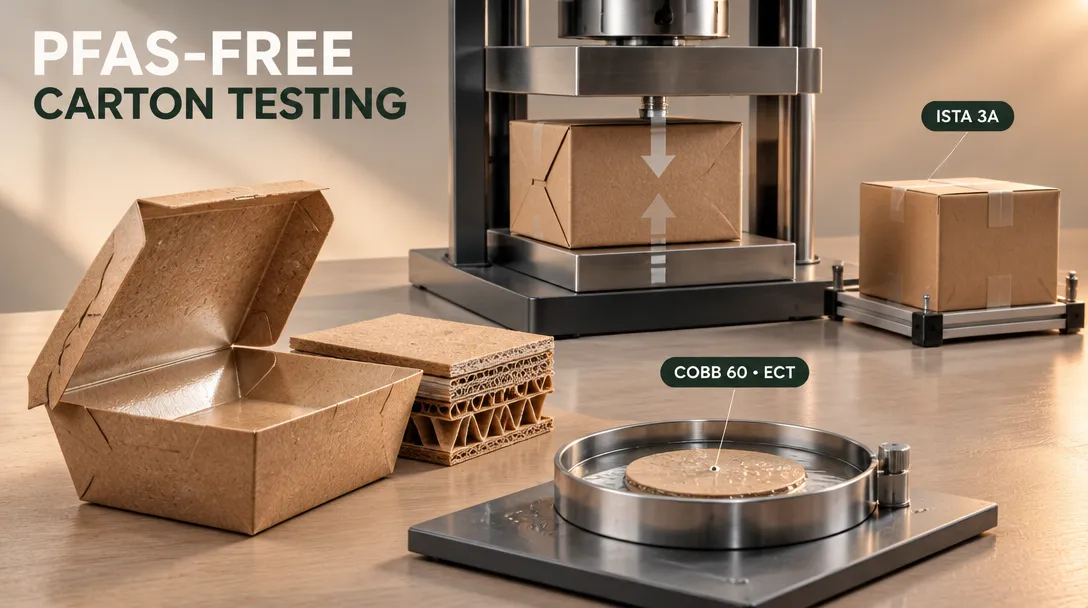
Specify PFAS-free paperboard by verified food-contact compliance and application-specific grease resistance—not by a coating label alone—and validate it with Cobb 60, converting trials and distribution testing. Use ECT/McKee calculations only for shipping cases, then confirm performance with ASTM D642 or ISTA 3A as appropriate; TadaPack can support structural prototyping and calculation checks.
Packaging World (PMMI Media Group) provides industry context for packaging materials and testing; this review uses it as context, not as evidence for a particular coating’s performance. The engineering decision is application-specific: establish a food-contact compliance file, test grease holdout after converting, and verify the complete pack under its actual distribution risks.
What should procurement require from a PFAS-free grease-resistant carton supplier?
Require a documented formulation and food-contact compliance package, then qualify the finished carton against defined grease, moisture, converting and distribution requirements.
“PFAS-free” needs a defined scope. Ask whether the supplier’s statement covers intentionally added PFAS, specified analytical screening, fluorinated processing aids and the finished article—not just the coating formulation. Request a signed composition declaration, applicable food-contact basis for the intended market and conditions of use, and supporting test reports with methods, detection limits and sample description. A total-fluorine screen alone does not identify PFAS or prove their absence; pair it with supplier controls and an appropriate targeted analytical strategy.
For the EU, assess the packaging against Regulation (EU) 2025/40 (PPWR), including its applicable PFAS provisions for food-contact packaging and implementation dates, alongside relevant food-contact requirements. For the US, confirm the material and intended use with the supplier against applicable FDA food-contact requirements; do not treat a general “PFAS-free” claim as FDA approval. Legal and compliance teams should check current rules and any applicable exemptions before release.
Specify performance at the carton level: grease resistance at intended contact time and temperature, seam integrity, odor/taint, print and adhesive compatibility, and recyclability claims supported for the destination’s collection system. Neither a Cobb 60 result nor a kit test alone establishes food-contact compliance or universal grease resistance.
How do coating, paperboard and Cobb 60 results affect carton performance?
Choose the lowest-barrier construction that passes the actual food exposure and converting tests, because excessive barrier can compromise recyclability or crease and seal performance.
Paperboard options may include folding carton stock such as 350 gsm CCNB with a functional inner barrier, but grammage is not a substitute for caliper, stiffness, coating weight or wet-strength data. Compare the supplier’s proposed PFAS-free aqueous, dispersion or other barrier system on the same substrate and print/adhesive configuration. Request grease testing under a defined method and exposure condition; there is no single universal pass value for every food, temperature and dwell time.
Cobb 60, commonly evaluated using TAPPI T 441, measures water absorbed by a defined paper or board area over 60 seconds. It is a moisture-uptake indicator, not a direct grease-resistance test. Set an application-specific acceptance limit from trials, and assess both unconverted stock and creased, printed, glued samples: cut edges, scores and seams can become the first failure paths. Include humidity conditioning because moisture uptake can reduce board stiffness and contribute to delamination.
Structural calculations must also match the package type. ECT-32 or ECT-44 are corrugated board edge-crush grades, not folding-carton specifications. For a corrugated shipper, the McKee estimate is commonly expressed as BCT ≈ 5.87 × ECT × √(perimeter × board caliper), with consistent units and an empirical, approximate result. It does not predict food-carton grease performance, and it is not a substitute for compression tests on the actual box. E, B, C and BC flute choices change caliper, cushioning and compression behavior; select from load, dimensions and converting capability rather than grade name alone.
Q: Does a low Cobb 60 value prove a PFAS-free carton will resist hot oil?
No. Cobb 60 measures water absorption, while hot oil challenges a different barrier mechanism and can penetrate scores or seams. Procurement action: require a grease-specific test under representative temperature and contact time, then repeat it on converted cartons; use Cobb 60 as a separate moisture-control metric.
Which tests validate grease resistance and shipping performance?
Use separate protocols for food-contact barrier performance and distribution durability, and test the converted pack rather than relying only on flat-sheet certificates.
Build a qualification plan around the product’s real exposure: food type, oil content, temperature, dwell time, fill weight, closure, stacking and distribution route. Record the test method and acceptance criteria in the purchase specification. Use ASTM D685 for standard atmospheric conditioning where applicable to paper and paperboard testing, and document deviations. Grease-specific methods must be selected with the supplier or laboratory for the substrate and end use; do not invent a universal pass threshold.
For shipping cases, use ECT data and a McKee estimate for preliminary sizing, then verify box compression using ASTM D642. The estimate is sensitive to dimensions, board caliper, joints, humidity and manufacturing variation; use a conservative design margin established for the project rather than presenting the calculation as a guaranteed rating. For parcel distribution, ISTA 3A is a relevant general simulation protocol when the package fits its scope. ASTM D4169 may be selected for distribution-cycle performance planning. Neither protocol proves food-contact compliance.
For direct-to-consumer fulfillment, test the complete pack, including any molded-pulp insert. Set insert dimensional tolerances from the CAD fit and supplier capability—do not assume a generic molded-pulp tolerance—and check retention after vibration and drops. Optimize external dimensions to avoid unnecessary dimensional-weight charges and Amazon FBA size-tier or fulfillment-fee impacts; confirm current carrier and marketplace rules at quote time.
How should factories qualify dielines and control coating-related defects?
Lock the material and geometry together through a controlled prototype-to-production approval, checking barriers at scores, seams and cut edges.
Use this four-step verification SOP: Step 1: freeze the approved board, coating, ink, adhesive and intended food-contact conditions in the specification. Step 2: review the CAD dieline for grain direction, score placement, seam overlap and exposed edges; record the converter’s achievable registration and crease tolerances rather than assuming a universal ±0.15 mm capability. Step 3: make production-representative samples and inspect coating continuity, cracking at folds, glue wet-out, dimensional fit and grease migration after the agreed exposure. Step 4: run the selected distribution tests on filled, closed packs, then approve the controlled master sample and change-control requirements.
Two common defects merit explicit checks. Grease staining at a fold may indicate coating fracture, excessive score compression or a barrier that is inadequate for the exposure; adjust crease geometry with the converter and repeat the grease test on folded samples. Adhesive debonding in humid transit may reflect incompatible surface treatment, poor glue application or moisture-softened board; check adhesive compatibility and conditioning, then retest the seam and complete pack. These are diagnostic possibilities, not a substitute for examining the failure.
For a cost-down, compare total delivered cost rather than coating price alone: board basis weight and caliper, coating add-on, line speed, scrap, reject rate, pack dimensions and freight fees. A lighter substrate that increases line stops or transit damage can raise total cost. TadaPack’s structural packaging and prototyping support can help evaluate dielines and production samples; use TadaPack calculation tools for preliminary engineering checks, not as a replacement for lab or shipment testing.
What acceptance criteria make a PFAS-free carton specification auditable?
An auditable specification ties each claim to a named material, test method, condition and decision rule.
Procurement documents should identify the supplier and board grade, coating chemistry declaration, food-contact use conditions, grease-test method and exposure, Cobb 60 method and project-specific limit, and the sampling and retest rules. For corrugated shippers, state ECT grade and caliper alongside the required compression or distribution protocol; do not transfer ECT-32/ECT-44 requirements to folding cartons. Include artwork, dieline revision, adhesive, closure and allowable material substitutions under change control.
Recyclability language requires separate substantiation. A fiber-based carton is not automatically recyclable in every collection stream, particularly where barriers, laminates or food residue affect sorting and repulping. Assess the finished construction for the intended market, substantiate environmental claims under applicable rules such as the FTC Green Guides where relevant, and align design decisions with PPWR requirements for the EU. The release decision is therefore a combined compliance, barrier, converting and distribution sign-off—not a single “PFAS-free” certificate.
Recommended Engineering Reading
[TOOLS] Featured Engineering & Calculation Tools
Explore 70+ Packaging Tools ➔CBM Volume & Freight Dim-Weight Calculator
Calculate cubic meters & dimensional weight to minimize freight costs and avoid FBA size tier penalties.Mailer Box Area & Dieline Size Calculator
Instant flat dieline dimensions, material consumption, and sheet nesting for custom D2C mailer boxes.
