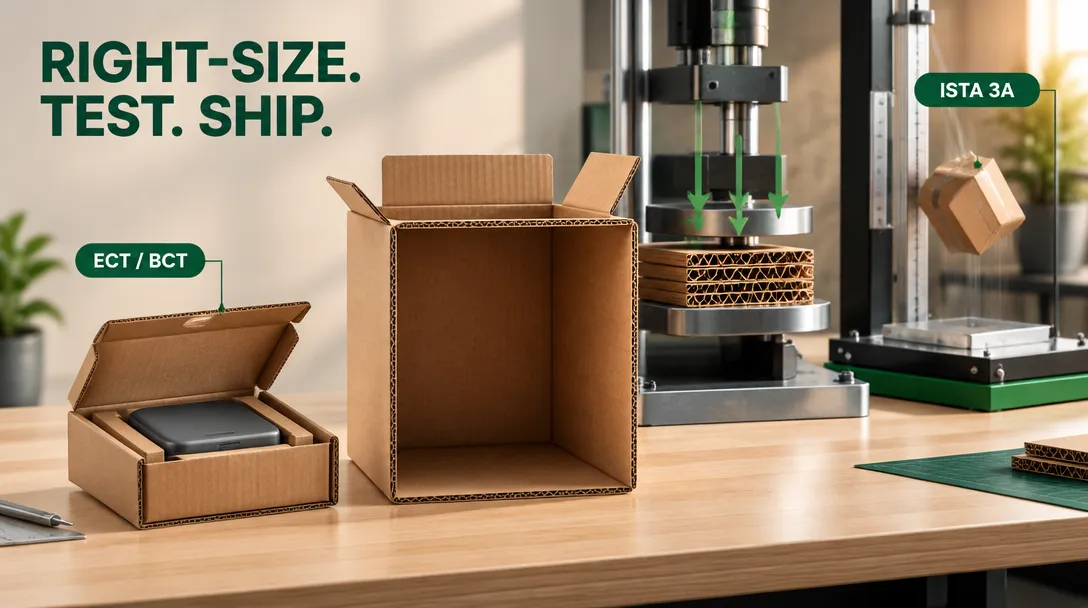
SPC provides industry context for packaging sustainability; it is not a substitute for product-specific distribution testing. This review translates the right-sizing objective into engineering decisions for e-commerce parcels, where excess package volume can increase material use, handling burden, and exposure to dimensional-weight charges.
- Right-sizing means designing for measured product dimensions, protective clearances, restraint and manufacturing tolerances—not simply choosing the smallest carton.
- ECT-32 and ECT-44 are board edge-crush ratings, not guaranteed finished-box compression values; verify the assembled package with ASTM D642.
- Use the McKee relationship as a screening estimate, then validate the actual product-package system under ISTA 3A or an appropriate distribution test plan.
- Compare total delivered cost, including board, void fill, pack labor, damage exposure and dimensional freight—not carton price alone.
Right-sizing removes avoidable volume only when protection is engineered
Void fill is a symptom, not a design specification. It can compensate for an oversized shipper, but it can also restrain a product, absorb impact, or prevent movement. Removing it without replacing its function can increase product-to-wall contact, edge loading or damage. Start by documenting the product’s maximum packed dimensions, mass, center of gravity, fragile surfaces and allowable movement. Include actual production variation, not nominal CAD dimensions alone.
Build a pack architecture around the product: close-fitting corrugated partitions, a paper-based wrap, folded inserts, or molded pulp can control movement while reducing empty cube. E-, B- and C-flute constructions have different calipers and cushioning behavior; BC double-wall can add stiffness but is not automatically the most efficient answer. For premium printed packs, 350 gsm CCNB may provide a printable face, but it is not a substitute for a corrugated shipping structure. Specify board by performance, flute, caliper and converting capability together.
Model the internal dimensions from product envelope plus protective clearance and insert thickness. Then translate them into the dieline, accounting for score locations, board caliper, flap geometry, glue area and converting tolerances. A nominally tight fit can become an interference fit after board variation or humidity changes. Conversely, excessive allowance recreates the void that right-sizing was intended to remove. Obtain a factory CAD dieline and production-intent prototype before committing a large run.
Strength calculations screen designs but do not replace parcel testing
Edge crush strength measured using TAPPI T 811 characterizes a corrugated board’s resistance to edgewise compression. ECT-32 and ECT-44 identify nominal performance classes in customary units; actual supplied-board values, construction and conditioning matter. Box compression strength (BCT) is the load capacity of a completed box under compression. ASTM D642 provides a container compression test method. Do not equate an ECT rating with a finished-carton BCT guarantee.
The McKee equation relates ECT, box perimeter and board caliper to an estimated BCT. Its commonly used form is an empirical estimate whose unit conventions and coefficients must be checked; it does not capture every design detail, converting defect, humidity condition or load eccentricity. Apply a safety margin for stacking duration, warehouse conditions, pallet pattern and expected top load. Treat the calculation as a candidate-screening tool, then test representative finished boxes. ASTM D685 atmospheric conditioning can help standardize paper and paperboard test specimens; specify the applicable conditioning procedure and laboratory conditions in the test plan.
Right-sizing can improve compression efficiency by reducing unsupported panel span, but a smaller footprint can also reduce perimeter and change BCT. A taller carton may have different panel buckling behavior than a shorter one with the same volume. Measure caliper consistently, specify flute and board grade, and account for score quality and joint integrity. For moisture-sensitive routes, assess water absorption using Cobb testing, such as TAPPI T 441 (Cobb 60 where the 60-second exposure is specified), and check whether coating or adhesive choices compromise recycling pathways. PFAS-free barrier options should be confirmed with supplier documentation and end-market requirements.
ISTA 3A is a general simulation test protocol for packaged products shipped through parcel delivery systems. Use it to evaluate the complete pack—including product, insert, closure and shipper—against the relevant hazards and configuration. ASTM D4169 can support a distribution-cycle evaluation where appropriate. Select the protocol with the test lab and customer requirements; neither standard guarantees zero damage in every actual network.
Q: If McKee estimates BCT from ECT, why require a compression test?
Answer: First, McKee gives a screening estimate, not a verified production-box result. Second, the estimate cannot fully represent score weakening, joints, humidity, print/converting variation or off-center loading. Third, use it to compare concepts, then test production-intent samples under ASTM D642 and confirm parcel protection under the agreed ISTA 3A plan.
Procurement should optimize total cost per protected shipment
A smaller carton can reduce board area and dimensional-weight exposure, but savings depend on the carrier’s pricing rules, pack configuration, shipment zone and billable-weight calculation. Measure the packed outer dimensions—not just the product or internal carton dimensions—and model the carrier’s current rules for each destination. Do not assume a change in cube automatically changes the billed tier. For Amazon FBA, confirm the applicable dimensional and fee rules directly against current program documentation before approving a design; thresholds and fees can change.
Use a cost-down model with comparable assumptions: carton and insert material, void-fill consumption, pack time, storage cube, freight charge, damage/returns allowance, and tooling or changeover cost. For example, a hypothetical comparison should price the baseline and right-sized design using the same shipment mix and carrier rates, then report cost per successful delivery. A lower packaging BOM can lose commercially if the new pack adds labor or damage exposure. Do not describe an untested design as a proven savings or protection result.
For US and European buyers, include end-of-life and regulatory review alongside strength. EU PPWR, Regulation (EU) 2025/40, establishes packaging and packaging-waste requirements, including waste prevention and recyclability obligations as applicable under its implementation provisions. Review the actual market, packaging category and applicable dates with compliance counsel; do not claim a particular design is compliant solely because it uses paper. In the US, FTC Green Guides (16 CFR Part 260) require substantiation for environmental marketing claims. Document material composition, coatings, separability and the basis for any recyclability claim.
Convert the concept into a controlled production specification
Use this four-step verification SOP to keep right-sizing from becoming an uncontrolled reduction in protection:
- Step 1 — Measure: Record product dimensions and mass across representative production units; define the maximum envelope, fragile zones and permitted movement. Set clearance from validated prototype trials rather than an assumed universal gap.
- Step 2 — Engineer: Create CAD dielines for the shipper and insert; document board grade, ECT target, flute, caliper, joint and closure. Set factory-specific dimensional and registration tolerances based on converter capability, and verify them on the approved drawing.
- Step 3 — Prototype: Build production-intent samples and inspect fit, insertion force, closure, score cracking, adhesive bond and pack time. Check caliper with a calibrated micrometer and record results against the agreed specification; do not substitute a hand sample for production validation.
- Step 4 — Validate and release: Test compression and distribution performance using the agreed ASTM D642 and ISTA 3A or other applicable protocol. Record configuration, conditioning, pass criteria and change-control triggers; repeat validation when material, dimensions, closure or product mass changes materially.
TadaPack can support custom structural packaging, CAD dieline development and short-run prototyping so teams can evaluate fit and manufacturability before production tooling or volume commitments. Use TadaPack calculation tools to support preliminary packaging calculations, then have the selected construction verified with representative samples and an agreed test laboratory. The engineering decision is not “remove all fill”; it is “remove unnecessary volume while preserving a tested restraint and protection system.”
Recommended Engineering Reading
[TOOLS] Featured Engineering & Calculation Tools
Explore 70+ Packaging Tools ➔CBM Volume & Freight Dim-Weight Calculator
Calculate cubic meters & dimensional weight to minimize freight costs and avoid FBA size tier penalties.Mailer Box Area & Dieline Size Calculator
Instant flat dieline dimensions, material consumption, and sheet nesting for custom D2C mailer boxes.
