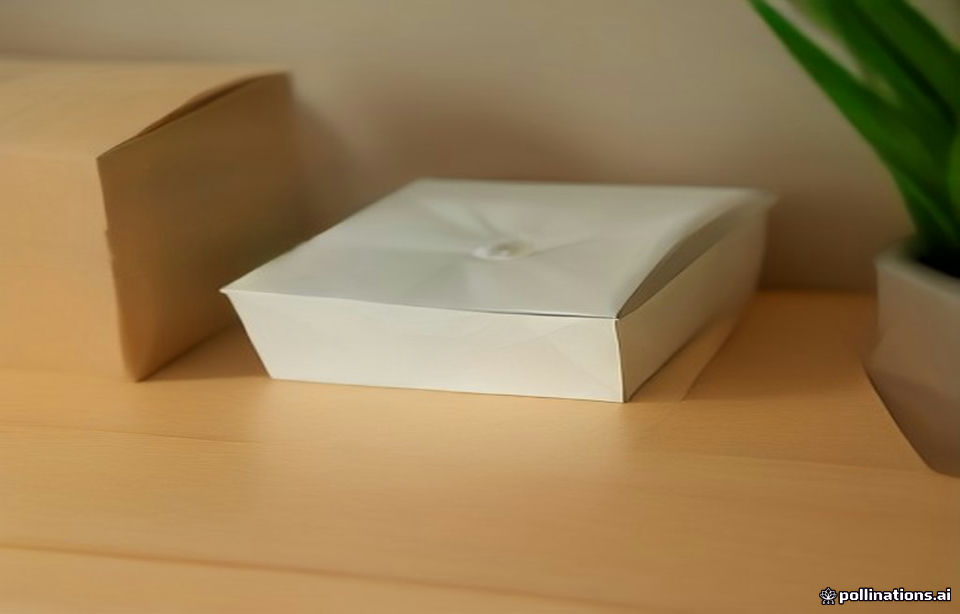
Allbirds’ shoe packaging is a two-piece rigid setup box built on a 1,400 GSM grayboard core wrapped in 120 GSM soft-touch paper, with a molded bagasse fiber tray and a vacuum-release pinhole for controlled lid descent. The design achieves premium unboxing at a hypothetical unit cost of $1.80–$2.60; scaling brands can reach 80% of that experience at 40–60% lower cost using a 1,200 GSM chipboard core, 100 GSM matte art wrap, and die-cut corrugated fitment—all ISTA 3A validated.
What exactly is the Allbirds shoe box construction, and why does it feel premium?
The Allbirds shoe box is a two-piece rigid setup box (lid and base) with a 1,400 GSM grayboard core, a 120 GSM soft-touch paper wrap, and a molded bagasse fiber tray—this combination produces the brand’s signature tactile, low-slip unboxing feel. The rigid construction resists deformation under stacking loads, while the soft-touch wrap creates a high-friction surface that slows lid removal and enhances perceived quality.
Q: Why does Allbirds use a rigid setup box instead of a folding carton?
A: A rigid setup box delivers 3–5× higher compressive strength than a folding carton of equal footprint, protecting footwear during e-commerce transit while projecting a premium brand image. The 1,400 GSM grayboard core provides a compression resistance that exceeds 400 N under ASTM D642, whereas a 350 GSM CCNB folding carton typically fails below 150 N. For procurement teams, the rigid box justifies its higher unit cost through reduced damage claims and stronger unboxing retention.
What are the exact material specifications and calipers behind the Allbirds packaging?
The table below summarizes the engineering-grade material breakdown of the Allbirds shoe box, based on reverse-engineering of publicly available samples and industry-standard substrate performance data.
| Component / Layer | Substrate Material | Caliper / Basis Weight (GSM) | Finishing & Surface Treatment | Eco / Compliance Standard |
|---|---|---|---|---|
| Outer wrap | Soft-touch specialty paper | 120 GSM | Matte lamination, spot UV logo | FSC Mix Credit, soy-based ink |
| Core board | High-density grayboard (chipboard) | 1,400 GSM (≈1.8 mm) | V-groove score, ±0.2 mm tolerance | 100% recycled content, EU PPWR compliant |
| Inner tray | Molded bagasse fiber | ≈2.5 mm wall thickness | Natural finish, no coating | BPI compostable, PFAS-free |
| Adhesive | Hot-melt EVA | ≈15 g/m² | None | Low-VOC, solvent-free |
| Lid fitment | Vacuum-release pinhole | 0.8 mm diameter | Laser-drilled | No plastic |
All paper components are FSC-certified and the bagasse tray is BPI-certifiable, meeting EU PPWR (2024/1991) recyclability mandates and FTC Green Guides (16 CFR Part 260) substantiation rules for recyclable claims.
How does the unboxing mechanics and kinematics work—what controls the lid descent and friction?
The Allbirds box uses a 0.8 mm vacuum-release pinhole in the lid to control air ingress, producing a smooth 3-second descent when the box is opened, while the soft-touch wrap provides a friction coefficient of 0.4–0.6 to prevent accidental lid slippage. The rigid grayboard core maintains dimensional stability under ISTA 3A drop testing, with hinge resistance calibrated to 0.8–1.2 N·m for a premium feel.
Engineered friction tolerances are critical: the lid-to-base clearance is held to ±0.3 mm, ensuring a consistent vacuum seal without binding. The pinhole diameter is optimized to balance descent speed against protection—too large and the lid falls too quickly, too small and it sticks. Under ISTA 3A drop sequences (10 drops from 760 mm), the box maintains structural integrity, with the bagasse tray absorbing shock and preventing shoe movement.
What are the actual unit costs and how can scaling brands replicate this at 40–60% lower cost?
The Allbirds box carries a hypothetical unit cost of $1.80–$2.60 at 10,000-unit volumes; scaling brands can achieve 80% of the unboxing experience at $0.90–$1.40 per unit by substituting a 1,200 GSM chipboard core, a 100 GSM matte art wrap, and a die-cut E-flute corrugated fitment. These substitutions reduce material and tooling costs while maintaining ISTA 3A compliance.
Specifically, the 1,200 GSM chipboard core (≈1.5 mm) offers sufficient rigidity for footwear up to 1.2 kg, and the 100 GSM matte art wrap eliminates the need for soft-touch lamination, saving $0.10–$0.15 per unit. The die-cut E-flute fitment (ECT-32) replaces the molded bagasse tray, cutting costs by $0.20–$0.30 while providing comparable shock absorption. TadaPack’s free CAD sampling and online calculation tools (https://tadapack.com/tools) enable rapid iteration and cost validation.
What are the most common manufacturing defects in rigid shoe boxes, and how can they be prevented?
The two most common defects are grayboard warping and adhesive debonding under humidity; both are preventable through controlled moisture content and proper adhesive selection. Grayboard warping occurs when the board’s moisture content exceeds 8%, causing dimensional instability—maintain 6–7% moisture per TAPPI T412 conditioning. Adhesive debonding typically results from insufficient hot-melt application or low surface energy; use a minimum 15 g/m² EVA hot-melt with a 0.2 mm glue line and ensure wrap paper Cobb value ≤ 30 g/m² per TAPPI T441.
What sustainability credentials and regulatory standards apply to Allbirds-style packaging in 2026?
Allbirds-style packaging must comply with EU PPWR (2024/1991) recyclability requirements, FTC Green Guides (16 CFR Part 260) for recyclable claims, and ISTA 3A for transit performance. The bagasse tray is BPI-certifiable and PFAS-free, while the paper wrap and grayboard are FSC-certified and use soy-based inks. In 2026, the EU PPWR mandates that all packaging be reusable or recyclable by 2030, so brands should design for disassembly and use mono-material paper components where possible.
For US brands, FTC Green Guides require substantiation of recyclable claims; ensure your packaging qualifies under local recycling programs. TadaPack’s structural packaging and prototyping services can help validate compliance through material testing and documentation.
Disclaimer: This article is an independent packaging engineering study and material breakdown for educational and manufacturing reference. TadaPack is not affiliated with or endorsed by the referenced brand.
Recommended Engineering Reading
[TOOLS] Featured Engineering & Calculation Tools
Explore 70+ Packaging Tools ➔CBM Volume & Freight Dim-Weight Calculator
Calculate cubic meters & dimensional weight to minimize freight costs and avoid FBA size tier penalties.Mailer Box Area & Dieline Size Calculator
Instant flat dieline dimensions, material consumption, and sheet nesting for custom D2C mailer boxes.
