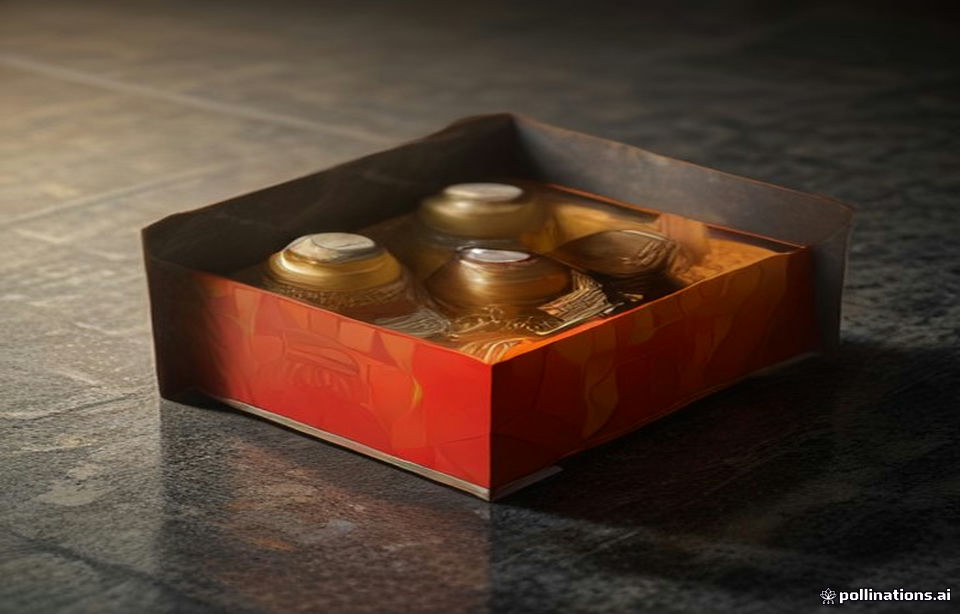
Premium spirits and wine gift packaging fails primarily at the bottle-to-cradle interface and through moisture-driven board softening during ocean transit. A validated design pairs a 2.0–2.5 mm molded pulp or 350 gsm CCNB wrapped rigid cradle with an ECT-44 outer shipper, verified to ISTA 3A and ASTM D642, to keep compressive and drop shock within tolerance.
- Bottle-cradle clearance below 1.5 mm is the single largest cause of transit breakage in premium spirits gift sets.
- ECT-44 outer shippers outperform ECT-32 by roughly 35% in BCT under humid conditions typical of 30-day ocean transit.
- Molded pulp cradles require 2.0–2.5 mm wall thickness and ±0.5 mm dimensional tolerance to survive ISTA 3A drop sequences.
- PFAS-free barrier coatings must be validated for Cobb 60 water absorption below 35 g/m² to prevent delamination.
- Rigid gift boxes with 350 gsm CCNB wrap and 2.0 mm greyboard core balance premium hand-feel with PPWR recyclability.
Why premium spirits gift sets fail in transit before they ever reach the shelf
The global premium spirits and fine wine market continues to shift toward DTC and cross-border e-commerce, and with it the packaging engineer’s problem set has changed. A gift set that leaves a European distillery in perfect condition must survive multi-leg parcel networks, 30-day ocean transit, and the final-mile drop onto a consumer doorstep. The dominant failure modes are not cosmetic: they are structural. Bottle-to-cradle clearance, board moisture uptake, and compressive creep under stacked loads account for the majority of transit claims in this vertical. This teardown dissects a representative premium spirits gift set architecture, isolates the structural bottlenecks, and extracts the engineering principles that procurement directors and DTC brand owners can apply to their own programs.
Teardown of the rigid gift box and molded pulp cradle architecture
A typical premium spirits gift set is a two-part system: an outer rigid gift box and an internal bottle cradle. The rigid box is built from a 2.0 mm greyboard core wrapped in 350 gsm CCNB (coated clay news back) or a specialty textured paper. The cradle is either molded pulp (wet-press or dry-press) or a thermoformed PETG insert. For recyclability under EU PPWR (2024/1991), molded pulp is strongly preferred; PETG inserts trigger sorting and recyclability penalties.
| Component | Typical Specification | Reference Tolerance | Governing Standard / Test Protocol |
|---|---|---|---|
| Rigid box greyboard core | 2.0 mm, 1200 gsm | ±0.10 mm caliper | TAPPI T411 |
| CCNB wrap | 350 gsm | ±5% basis weight | TAPPI T410 |
| Molded pulp cradle wall | 2.0–2.5 mm | ±0.5 mm dimensional | ISTA 3A drop sequence |
| Outer shipper ECT | ECT-44 (BC flute) | ≥44 lb/in edge crush | TAPPI T811 / ASTM D642 |
| Barrier coating | PFAS-free, water-based | Cobb 60 < 35 g/m² | TAPPI T441 |
The critical interface is the bottle-to-cradle fit. A clearance greater than 1.5 mm allows the bottle to accelerate before impact during a drop, concentrating shock at the shoulder or base. A clearance below 0.5 mm risks scuffing the label and makes insertion ergonomically difficult. The design target is a nominal 1.0 mm radial clearance with a ±0.5 mm molded pulp tolerance, which keeps the bottle captured without pre-loading the glass.
How material selection and moisture management determine survival
Corrugated board loses compressive strength as moisture content rises. Under ISO 186 conditioning (23°C ± 1°C, 50% ± 2% RH), an ECT-44 BC-flute shipper performs predictably. But during a 30-day ocean transit, container sweat and ambient humidity can push board moisture content from 8% to 14%, degrading BCT by 30–40%. The engineering response is twofold: specify a moisture-resistant coating or liner, and derate the BCT calculation by at least 35% for ocean-freight programs. For the rigid gift box itself, the greyboard core is less moisture-sensitive than corrugated, but the CCNB wrap can cockle if applied with a water-based adhesive at high coat weight. Adhesive coat weight should be controlled to 12–18 g/m² and the wrapped board conditioned before assembly.
PFAS-free barrier coatings are now mandatory for EU-bound programs. A water-based acrylic coating achieving Cobb 60 below 35 g/m² provides adequate grease and moisture resistance for spirits gift sets without compromising repulpability. Coatings that exceed 35 g/m² Cobb risk delamination at the fold line after 48 hours at 85% RH.
Q: If the McKee formula derives BCT from ECT, why do overseas enterprise POs still mandate Mullen burst testing?
A: Mullen burst (TAPPI T810) remains a procurement requirement because it correlates with resistance to puncture and handling damage, which ECT does not capture. ECT governs stacking strength; Mullen governs rough-handling survivability. The practical recommendation is to specify both: ECT-44 for BCT and a minimum Mullen burst of 275 psi for the outer shipper, with both values verified on the same lot.
Process controls that close the tolerance gap on the line
The gap between a CAD-approved design and a production-ready gift set is closed by four process controls. First, the dieline must be verified against the bottle’s actual 3D scan, not the nominal drawing; glass molds vary by ±0.8 mm across cavitation. Second, molded pulp tooling must be validated with a first-article inspection at ±0.5 mm dimensional tolerance across the cradle cavity. Third, the rigid box wrap adhesive must be applied at controlled coat weight and the box pressed at 0.3–0.5 MPa to prevent bubble formation. Fourth, the assembled gift set must pass ISTA 3A drop and vibration sequences before production release.
- Step 1 – Bottle scan and dieline reconciliation: 3D-scan three bottles from different cavities; reconcile cradle cavity to ±0.5 mm.
- Step 2 – First-article inspection: Measure cradle wall thickness (2.0–2.5 mm) and radial clearance (1.0 mm ±0.5 mm) on five samples.
- Step 3 – Wrap and press validation: Verify adhesive coat weight 12–18 g/m² and press pressure 0.3–0.5 MPa; inspect for cockling after 24-hour conditioning.
- Step 4 – ISTA 3A protocol: Run drop, vibration, and compression sequences per ISTA 3A; confirm no bottle breakage and no cradle cracking.
TadaPack’s online calculation tools allow engineers to model BCT from ECT inputs and apply moisture derating factors before committing to tooling. For teams developing a new gift set architecture, TadaPack’s custom structural packaging and prototyping service provides dieline development, molded pulp tooling, and ISTA 3A pre-validation.
What procurement and brand teams should borrow from this teardown
The lessons from this structural teardown are transferable to any premium gift packaging program. First, treat the bottle-to-cradle interface as a precision fit, not a cosmetic detail: specify 1.0 mm nominal radial clearance and validate with a first-article inspection. Second, derate BCT by 35% for ocean transit and specify ECT-44 rather than ECT-32 for any program crossing a major trade lane. Third, move to PFAS-free barrier coatings with Cobb 60 below 35 g/m² and verify repulpability against EU PPWR requirements. Fourth, build ISTA 3A validation into the development timeline rather than treating it as a final gate. Finally, use a worked example to size the outer shipper: for a 1.5 kg bottle plus 0.4 kg gift box and cradle, a total shipped weight of 1.9 kg with a 200 mm × 120 mm × 320 mm shipper requires an ECT-44 BC-flute board to maintain a safety factor above 3.0 under 35% moisture derating.
Assumed inputs: bottle mass 1.5 kg, gift box and cradle 0.4 kg, shipper footprint 200 mm × 120 mm, stack height 6 boxes. Required BCT = safety factor 3.0 × (1.9 kg × 6 × 9.81 m/s²) ÷ 1000 ≈ 0.34 kN. Applying a 35% moisture derating, the dry BCT target becomes 0.52 kN. An ECT-44 BC-flute shipper typically delivers BCT in the 4–6 kN range for this footprint, providing a comfortable margin. This example is illustrative only and must be replaced with project-specific testing per ASTM D642.
Procurement directors should also note that Amazon FBA dimensional freight penalties apply to any gift set whose packaged dimensions exceed tier thresholds. Designing the shipper to fit within the 18 × 14 × 8 inch tier avoids oversize penalties and reduces dimensional weight charges. Combined with ECT-44 board and a validated cradle, this approach reduces transit claims while keeping unit cost predictable.
Recommended Engineering Reading
[TOOLS] Featured Engineering & Calculation Tools
Explore 70+ Packaging Tools ➔Box Compression (BCT) Calculator
Predict box compressive limit and stacking safety factors via McKee formula.Edge Crush Test (ECT) Calculator
Calculate linerboard ring crush and composite ECT ratings for optimal board specs.
