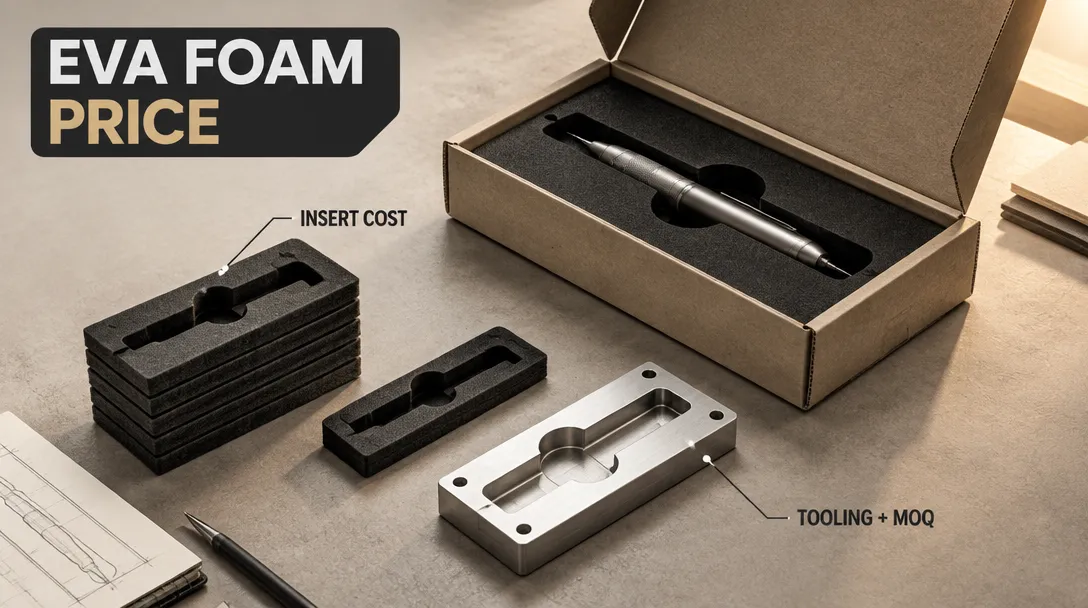
As a planning reference, straightforward custom EVA foam inserts may cost about $0.60–$2.50 each at higher volumes, while low-volume CNC-machined or complex parts can be about $3–$12 or more. These are indicative estimates rather than live quotes; dimensions, density, conversion method, order quantity, finishing, and freight drive the final price.
EVA foam price is not a reliable standalone material-price question: buyers usually purchase a converted part, not raw foam by weight. For procurement comparisons, specify the finished insert geometry, material properties, annual demand, and delivery terms, then separate one-time setup charges from recurring unit cost. The ranges below are broad US and European planning references, not supplier quotations or measured market transactions.
Custom EVA foam inserts can range from cents to double-digit dollars per piece
For a simple, flat, die-cut insert ordered in a commercially efficient quantity, use approximately $0.60–$2.50 per piece as an initial budgeting range. A low-volume CNC-cut insert may be approximately $3–$12 or more per piece because machine time and setup are spread over fewer parts. Deep cavities, multiple foam layers, adhesive lamination, tight cosmetic requirements, and protective cases can move a design above those ranges.
These estimates assume a custom converted part, not a complete retail carton, tax, or expedited delivery. They can vary substantially between suppliers and regions. Confirm whether the quote includes foam, cutting, finishing, packaging, tooling, sampling, and freight. Request a quote at more than one quantity; the unit-price curve can change sharply as setup and nesting costs are amortized.
| Configuration | Indicative unit-price range | Typical cost behavior | Governing standard / test protocol |
|---|---|---|---|
| Simple flat die-cut insert | $0.60–$2.50 at higher volumes | Material and sheet yield dominate; tooling or setup may be separate | ASTM D3575 for applicable olefin foam property tests; confirm method with supplier |
| Low-volume CNC-cut insert | $3–$12 or more | Programming, machine time, and handling have greater per-piece impact | ASTM D3575 for applicable foam properties; dimensional acceptance agreed on drawing |
| Layered or complex assembly | Quote to specification; may exceed the ranges above | Lamination, multiple operations, tight fit, and cosmetic finish add cost | ASTM D4169 where distribution performance testing is appropriate |
The table’s ranges are reference values for early budgeting, not guaranteed 2026 spot prices. Foam grade, country of manufacture, currency, order quantity, and supplier capacity all affect quotes. ASTM D3575 covers test methods for flexible cellular materials made from olefin polymers; ask the supplier to identify the applicable method and report the material properties relevant to the design. ASTM D4169 can be used to evaluate shipping-container performance under a defined distribution cycle, but it does not prescribe an EVA price or guarantee a particular insert design.
Material, conversion, and setup make up the finished part cost
A practical cost model separates the foam blank from the operations that turn it into a usable component. Raw stock cost depends on the foam’s density, thickness, grade, color, and sheet or block dimensions. Density is a key purchasing variable, but it is not a substitute for performance specification: a design should also consider compression response, recovery, fit, and the product’s sensitivity to shock. Specify a property requirement and test method rather than simply asking for the “firmest” foam.
Conversion cost covers cutting, machining, cavity removal, and part handling. Die cutting can be economical for repeatable profiles at sufficient volume, but a die or other setup charge may apply. CNC routing avoids a cutting die for many geometries and can suit prototypes or shorter runs, though machine time can make each part more expensive. Complex pockets, narrow walls, deep features, and features requiring multiple passes can increase cycle time and scrap risk.
Finishing and assembly include adhesive lamination, fabric or film facing, color matching, printing, and packing. Each operation adds labor, inspection, and sometimes material yield loss. The final quote may also include protective packaging, freight, import costs, and currency or minimum-order conditions. Ask suppliers to itemize nonrecurring engineering or tooling separately from recurring part price so that a low unit quote does not conceal a large initial charge.
For a planning model, the cost-breakdown illustration below allocates 100% of a hypothetical converted-part price across material (40%), conversion (30%), setup and tooling (15%), finishing (10%), and packing (5%). These shares are an illustrative allocation, not an industry measurement or a prediction for any specific order; a CNC prototype, for example, can have a much higher conversion share.
Assume a hypothetical 1,000-piece order has a quoted recurring price of $2.00 per insert, plus a separate $300 setup charge. Recurring parts total 1,000 × $2.00 = $2,000; including setup, the order totals $2,300 before freight and taxes, or $2.30 per piece when the setup is allocated across the order. At 5,000 pieces with the same hypothetical setup charge and unit price, the allocated setup becomes $0.06 per piece, giving $2.06 each before freight and taxes. This arithmetic demonstrates amortization only; actual supplier pricing may change with quantity.
When comparing quotations, align the specification and commercial basis: identical CAD geometry, foam grade, color, tolerances, quantity, incoterm, and included operations. Otherwise, a nominally cheaper offer may be based on a thinner sheet, fewer cavities, a different density, or excluded setup and freight.
Geometry, density, order size, and process move the quote
Part volume and material utilization matter more than the outside dimensions alone. A thick insert with deep pockets consumes more foam and can generate more scrap than a flat profile. Nesting parts efficiently on a standard sheet reduces offcut, while an unusual blank size or tight grain-orientation requirement can limit yield. Ask for the proposed sheet layout or a yield assumption when material cost is a significant share of the quote.
Density and grade affect stock cost and functional behavior. The right selection depends on the product’s mass, fragility, retention needs, and expected handling. Very tight cavities can raise machining time and increase the risk of difficult loading or removal; overly loose cavities can allow movement and reduce protection. Use CAD prototypes to verify fit before committing to production tooling. TadaPack’s custom structural packaging and prototyping services can help coordinate insert geometry with the outer package and product presentation.
Order quantity changes both setup allocation and manufacturing efficiency. A larger order can reduce the per-piece impact of programming, tooling, and setup, but it does not guarantee a lower price if the foam grade, process, or delivery requirements change. Conversely, a short run may justify CNC conversion over a die when avoiding a dedicated tool offsets the higher machine time. Compare the total cost at realistic first-order and annual volumes, including storage and inventory exposure.
Finish requirements can be a hidden cost driver. Laminated layers, adhesive bonding, multiple colors, clean cosmetic edges, and individually wrapped parts add handling or inspection. If the insert ships internationally, include protective packing and transit cost in the landed-cost comparison. For products sold through Amazon FBA, assess the assembled package’s external dimensions: dimensional freight charges are determined by the shipping package, not merely by the foam insert’s unit price.
For 2026 market access planning, treat packaging rules as a design input rather than assuming an EVA insert has a universal recyclability status. EU PPWR (Regulation (EU) 2024/1991) introduces packaging requirements with implementation details and applicable dates that should be checked for the specific market and packaging format. Confirm current obligations with qualified regulatory counsel or the relevant authority; do not infer compliance from a supplier’s material name alone.
Design and procurement choices can reduce total cost
Start with the functional requirement and remove cost that does not support it. Reduce unnecessary thickness, simplify cavity geometry, combine parts where loading and serviceability allow, and avoid cosmetic finishes that do not improve protection or brand requirements. Do not reduce density or wall thickness without reviewing product retention and distribution performance; material savings that increase damage risk can increase total supply-chain cost.
Ask the converter to compare die cutting and CNC machining at your planned quantities, and request separate prices for prototype, initial production, and repeat orders. Standardize foam thicknesses and colors across product families where feasible. Allow practical clearances and tolerances based on the product and conversion method rather than imposing precision requirements that the package does not need. Confirm tolerances on the drawing and agree how parts will be inspected.
Validate the assembled package, not only the foam coupon. Where distribution risk warrants it, use an appropriate ASTM D4169 distribution cycle or another agreed test protocol to assess the complete packaged product. The outer carton also matters: ECT-32 or ECT-44 corrugated board may be considered according to package weight, stacking, and distribution needs, but an ECT value alone does not determine the required board construction. Test the actual pack configuration rather than assuming a stronger insert can compensate for a weak or poorly sized carton.
To improve quote quality, provide a 3D file or dimensioned drawing, product mass and fragility constraints, annual and initial quantities, required material properties, finish, inspection criteria, and ship-to region. Ask suppliers to state any assumptions, minimum order, tooling ownership, sample charges, lead time, and freight basis. TadaPack can support custom structural packaging and prototyping; its online calculation tools at https://tadapack.com/tools can help with early packaging estimates. Use those outputs for planning, then confirm production pricing and test requirements with the converter.
Recommended Engineering Reading
[TOOLS] Featured Engineering & Calculation Tools
Explore 70+ Packaging Tools ➔Box Area & Dieline Size Calculator
Calculate precise dieline dimensions and board blank area for rigid boxes.Paper Weight & Thickness Converter
Instant conversion between GSM, Caliper (pt), and board caliper millimeters.
Frequently Asked Technical Questions (FAQ)
What is a reasonable EVA foam insert price for budgeting?
Why can two EVA foam quotes for the same product differ so much?
Is CNC cutting cheaper than die cutting for EVA foam?
Which standards should be specified for an EVA foam insert?
