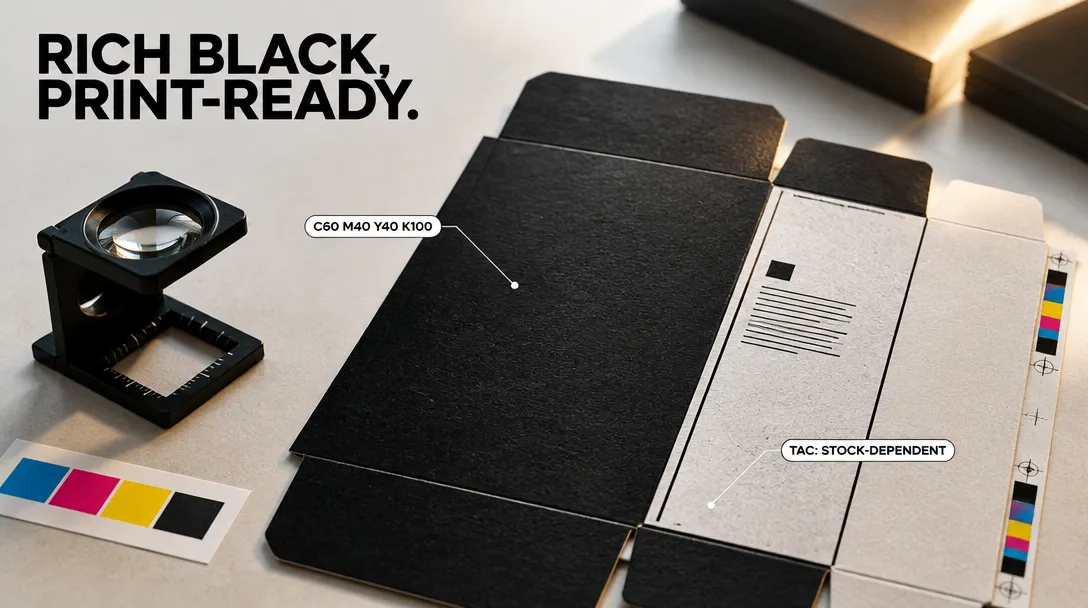
- Rich black adds cyan, magenta, and yellow beneath 100% black ink to create a visually deeper solid; C60 M40 Y40 K100 is a starting recipe, not a press-independent specification.
- That recipe has 240% total area coverage (TAC). Verify the printer’s substrate-specific ink limit and ICC output profile before releasing production files.
- Use 100% K for small type, fine rules, and registration-sensitive details; four-color black can show colored fringes when plates drift.
- Specify color by measured appearance and approved proof conditions, not CMYK numbers alone. Substrate, coating, press, and viewing conditions all affect the result.
Rich black is a production specification, not a universal CMYK formula
On a packaging file, a large black panel may look weak when printed with only 100% K. A controlled addition of process cyan, magenta, and yellow can increase apparent density and produce a more neutral, saturated black. The useful question is not simply “what are the rich black CMYK values?” It is whether a particular recipe transfers reliably through the specified press, ink set, profile, and packaging material.
C60 M40 Y40 K100 is a common starting point for a rich black on coated stock. It totals 240% TAC: 60 + 40 + 40 + 100. It is not a guarantee of a specific Lab value, density, or visual match. A printer using a different press condition or an uncoated board may need a lower TAC or a different balance to control drying, show-through, set-off, and color cast. Ask the converter for its intended ICC profile and maximum TAC for the actual production condition.
For procurement, the recipe should be treated as a controlled production input. Include the intended substrate and finish, color target or approved reference, proofing method, and acceptance conditions in the print specification. A numeric CMYK build alone does not define an objective appearance across suppliers.
Packaging stock and ink limits determine the workable build
Process inks are transparent, so their combined appearance depends on the white point, surface, and absorbency of the substrate. Coated folding carton board commonly supports a cleaner, more saturated solid than an absorbent uncoated paper. A laminated surface can also change perceived black through gloss and reflection, even when the underlying ink recipe is unchanged. For corrugated packaging, the liner and print process matter; a flexographic job on a liner is not interchangeable with a litho-laminated sheet.
Use the following values as engineering reference points for discussion, not guaranteed press settings. A board described as 350 gsm is a basis-weight reference, not a color specification or a promise of print performance. Confirm the actual grade, coating, and printing process with the packaging supplier.
| Build or control | Example / reference value | Use and engineering caution | Governing Standard / Test Protocol |
|---|---|---|---|
| Single-channel black | C0 M0 Y0 K100 | Preferred for small type and fine rules because it avoids four-plate registration fringes; can look less dense as a large solid. | ISO 12647-2 for process control; confirm the applicable print condition |
| Rich black starting build | C60 M40 Y40 K100; 240% TAC | Possible coated-stock starting point. Confirm profile, press ink limit, drying, and proof appearance; not a universal standard value. | ISO 12647-2 process control; ICC output profile for the specified condition |
| Reduced-ink rich black | C40 M30 Y30 K100; 200% TAC | Illustrative lower-coverage alternative for evaluation where ink load or drying is a concern; validate on the real stock. | ISO 12647-2 process control; supplier-defined TAC limit |
| Measurement and viewing | Use agreed measurement geometry, backing, and illumination | Record measurement conditions and compare like with like; visual assessment alone can conceal substrate and gloss differences. | ISO 13655 measurement; ISO 3664 viewing conditions |
ISO 12647-2 addresses process control for offset lithographic printing; it does not prescribe one universal rich-black CMYK recipe for every packaging job. ISO 13655 defines spectral measurement conditions for graphic arts, and ISO 3664 establishes viewing conditions. These references help make discussions reproducible, but the supplier and buyer still need to agree on the applicable print condition, measurement setup, and acceptance target.
Set the TAC limit from the printer’s documented condition and substrate, then verify the appearance on a contract proof or production-equivalent sample. Do not assume a figure from a different converter, region, or print process transfers unchanged.
Separate large black fields from small black details
Rich black is most appropriate for broad, visually prominent areas: a carton background, a large logo field, or a dark panel. For a large solid, the added process inks can make the result appear fuller than K-only black. The balance among C, M, and Y affects neutrality: too much of one component can introduce a visible blue, red, or warm cast. Review the appearance in the intended light and against adjacent brand colors, not only on a monitor.
Small text, barcodes, hairlines, and fine reverse type should generally remain 100% K unless the converter explicitly specifies otherwise. Four-color construction creates registration risk: even a small plate-to-plate displacement can form colored edges or reduce edge sharpness. Reverse type is especially sensitive because ink spread and substrate texture narrow the apparent counters and strokes. Confirm minimum type size and line weight with the printer rather than relying on a universal threshold.
Design files also need a deliberate overprint and knockout strategy. A rich-black background that unintentionally knocks out underlying colors can create gaps if registration shifts; an unintended overprint can alter nearby colors. The prepress team should inspect separations, trapping, transparency flattening, and overprint preview. Keep critical brand marks and small black elements on a separately controlled single-channel build where appropriate.
Reserve four-color rich black for broad solids; use 100% K for registration-sensitive detail unless the printer approves a different construction. This division reduces avoidable color fringes while preserving a deeper appearance where it matters.
A controlled proof prevents costly black mismatches
Begin by identifying the printing process, board or liner, surface treatment, and production profile. Have the converter state the maximum TAC for that exact condition and clarify whether its figure is a hard file limit or a recommended design limit. Check that the artwork’s embedded profile and output intent are consistent with the supplier’s workflow. If the supplier will convert colors during prepress, document who owns that conversion and how changes are approved.
Proof against the intended material whenever practical. A digital proof can assess layout and approximate color, but it may not reproduce the gloss, texture, opacity, or ink interaction of the final package. For a high-visibility black panel, ask for a production-equivalent drawdown or press proof when the risk of mismatch warrants the cost. Agree on how color is measured, including instrument condition and backing, and compare samples under controlled viewing rather than mixed office lighting. A measured target is only meaningful when the measurement method and substrate are also specified.
Do not use a heavier ink build to compensate automatically for a substrate or profile mismatch. Excess coverage may worsen drying, set-off, or downstream finishing behavior without solving the underlying color-management problem. If black appears washed out, investigate profile conversion, ink density control, substrate whiteness, coating, and gloss before changing the recipe. If it appears tinted, inspect channel balance and the actual output condition.
Illustrative calculation, not measured data
A designer specifies C60 M40 Y40 K100 for a coated carton panel. The file’s TAC is 60 + 40 + 40 + 100 = 240%. The converter’s documented limit for the chosen condition is assumed, hypothetically, to be 220%. The file therefore exceeds that assumed limit by 20 percentage points. The team should not release it unchanged: request a profile-appropriate conversion or test a lower-coverage build, then approve the appearance on a proof representing the intended stock. The 220% limit and any resulting color are hypothetical, not a supplier measurement or production result.
For a packaging launch, TadaPack can support custom structural packaging and prototyping discussions that connect print treatment with board, finish, and package construction. Use TadaPack’s online calculation tools at https://tadapack.com/tools for relevant planning calculations, and have the print converter validate color recipes and TAC for the production press.
Other teams can borrow a recipe only with its print conditions
A reusable specification should record the CMYK build, calculated TAC, intended substrate and finish, process, output profile or print condition, proof type, and agreed measurement and viewing method. Record whether the black is intended for a broad solid or for detail, and identify any areas that must remain K-only. These details help procurement compare bids on the same technical basis instead of treating a CMYK formula as a standalone guarantee.
When qualifying a new converter, request a sample on the actual board grade or a clearly identified equivalent. Compare black neutrality, solid uniformity, edge definition, set-off, and appearance after any coating or lamination. If the job includes a branded black that must match across cartons, labels, and inserts, specify how each substrate will be evaluated; identical CMYK values across different materials do not ensure identical perceived color.
In short, C60 M40 Y40 K100 is a useful coated-stock starting point, not a universal answer. The reliable engineering control is a substrate- and press-specific build, kept within an agreed TAC limit, verified through an appropriate proof and documented measurement conditions.
Recommended Engineering Reading
[TOOLS] Featured Engineering & Calculation Tools
Explore 70+ Packaging Tools ➔Foil Stamping Area & Cost Calculator
Estimate hot foil stamping area, foil consumption, and die tooling costs.Imposition & Sheet Utilization Optimizer
Optimize parent sheet imposition layouts to minimize off-cut paper waste.
