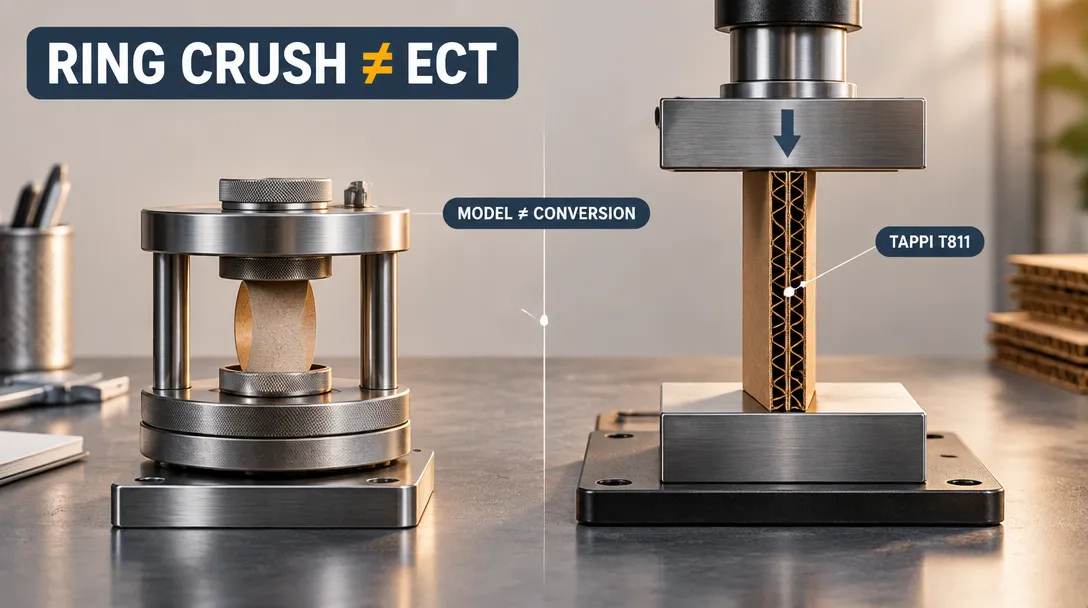
- RCT measures compression resistance of a ring-shaped paper specimen; ECT measures edgewise compression resistance of finished corrugated board. They are not interchangeable.
- The ECT equation is ECT = maximum edgewise failure load ÷ specimen width. For a 25 mm-wide specimen failing at 180 N, ECT is 7.2 kN/m.
- Paper RCT values may support a calibrated prediction, but no universal RCT-to-ECT conversion factor accounts for flute take-up, board caliper, bonding and process variation.
- Specify the ECT test method, units, conditioning and finished-board construction in procurement documents; validate performance on production-representative samples.
1. Separate the two tests before trying to convert results
The French query, “formule pour calculer le ect a partir du ring crush des papiers,” asks for a conversion from paper Ring Crush Test results to corrugated-board Edge Crush Test. The engineering answer is that a direct, universally valid conversion formula does not exist. Ring crush characterizes a paper specimen formed into a ring and compressed; ECT tests an edgewise section of the assembled corrugated board, including liners, fluted medium, adhesive bonds and flute geometry.
For paper RCT, TAPPI T822 describes a ring-crush method for paperboard; the applicable method and specimen configuration should match the material being tested. For corrugated-board ECT, TAPPI T811 is the relevant edgewise compressive-strength method. A result from one method cannot simply be relabelled as a result from the other. A supplier’s RCT data can help compare paper furnish or support an internal predictive model, but it is not a substitute for an ECT test on the finished board.
This distinction matters in structural packaging procurement. An ECT-32 or ECT-44 specification refers to a corrugated-board edge-crush performance class under the stated rating convention—not the ring-crush value of one liner or medium. For boxes subjected to distribution hazards, ECT is also only one design input: ASTM D4169 distribution-cycle testing addresses shipping hazards such as vibration and handling, while compression performance depends on the complete box design and use conditions.
2. Use the correct ECT equation and units
To calculate ECT from a test, divide the maximum load at edgewise failure by the specimen width. In coherent SI units, ECT in kN/m equals failure load in newtons divided by specimen width in millimetres. The numerical equivalence follows because 1 N/mm equals 1 kN/m. In US customary units, report the result in lbf/in when that is the specified convention.
ECT (kN/m) = maximum edgewise failure load (N) ÷ specimen width (mm). For a hypothetical worked example, a 25 mm-wide specimen that fails at 180 N gives 180 ÷ 25 = 7.2 kN/m. This calculation converts a measured load into strength per unit width; it does not use RCT as its input.
For procurement, state the test method and unit alongside the target. Do not compare figures without confirming whether they are reported in kN/m or lbf/in, what specimen width and orientation were used, and whether the supplier’s stated grade is a minimum, nominal value or another contractual basis. These details prevent unit mismatches from becoming false nonconformances—or, more seriously, false assurance.
3. Treat any RCT-to-ECT estimate as a model, not a conversion
A model may estimate finished-board ECT from liner and medium properties, but it must be calibrated against actual ECT tests for the relevant materials and converting process. At minimum, the model needs the RCT results for each component paper, flute type and flute take-up, board construction, paper grammage, moisture condition, adhesive and manufacturing process. The resulting estimate should be reported as a prediction with a defined scope—not as a measured ECT certificate.
Why can’t the RCT values simply be added? The papers do not remain flat, independent strips in the finished board. The medium is fluted, so its effective length and orientation differ from the liners; adhesive bonds transfer load; and local crush, flute geometry and converting quality affect failure. E/B/C/BC flute constructions also differ in geometry and caliper, changing how the board behaves under edgewise loading. Even two boards made from papers with similar RCT can produce different ECT results if their flute formation, bonding or moisture condition differs.
Calibrate a predictive model using paired component-paper RCT and finished-board ECT data from representative production, with agreed test methods and conditioning. Keep the model restricted to the combinations of paper, flute, supplier and process it has been validated for. Revalidate after a material, mill, flute or converting change; a formula fitted to one construction is not a universal material law.
4. Control conditioning, construction and test method
Paper and corrugated board are moisture-sensitive. A comparison is meaningful only when test specimens are conditioned consistently and the conditioning method is documented. ASTM D685 covers standard conditioning and testing atmospheres for paper and paper products; ISO 186 provides a corresponding standard atmosphere framework for paper and board. Follow the selected method and the relevant laboratory procedure rather than mixing results from different environments.
Record board construction, including the liner and medium grades, flute profile, number of walls and nominal caliper, alongside test results. A caliper entry is useful for identifying a construction change, but caliper alone cannot predict ECT. For moisture-exposed distribution, investigate water resistance and bond integrity as well as ECT: a board that absorbs moisture can lose compression strength even if its initial dry result meets specification. Where barrier treatments are proposed, assess their effect on converting, adhesive performance and end-of-life recyclability; do not assume a PFAS-free coating is automatically suitable for every barrier requirement.
Procurement specifications should distinguish component-paper acceptance tests from finished-board performance requirements. If the packaging system needs a defined ECT grade, require finished-board test results using the agreed method and sampling plan. For shipping performance, select distribution tests based on the actual channel and hazards; ASTM D4169 is a distribution-cycle performance evaluation, not a formula for translating RCT into ECT. Amazon FBA dimensional freight charges are a separate cost driver: reducing package dimensions must not compromise protective performance or compliance with applicable fulfilment requirements.
5. Apply a four-step verification SOP before approving a grade
Use this sequence to prevent an estimate from being mistaken for a verified board specification:
- Step 1 — Define the claim. Specify whether the required value is paper RCT or finished-board ECT, name the test method, reporting units, board construction and acceptance basis.
- Step 2 — Align conditioning. Agree the conditioning method and test atmosphere under the selected paper or board standard; record the actual laboratory procedure so supplier results are comparable.
- Step 3 — Test representative board. Test finished corrugated samples made with the intended liners, medium, flute and converting process using TAPPI T811 when that is the agreed ECT method. Keep component-paper RCT as supporting data, not a pass/fail substitute for ECT.
- Step 4 — Validate the shipment design. Review the box structure, payload, stacking and distribution hazards. Use ASTM D4169 where an appropriate distribution-cycle test is required, and confirm that dimensional changes do not create avoidable freight penalties or reduce protection.
The SOP intentionally sets no universal caliper tolerance or predicted ECT from RCT: those limits depend on the approved construction, supplier capability and product risk. Set them in the controlled drawing or purchase specification after trials, not by importing an unrelated generic tolerance.
6. Make the purchase decision on verified performance
For a reliable commercial decision, request three distinct data items: component-paper RCT where useful for material control, finished-board ECT measured by the agreed method, and packaging-system performance evidence appropriate to the distribution channel. A paper supplier’s RCT certificate alone does not establish that a converted ECT-32 or ECT-44 board—or a finished shipper—will meet its design requirement.
Bottom line: calculate ECT from measured edgewise failure load and specimen width; do not calculate it directly from RCT without a validated, construction-specific model. TadaPack’s online calculation tools at https://tadapack.com/tools can support packaging calculations, while custom structural packaging and prototyping services can help assess a defined board construction and box design before production approval. Treat calculated outputs as design aids and confirm critical performance through testing.
- ☐ Confirm whether the specification calls for paper RCT or finished-board ECT.
- ☐ State TAPPI T811 for ECT where applicable, plus units, conditioning and acceptance basis.
- ☐ Record the full board construction, including flute and component papers.
- ☐ Use RCT-based estimates only within a validated model; verify the finished board.
- ☐ Review distribution testing and package dimensions as separate engineering and cost checks.
For procurement teams, the practical rule is simple: RCT helps describe paper; ECT verifies the edgewise strength of corrugated board. Keep the metrics distinct, and approve the board against the test that matches the actual requirement.
Recommended Engineering Reading
[TOOLS] Featured Engineering & Calculation Tools
Explore 70+ Packaging Tools ➔Box Compression (BCT) Calculator
Predict box compressive limit and stacking safety factors via McKee formula.Edge Crush Test (ECT) Calculator
Calculate linerboard ring crush and composite ECT ratings for optimal board specs.
Frequently Asked Technical Questions (FAQ)
Is there a direct formula to convert ring crush into ECT?
What is the formula for calculating ECT from a test?
Which standard should be specified for corrugated-board ECT?
Can ECT-32 or ECT-44 be inferred from the papers’ RCT values?
