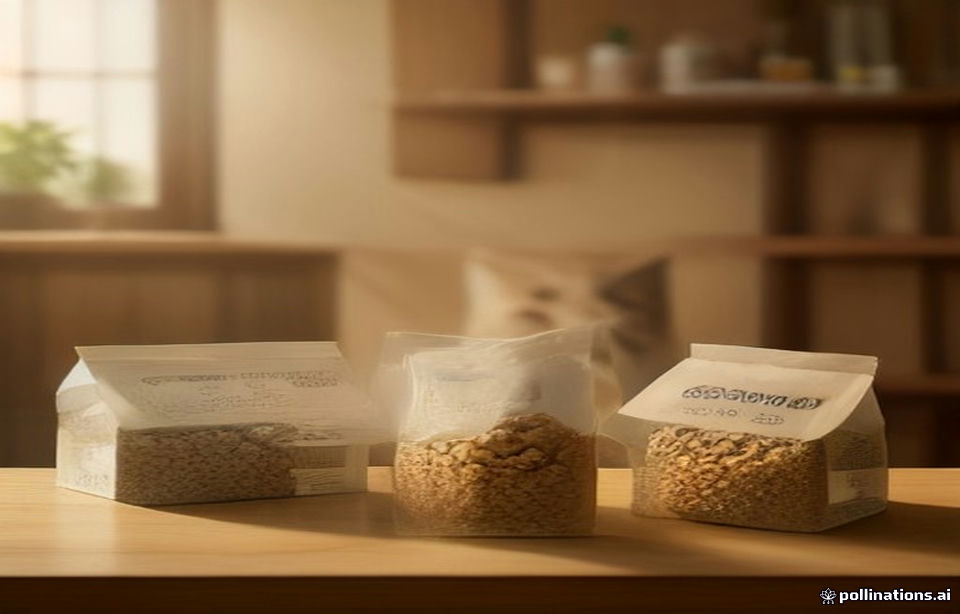
Compliant pet care packaging in 2026 must meet EU PPWR recyclability thresholds (70% by 2030) while maintaining ECT-32 minimum for kibble bags and PFAS-free grease barriers. Use ASTM D4169 and ISTA 3A testing to validate transit durability, and right-size corrugated to avoid FBA dimensional penalties.
- EU PPWR mandates 70% recyclable packaging by 2030; design for mono-material PE or PP films and paper-based corrugated.
- ECT-32 corrugated (32 lb/in edge crush) is the minimum for 10 kg kibble bags in stacked pallets; ECT-44 for export.
- PFAS-free barrier coatings (e.g., water-based acrylic) achieve Cobb 60 values below 20 g/m², preventing grease migration.
- Right-sized packaging reduces FBA dimensional weight penalties by up to 30% and cuts freight costs.
- Use TadaPack’s free calculators to optimize BCT, cushioning, and cost per unit.
1. PPWR Compliance: Design for Recyclability and Mono-Material Films
The EU Packaging and Packaging Waste Regulation (PPWR 2024/1991) sets a 70% recyclability requirement for all packaging by 2030. For pet care, this means moving away from multi-material laminates (e.g., PET/AL/PE) toward mono-material PE or PP films with EVOH barrier layers that are compatible with mechanical recycling. According to EU Directive 94/62/EC Annex II, heavy metals and PFAS are restricted; PFAS-free coatings are mandatory under the upcoming PPWR revisions. For kibble bags, a 12 µm EVOH layer within a 120 µm PE structure can achieve an oxygen transmission rate (OTR) below 5 cc/m²/day while remaining recyclable in PE streams. Smart accessories (e.g., GPS trackers) require paper-based or molded pulp inserts that are easily separated.
2. Corrugated Strength: ECT-32 vs ECT-44 for Stacked Kibble Bags
For 10 kg kibble bags stacked 5-high on a pallet, the bottom box must withstand a compressive load of approximately 500 N. Per TAPPI T810 (Mullen burst) and ASTM D642 (compressive resistance), ECT-32 (32 lb/in) corrugated with B-flute (3 mm caliper) provides a typical BCT of 1,200 N for a 400×300×200 mm box, sufficient for warehouse stacking. For export or high-humidity routes (e.g., Pacific crossing), specify ECT-44 with BC-flute (6 mm caliper) to compensate for moisture-induced flute softening. ISO 186:2020 conditioning at 23°C ± 1°C and 50% ± 2% RH is required before testing. A common mistake is using ECT-32 for heavy bags without moisture barriers, leading to creep failure.
Q: Why do some retailers still demand Mullen burst testing when ECT is specified?
A: Direct answer: Mullen burst (TAPPI T810) measures puncture resistance, which ECT does not capture. Underlying reason: Kibble bags can puncture corrugated during handling, reducing BCT. Procurement recommendation: Specify both ECT-32 and minimum Mullen burst of 200 psi for bags with sharp edges.
3. Barrier Coatings: PFAS-Free Solutions for Grease and Moisture
Traditional pet food bags use PFAS-based coatings for grease resistance, but these are being phased out under EU PPWR and US state regulations. PFAS-free alternatives include water-based acrylic coatings and bio-wax dispersions. A Cobb 60 value (TAPPI T441) below 20 g/m² is achievable with a 3 g/m² acrylic coating, preventing grease migration and maintaining bag integrity. For smart accessories, avoid desiccant packets that can be ingested; use molded pulp with 2% moisture content and a PE liner only if necessary. Test per ASTM D4169 Schedule 10 for vibration and drop.
4. Right-Sizing for FBA and Freight: Dimensional Weight Penalties
Amazon FBA dimensional weight is calculated as (L×W×H)/139 for inches. A 10 kg kibble bag in a 400×300×200 mm box has a dimensional weight of 8.5 kg, close to actual weight, but over-sized boxes increase costs. By reducing box dimensions to 350×250×180 mm, dimensional weight drops to 5.2 kg, saving up to 30% on FBA fees. For DTC brands, use TadaPack’s packaging calculator (https://tadapack.com/tools) to optimize box size against product dimensions and stacking strength. Also consider ISTA 3A for parcel delivery; a typical drop sequence from 760 mm induces 50 G shock, requiring 5 mm cushioning for smart accessories.
5. Smart Accessories: Cushioning and Sustainability
GPS trackers and smart feeders require protection from shock and vibration. Molded pulp (e.g., 350 gsm recycled fiber) with a 2 mm wall thickness provides adequate cushioning for 50 G drops when designed with ribs. Per ASTM D4169, vibration testing at 1.5 G rms for 30 minutes ensures no loose components. For recyclability, avoid EPS; use paper-based honeycomb or molded pulp. A common mistake is using excessive cushioning that increases box size and freight cost—optimize with TadaPack’s CAD prototyping services.
6. Cost Teardown: Material and Freight Savings
Hypothetical worked example: A DTC pet brand shipping 10,000 units/month of 5 kg kibble bags. Switching from ECT-44 to ECT-32 (where applicable) saves $0.15 per box; right-sizing reduces dimensional weight from 6 kg to 4.5 kg, saving $0.50 per shipment in freight. PFAS-free coating adds $0.05 per bag but avoids potential fines. Total annual savings: $78,000. Validate with ASTM D642 compression tests and TAPPI T810 burst tests. Use TadaPack’s cost calculator for custom quotes.
7. Verification Checklist for Compliance and Performance
- ☐ Confirm recyclability per EU PPWR 2024/1991 (70% by 2030).
- ☐ Specify ECT-32 or ECT-44 corrugated with B or BC flute.
- ☐ Require PFAS-free coating with Cobb 60 < 20 g/m².
- ☐ Test per ASTM D4169 and ISTA 3A for transit.
- ☐ Right-size boxes to minimize dimensional weight.
- ☐ Use TadaPack’s free tools for BCT and cost optimization.
Wrap-up: Sustainable pet packaging in 2026 is an engineering discipline—balance PPWR recyclability with ECT strength and PFAS-free barriers. Leverage TadaPack’s structural prototyping and calculators to achieve compliance and cost efficiency.
Recommended Engineering Reading
[TOOLS] Featured Engineering & Calculation Tools
Explore 70+ Packaging Tools ➔Box Compression (BCT) Calculator
Predict box compressive limit and stacking safety factors via McKee formula.Edge Crush Test (ECT) Calculator
Calculate linerboard ring crush and composite ECT ratings for optimal board specs.
