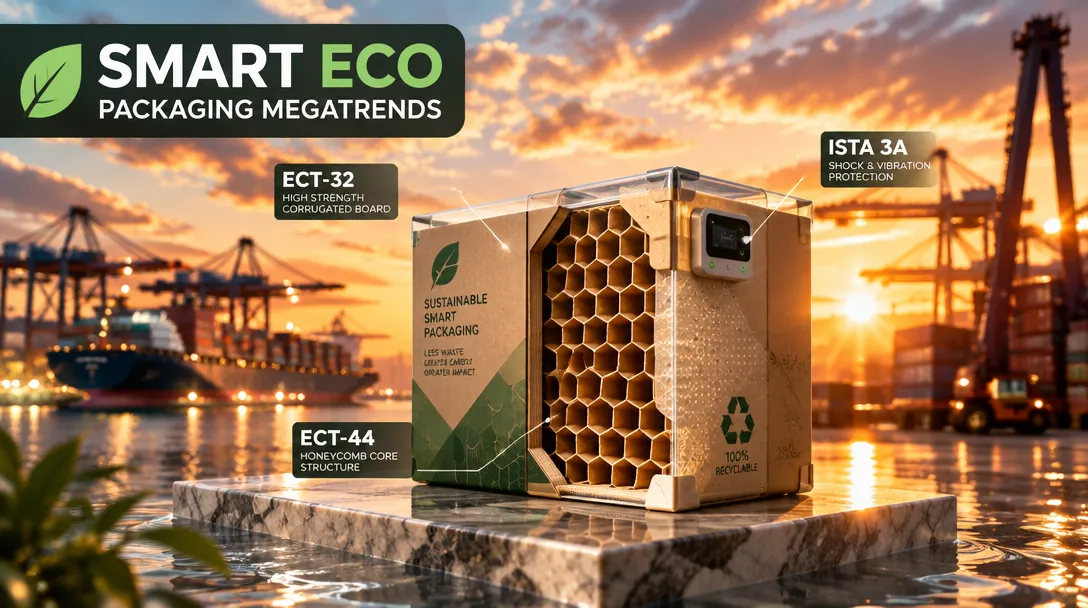
Steinle’s interpack forecast (smart packages with sensors and microchips, cradle-to-cradle loops, seaweed feedstock, drone-era single-use stability, AI-driven demand forecasting) is not a trend list — it is a set of structural design constraints. Procurement teams should respond by locking ECT/BCT targets (e.g., ECT-32 for single-wall B-flute, ECT-44 for BC double-wall), enforcing Cobb 60 limits of 35 g/m² or lower for humid corridors, and validating every redesigned structure under ISTA 3A before committing tooling.
- Steinle (interpack magazine) predicts packaging will develop ‘communicative intelligence’ — sensors and microchips embedded in packs, with the most promising application in medicine: monitoring correct drug intake and warning about incompatible drugs.
- Drone deliveries will require more stable, quick single-use packaging optimised for on-the-go consumption; sustainability pressure drives cradle-to-cradle design and seaweed as a cost-effective renewable raw material.
- The food industry faces the greatest change; AI brings efficiency through autonomous demand forecasting, and the neo-ecology megatrend forces decoupling of consumption/production from rising carbon emissions.
- Engineering response #1: every ‘smart’ or mono-material redesign must re-qualify compressive strength — use McKee BCT = 5.87 × ECT × √(caliper × perimeter) as the first-pass check, then confirm per ASTM D642.
- Engineering response #2: mono-material and seaweed-based barriers behave differently under 30-day ocean transit; enforce Cobb 60 ≤ 35 g/m² and derate stacking loads in high-humidity coastal hubs.
What Steinle’s Forecast Actually Specifies for Structural Teams
Stripped of futurist language, the interpack interview delivers five actionable design constraints: (1) microchips and sensors inside packs, meaning dielectric windows, antenna clearances and chip survival must be protected through the corrugating and die-cutting process; (2) medical packs that monitor drug intake, implying tamper-evident structures with printed-electronics compatible substrates; (3) drone-era packs that are ‘more stable’ and optimised for quick, single use — a direct compression and drop requirement, not a marketing claim; (4) cradle-to-cradle design, meaning mono-material construction with separable inks, labels and barrier coatings; and (5) seaweed as a cost-effective renewable raw material, which shifts barrier performance from PFAS-based fluorochemicals toward PFAS-free coatings — a direction already required by EU PPWR (Regulation (EU) 2024/1991) recyclability mandates.
Why It Is Happening: Compression Physics Meets the Drone Economy
Two forces converge. First, Steinle’s neo-ecology megatrend forces producers to decouple output from carbon emissions, which in packaging means lighter boards, mono-material structures and renewable feedstocks — all of which reduce fiber reserve and therefore compressive margin. Second, the shift he describes toward drone and on-the-go delivery removes the palletised, climate-controlled middle mile. A drone-rated mailer sees individual parcel drops rather than unit-load stacking, so its governing spec moves from pallet BCT toward ISTA 3A General Simulation Performance Testing drop shock sequences and ASTM D4169 vibration profiles.
The engineering tension is real: lighter, mono-material board loses ECT margin exactly when the new distribution model adds drop and vibration stress. First-pass math: with McKee, a 300 × 220 × 120 mm B-flute mailer (perimeter 1,280 mm, caliper 3.0 mm) at ECT-32 yields a hypothetical BCT ≈ 5.87 × 32 × √(3.0 × 1280) ≈ 1,128 N — typical illustrative calculation, to be confirmed by ASTM D642 compression testing on production board. Cutting fiber to hit a cradle-to-cradle weight target (say down to ECT-26) drops that estimate to roughly 917 N, a ~19% compression loss that must be recovered through geometry (honeycomb inserts, folded edge reinforcements) or flute change.
Q: If the McKee formula derives BCT from ECT, why do overseas enterprise POs still mandate Mullen burst testing (TAPPI T810)?
A: Direct answer: because burst strength (kPa/lb/in²) tests multi-directional laminate integrity — especially liner-to-medium bond — which ECT alone cannot detect. Mechanical reason: McKee assumes sound board; delamination from moisture (Cobb 60 > 35 g/m²) or poor corrugating adhesive application collapses real BCT far below the formula prediction, and Mullen is the fastest screen for bond failure. Procurement recommendation: specify both — ECT for stacking design, TAPPI T810 burst (e.g., 200 lb/in² class) plus Cobb 60 limits as acceptance criteria — and reject lots failing either, regardless of the McKee estimate.
Impact on Packaging Buyers and Makers
Procurement directors: Steinle identifies food as the industry facing the greatest change, and expects AI to deliver efficiency via autonomous demand forecasting. Practically, this shortens order cycles and increases SKU fragmentation; your supplier must handle short-run structural changes without tooling premiums. Negotiate SLAs on dieline revision turnaround (typical industry reference: 24–48 h for structural CAD revisions on existing dies) and lock acceptance criteria per lot: ECT grade, Cobb 60, caliper per TAPPI T411 (typical tolerance ±0.05 mm on single-wall board), and ISTA 3A pass reports per ASTM D4169-confirmed distribution cycle for e-commerce lanes.
Structural engineers: ‘Communicative intelligence’ means RFID/NFC and sensor components must survive conversion. Place chip windows at least 15 mm (typical design rule) from crease lines to avoid antenna fracture through 45-durometer creasing matrices; verify print-and-apply registration at ±0.15 mm on die-cut windows. For seaweed-derived or coated barrier substrates, re-run Cobb 60 and adhesion testing — bio-based barriers typically need separate qualification because standard PVDC or acrylic lamination data does not transfer.
DTC brand owners: single-use, drone-optimised packs cut dimensional weight. At typical 2026 US domestic dimensional divisor of 139 (illustrative industry reference value), reducing a mailer from 12 × 9 × 4 in to 11 × 8 × 3.5 in cuts billed dimensional weight from 4 lb to 3 lb on FBA-sized lanes — a permanent per-unit freight saving that usually pays for the structural redesign within one quarter. Amazon FBA dimensional penalties reward exactly the ‘quick, single use’ formats Steinle describes.
Recommended Actions: A Verification SOP for Smart Eco-Packaging
- Step 1 — Re-derive strength targets. For every redesigned or lightweighted SKU, compute first-pass BCT with McKee from the specified ECT, caliper and perimeter, then verify on production board per ASTM D642 after conditioning at 23°C ± 1°C, 50% ± 2% RH (per ISO 187 / ASTM D685 standard atmospheres).
- Step 2 — Qualify the eco-barrier. For any mono-material or seaweed-based structure, run Cobb 60 (ISO 535 / TAPPI T441) and require ≤ 35 g/m² for ocean-freighted SKUs; confirm PFAS-free coating claims with supplier declarations consistent with FTC Green Guides (16 CFR Part 260) substantiation rules.
- Step 3 — Validate the distribution model. Run ISTA 3A full sequence (drop, vibration, compression) for e-commerce parcels, and ASTM D4169 with the appropriate distribution cycle for palletised replenishment; derate stacking loads ~20–30% (typical engineering reference) for 30-day Pacific ocean transit into humid coastal hubs.
- Step 4 — Lock conversion tolerances. Specify die-cut window registration ±0.15 mm for smart-element placement, creasing matrix at 45 durometer, and caliper variance per TAPPI T411; audit first production lot against these before releasing the PO balance.
Defect diagnostics: the two failures most likely to appear as you chase these megatrends are (1) flap popping / warped grayboard on bio-based boards — root cause is differential hygroscopic expansion between seaweed-derived or coated liners and the fiber core; corrective action is symmetric coating on both sides and moisture-controlled storage at 45–55% RH; and (2) adhesive debonding after ocean transit — root cause is starch adhesive softening above Cobb 60 thresholds; corrective action is upgrading to a higher-solids corrugating adhesive and adding a moisture-barrier carton liner, then re-running ISTA 3A.
TadaPack supports each step: use the free calculators at https://tadapack.com/tools for BCT, stacking load and dimensional-weight checks, and our custom structural prototyping service to turn Steinle’s megatrends — smart-element integration, mono-material loops, drone-stable single-use formats — into die-cut, test-passed structures without full tooling commitment.
Recommended Engineering Reading
[TOOLS] Featured Engineering & Calculation Tools
Explore 70+ Packaging Tools ➔Box Compression (BCT) Calculator
Predict box compressive limit and stacking safety factors via McKee formula.Edge Crush Test (ECT) Calculator
Calculate linerboard ring crush and composite ECT ratings for optimal board specs.
