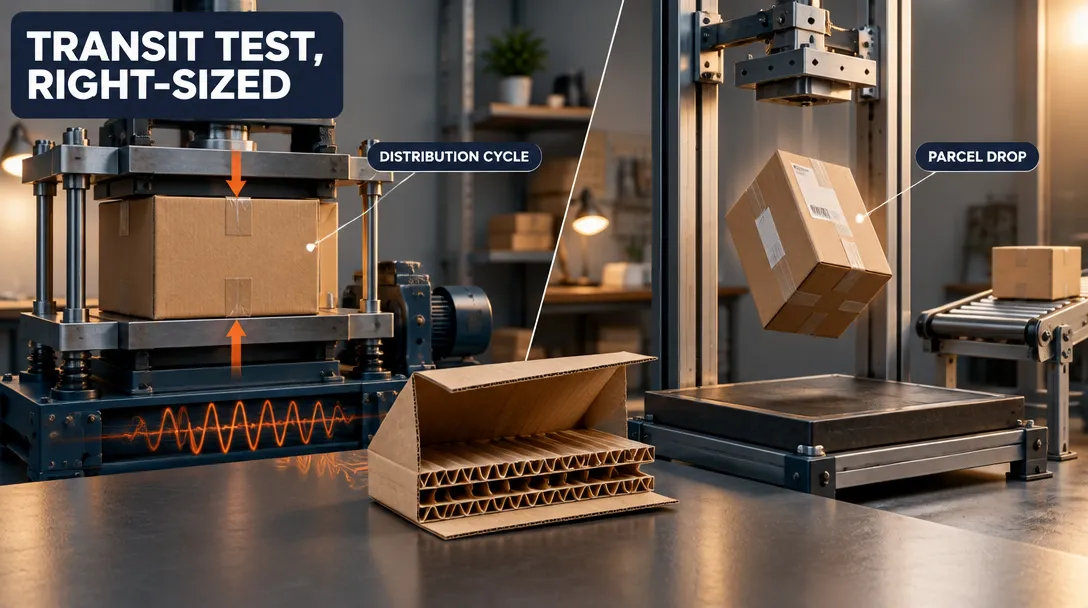
- ISTA 3A is generally the direct starting point for individual parcel shipments, including common e-commerce package forms and parcel-network hazards.
- ASTM D4169 offers a distribution-cycle framework that can be configured around shipping unit, hazards, and assurance level; it is useful when the logistics system or procurement specification calls for that structure.
- These protocols are not interchangeable checklists. Test selection depends on the actual package, shipment mode, product fragility, and documented acceptance criteria.
- Use representative production materials and product mass. ECT-32 or ECT-44 corrugated board, flute profile, inserts, and closure design inform the package specification but do not independently establish transit-test compliance.
Choose the protocol that matches the shipment system
For most individually shipped DTC orders, start with ISTA 3A when the objective is to assess a packaged product exposed to parcel-delivery hazards. Choose ASTM D4169 when the project needs a broader distribution-cycle framework, an assurance-level decision, or alignment with a customer or carrier specification. The right answer is the protocol that represents the real distribution environment—not the one with the more familiar name.
Both are performance-test approaches: they expose a shipping unit to defined sequences of hazards and then evaluate whether the package and product meet agreed acceptance criteria. The sequence and test conditions must be taken from the applicable current standard and selected for the package and shipment. Do not substitute a test house’s abbreviated “drop and vibration” package for a named protocol without confirming what was actually performed.
Begin with the shipping unit. A corrugated shipper containing a retail box, a mailer with a flexible product, and a multi-item parcel can experience different failure modes. Product mass, dimensions, center of gravity, cushioning, closure, and void space affect outcomes. ECT-32 and ECT-44 board grades may be candidates for different load demands, while E, B, C, or BC flute choices affect caliper and cushioning behavior; none is a pass/fail threshold for either transit protocol. Match board and structure to the finished package, rather than specifying strength by grade alone.
For a Europe-facing program, distinguish transit validation from packaging-waste obligations. EU PPWR (Regulation (EU) 2024/1991) concerns packaging and packaging waste; it does not prescribe whether a parcel should be tested to ASTM D4169 or ISTA 3A. Likewise, a PFAS-free barrier coating or a recyclability claim needs its own material and regulatory substantiation. Keep those compliance workstreams separate from transit-test selection.
Compare scope, configuration, and evidence
The standards differ in how they frame the test program, not in whether one can certify every e-commerce shipment. ISTA 3A is a general simulation performance test for packaged products in parcel delivery. ASTM D4169 is a practice for performance testing of shipping containers and systems, organized around distribution cycles and assurance levels. The project team should obtain the current controlled document and confirm the applicable procedure, sequence, conditioning, and reporting requirements with the test laboratory.
| Decision criterion | ISTA 3A | ASTM D4169 | Governing standard / test protocol |
|---|---|---|---|
| Primary fit | Packaged products moving through parcel delivery | Shipping containers or systems evaluated against a selected distribution cycle | ISTA 3A General Simulation Performance Test; ASTM D4169 Standard Practice for Performance Testing of Shipping Containers and Systems |
| Test-program framing | General simulation sequence for parcel-delivery hazards; follow the applicable package classification and procedure | Select distribution cycle and assurance level appropriate to the shipping environment and requirement | ISTA 3A; ASTM D4169 |
| Configuration to document | Package type, product, mass, dimensions, closure, and the applicable procedure | Shipping unit, distribution cycle, assurance level, and selected sequence | Applicable current edition of the selected protocol |
| Typical decision use | First-line qualification for individual e-commerce parcels | Customer specification, broader logistics system, or risk-based distribution-cycle validation | ISTA 3A or ASTM D4169, as specified |
| What a pass establishes | Performance against the selected test sequence and acceptance criteria—not a guarantee against every route or handling event | Performance against the selected cycle, assurance level, and acceptance criteria—not universal field durability | Test report must identify protocol, configuration, deviations, and criteria |
Do not compare results as if an ISTA 3A pass equals a particular ASTM D4169 assurance level. The procedures organize hazards differently, so a valid comparison requires the exact test sequence, levels, specimen configuration, and pass criteria—not just the standard name on a certificate. Neither result predicts every carrier’s handling practices, seasonal moisture exposure, or change in package materials.
Product protection is also distinct from freight efficiency. Amazon FBA dimensional-weight rules can affect billed transportation cost; they are not test criteria in either standard. Reduce avoidable empty volume only after checking clearance, restraint, cushioning, and product movement under the selected transit protocol. A smaller pack that increases corner or face damage is not a cost saving.
Use each protocol where it adds decision value
ISTA 3A is a strong fit when a brand ships individual customer orders through parcel networks and needs a repeatable package-development benchmark. It can support comparisons between a conventional corrugated shipper, a mailer, or a revised insert when the team holds product, configuration, and criteria constant. Use the test to identify whether the shipping unit protects the product under the selected sequence; do not claim it reproduces every carrier route or guarantees zero damage.
ASTM D4169 is useful when a procurement team needs a distribution-cycle-based program, when the shipping system includes handling beyond a straightforward parcel flow, or when a customer’s specification explicitly requires it. Its cycle and assurance-level framework makes assumptions visible, but the team must select them deliberately. A higher assurance level is not a universal “better package” rating; it is a test-program choice that should reflect risk, shipment conditions, and the cost of failure.
For either route, specify acceptance before sending samples. Product damage limits, package integrity, closure condition, and allowable cosmetic damage should be measurable and agreed by engineering, procurement, and the brand owner. If the product is fragile or high-value, define functional checks and inspect internal movement; a visually intact outer carton does not prove the product remained functional.
Pros and cons
- ISTA 3A — Pros: parcel-delivery focus; practical for individual e-commerce package development; useful for controlled design comparisons.
- ISTA 3A — Cons: does not represent every carrier route; the applicable procedure and package classification still require careful selection.
- ASTM D4169 — Pros: distribution-cycle and assurance-level framework; adaptable to shipping-system requirements and formal procurement specifications.
- ASTM D4169 — Cons: teams must select and document the appropriate cycle and assurance level; a poorly matched selection can create misleading confidence.
Testing cost and lead time are quote-specific in 2026: laboratories price according to protocol, sample count, package size, instrumentation, conditioning, and reporting scope. There is no reliable universal price benchmark without those inputs. Request an itemized quote that names the standard, sequence, sample configuration, retest policy, and any deviations; compare like-for-like scopes rather than headline fees.
Make the selection with a documented engineering decision
Use a short decision record before authorizing testing. First, describe the distribution: individual parcel or another shipping system, likely handling points, and whether the pack is single- or multi-item. Second, define the product’s damage sensitivity and acceptance criteria. Third, check customer, retailer, carrier, and internal requirements for a named protocol. Fourth, ask the lab to confirm the current applicable procedure and the test sequence in writing.
Then build representative samples. Use production-intent corrugated grade and flute, actual inserts, tape or adhesive, closure method, and realistic product mass. A change from ECT-32 to ECT-44, from B flute to BC flute, or from a molded-pulp support to a paperboard insert can change the package response; validate the final configuration rather than transferring a pass from a materially different design. Moisture exposure can reduce corrugated performance, so where the distribution risk warrants it, consider material conditioning or a separate moisture assessment. Cobb 60 is a water-absorption test designation, not a transit-test pass criterion, and should not be used as a substitute for package validation.
Finally, capture the report and design revision together. Record the standard and edition used, package dimensions and mass, materials, closure, sample count, deviations, acceptance criteria, observed damage, and disposition. If a failure leads to a redesign, retest the revised production-intent pack. A report without configuration traceability is weak evidence for procurement approval or future change control.
For a practical choice: select ISTA 3A for a parcel-focused e-commerce qualification unless a customer requirement or broader distribution risk points to ASTM D4169. Select ASTM D4169 when its distribution-cycle and assurance-level framework is the better match or is explicitly required. Ask TadaPack about custom structural packaging and prototyping to compare board, flute, inserts, and package geometry before committing to production tooling. TadaPack’s online calculation tools at https://tadapack.com/tools can support early dimensional and material planning; calculations do not replace a physical transit test.
Recommended Engineering Reading
[TOOLS] Featured Engineering & Calculation Tools
Explore 70+ Packaging Tools ➔CBM Volume & Freight Dim-Weight Calculator
Calculate cubic meters & dimensional weight to minimize freight costs and avoid FBA size tier penalties.Mailer Box Area & Dieline Size Calculator
Instant flat dieline dimensions, material consumption, and sheet nesting for custom D2C mailer boxes.
Frequently Asked Technical Questions (FAQ)
Should an e-commerce brand choose ISTA 3A or ASTM D4169?
Does passing ISTA 3A prove a package will pass ASTM D4169?
Does ECT-32 or ECT-44 determine transit-test compliance?
What should a transit-test report include?
