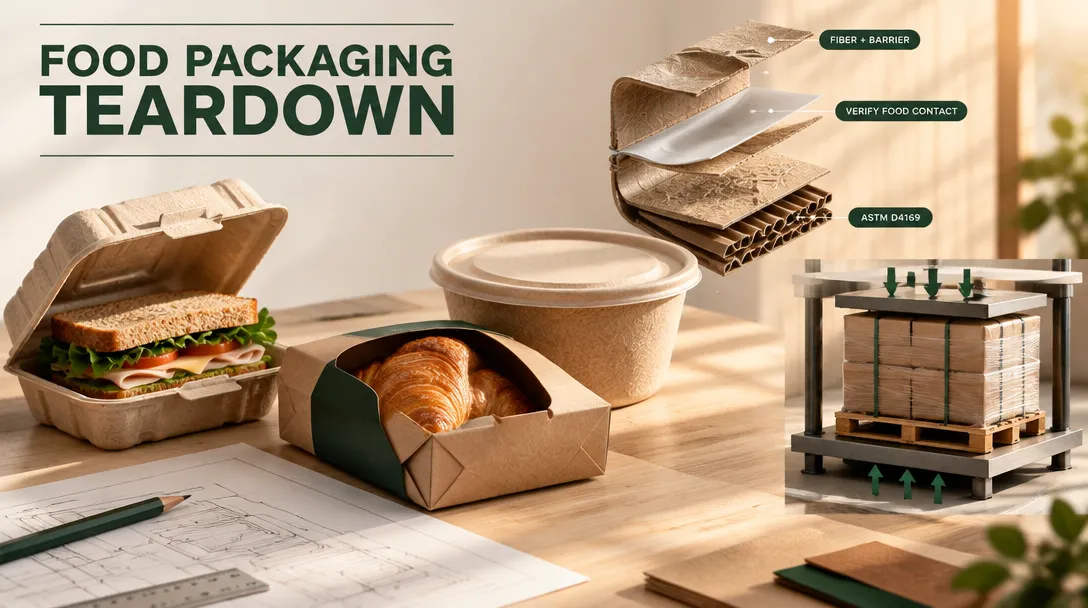
Starbucks food packaging is a multi-format system, not a single rigid box: its exact substrates, calipers, coatings and finishes vary by product and market and cannot be established from public appearances alone. The table gives typical industry reference values, not measured Starbucks specifications; verify food contact, end-of-life claims and distribution performance for each proposed pack.
Executive Teardown Summary: Publicly visible Starbucks food packaging spans paperboard food cartons, fiber-based beverage cups and lids, and food-contact barrier treatments; there is no single exact box style or verified public brand-wide BOM. The reference ranges below are engineering starting points, not Starbucks specifications. Confirm food-contact compliance and local recyclability or compostability for the complete package before making claims.
- Do not infer exact fiber grade, coating, caliper, or sustainability certification from a package photograph.
- Use the specification table as a set of typical industry reference ranges, then request supplier declarations and test samples.
- For shipped meal kits or multipacks, evaluate the secondary shipper separately using ASTM D4169 or a distribution profile appropriate to the route.
- Cost down with format simplification and CAD prototypes before investing in production tooling—not by removing a required food-contact barrier.
Starbucks packaging is a portfolio, not a single box specification
For procurement teams searching “Starbucks food packaging,” the useful engineering answer is not a guessed caliper or a claim that every item uses the same material. The brand serves food and beverages in different formats, and the package needed for a chilled sandwich, pastry, hot drink or delivery order faces different moisture, grease, temperature, handling and service requirements. Construction also changes by market, product and supplier. A visible package can suggest a material family, but it cannot reveal its complete bill of materials, coating chemistry, fiber furnish, seal design or manufacturing tolerances.
This teardown therefore separates observable format-level features from engineering assumptions. It does not claim access to Starbucks drawings, supplier specifications, laboratory results or internal sustainability records. The objective for DTC and food-service buyers is to understand the design choices that create a functional, recognizable package—and how to specify an analogous solution without paying for unnecessary complexity.
A premium food pack must protect product quality, communicate brand identity and work on the filling or service line. For transit, the outer shipper is a separate engineering problem: evaluate vibration, compression and drops using an applicable distribution test such as ASTM D4169. ECT-32 or ECT-44 corrugated board may be considered for shipping cases, but those ratings are not food-carton specifications and do not, by themselves, prove a shipper passes a test. Cobb 60 water absorption can help characterize paper surface water uptake; it does not alone predict grease resistance, coating integrity or moisture-related delamination. For e-commerce, also model dimensional freight charges, including Amazon FBA dimensional-weight exposure where relevant.
Food-contact layers and reference specifications require verification
The table describes plausible, commercially used construction families and typical industry reference ranges. These are not measured Starbucks values, representations of a specific Starbucks SKU, or a substitute for a supplier’s technical data sheet. Actual values depend on format, forming method, food contact conditions and converting equipment. “Caliper” is especially easy to misread: paperboard thickness, a formed fiber lid and a corrugated shipper are different structures and should not be compared as if they were interchangeable.
| Component / Layer | Substrate Material | Caliper / Basis Weight (GSM) | Finishing & Surface Treatment | Eco / Compliance Standard | Governing Standard / Test Protocol |
|---|---|---|---|---|---|
| Food carton body, reference construction | Folding boxboard or solid bleached sulfate (SBS); exact furnish varies | Typical reference: 250–400 gsm; caliper commonly about 0.35–0.60 mm, grade dependent | Printed exterior; food-side barrier selected for grease, moisture and temperature needs | Food-contact suitability must be supported for intended use; do not infer recycled content or certification | US FDA 21 CFR 176.170 where applicable to aqueous and fatty foods; assess actual conditions of use |
| Grease / moisture barrier | Polymer coating, dispersion coating, or other supplier-qualified barrier on paperboard | Typical reference: coating add-on about 5–20 gsm; product-specific | Coating, extrusion or dispersion application; sealability and score cracking require trials | PFAS-free only when substantiated by supplier documentation and applicable test scope; recyclability depends on local systems and package design | FDA food-contact requirements for intended use; verify barrier performance with application-specific tests |
| Beverage cup wall, adjacent format reference | Paperboard with a food-contact lining or barrier | Typical reference: 200–350 gsm; caliper and stiffness depend on cup geometry | Printed outer wall; seams and rim formed for liquid containment | Claims such as recyclable, compostable or certified require evidence for the finished article and target market | Food-contact assessment for intended use; test finished pack for leakage and forming integrity |
| Fiber-based lid or molded insert, where format requires | Molded pulp or molded plant fiber; recipe and geometry vary | Typical reference: approximately 0.8–2.5 mm wall; local thickness varies across a formed part | Formed surface; optional barrier or colorant must be declared and assessed | Do not assume home compostability or recyclability from fiber appearance alone | Check food-contact documentation and relevant local collection or composting acceptance |
| Secondary shipping case, if sold or shipped as a multipack | Corrugated fiberboard, selected by package mass, stacking and route | Typical reference: single-wall E-flute about 1.5–2.0 mm or B-flute about 2.5–3.2 mm; ECT-32/ECT-44 are strength grades, not calipers | Flexographic print or label; closure and internal restraint designed for distribution | Paper recyclability depends on local collection and contamination; substantiate claims under FTC Green Guides, 16 CFR Part 260 | ASTM D4169 distribution testing; ASTM D642 compression as appropriate |
Food-contact approval is not the same as a sustainability claim. In the United States, 21 CFR 176.170 is relevant to components contacting aqueous and fatty foods under specified conditions; the converter and brand must establish that the actual material and use are covered. In Europe, assess applicable food-contact legislation and the packaging-waste framework, including EU PPWR (2024/1991), against the product’s market and implementation requirements. FSC or other chain-of-custody claims should be used only where supported by valid certification and correct on-pack wording. Likewise, “zero-plastic,” “compostable” and “recyclable” are not safe assumptions based solely on a fiber substrate.
Forming, barriers and distribution determine real-world performance
Paperboard food cartons typically rely on converting operations such as printing, coating or lamination, die cutting, creasing, folding and gluing. The designer must balance board stiffness with score behavior: a board that is too stiff for the chosen crease can crack at folds, while an overly weak panel may bow or lose closure retention. Coatings can complicate ink adhesion, glue bonding, repulpability and seal formation. Supplier trials should therefore use the actual board, coating, inks, adhesive and converting sequence—not a look-alike sample made from a different furnish.
For chilled or greasy foods, barrier selection should follow the actual contact and storage conditions. A short service window and a refrigerated distribution route may need a different barrier from a hot, oily product held for an extended period. Cobb 60 is a water-absorption test condition, not a universal pass/fail value for a grease-resistant meal carton. Ask for test methods and acceptance criteria tied to the failure mode: leakage, staining, softening, delamination, seal failure or loss of print quality. Packaging and food-safety teams should jointly review migration and use conditions.
Unboxing mechanics are less elaborate than in a rigid gift box. In a food carton, the tactile impression usually comes from board stiffness, clean fold lines, secure but accessible closures, print registration and the way the carton presents the food. A tuck flap or interlocking tab uses panel geometry and friction to stay closed; excessive interference can tear a coated surface or slow packing, while insufficient engagement can allow the flap to open. Do not attribute a controlled three-second descent, vacuum-release pinholes, or other engineered motion to Starbucks food packaging without product-specific evidence. Such claims are not warranted by the appearance of an ordinary carton.
For products entering parcel distribution, the food package and shipper should be tested as a system. ASTM D4169 provides a framework for evaluating shipping units under selected distribution hazards; the distribution cycle and assurance level must match the actual route. ISTA 3A may be appropriate for certain parcel-delivery systems, but neither standard automatically certifies a package for every lane. Select conditioning, vibration, compression and drop sequences based on product mass, route and packaging configuration. Avoid claiming “ISTA 3A compliant” from a single informal drop test.
A hypothetical food carton uses a 300 gsm board blank with an estimated 0.45 mm caliper, plus a 10 gsm barrier coating. If the blank area is 0.12 m², the nominal paperboard mass is 300 × 0.12 = 36 g and the coating mass is 10 × 0.12 = 1.2 g, before allowances for tabs, waste, ink, adhesive and converting variation. This estimate is useful for comparing concepts only; obtain actual blank area, supplier basis-weight tolerances and finished-pack weights before costing freight or setting a purchase specification.
Brands can borrow the design logic without copying an unverified BOM
Scaling brands can reproduce much of a premium food-pack experience by matching the design intent rather than copying an assumed Starbucks construction. Start with the food’s real failure modes, select the simplest substrate and barrier that meet them, and spend selectively on visible surfaces: consistent color, controlled print placement, crisp creases and a dependable closure. A plain board with a well-controlled print and die line can outperform a more expensive laminated structure whose coating cracks at folds or whose adhesive is incompatible with the surface.
For cost-down work, compare at least two qualified structures: a conventional coated board and a fiber-forward alternative with a supplier-documented barrier. Evaluate material cost, board yield, line speed, scrap, packing ergonomics, shelf performance and end-of-life fit—not just unit price. Reduce unique components, standardize carton footprints where product geometry allows, and avoid oversized packs that increase material consumption and dimensional freight. A forecast of “80% of the luxury at 40–60% lower unit cost” is a project target, not a guaranteed result; validate it using comparable volumes, print coverage, tooling, freight and quality assumptions.
Specify measurable acceptance criteria before production: board grade and basis weight, caliper range, coating description, print color tolerance, crease and fold performance, glue compatibility, finished dimensions and allowable defects. For fiber components, include dimensional and fit tolerances agreed with the molder; molded-pulp variation is process- and geometry-dependent, so do not impose a generic tolerance without supplier capability data. For secondary shippers, select ECT-32 or ECT-44 only after load and distribution analysis, then verify performance under the selected ASTM D4169 or other applicable protocol.
TadaPack can support custom structural packaging development and CAD-based prototyping to compare dimensions, closures and material choices before production tooling. Use the online tools at tadapack.com/tools for preliminary packaging calculations, then confirm critical assumptions with your converter, food-contact specialist and test lab. The economic opportunity usually comes from eliminating over-specification and avoidable freight volume—not from treating an unverified brand package as a production-ready specification.
Reference-value discipline: Every caliper, basis weight and coating range in this article is a typical industry reference value for concept development, not a Starbucks measurement. No proprietary test records or brand-specific material declarations were supplied. Obtain current supplier documentation and verify applicable regulatory requirements in each sales market before approval.
Disclaimer: This article is an independent packaging engineering study and material breakdown for educational and manufacturing reference. TadaPack is not affiliated with or endorsed by the referenced brand.
Recommended Engineering Reading
[TOOLS] Featured Engineering & Calculation Tools
Explore 70+ Packaging Tools ➔Box Compression (BCT) Calculator
Predict box compressive limit and stacking safety factors via McKee formula.Edge Crush Test (ECT) Calculator
Calculate linerboard ring crush and composite ECT ratings for optimal board specs.
