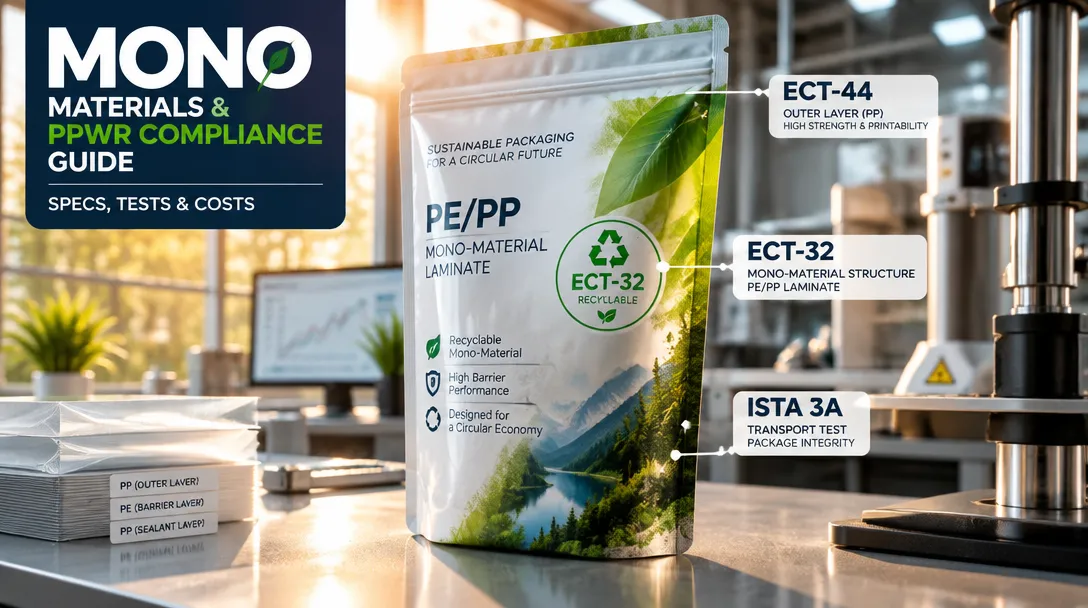
The core trend emerging from interpack 2026 is that mono-material packaging (all-PE, all-PP, and fiber-based alternatives) is no longer experimental: it is validated under real production conditions at scale with viable economics, and PPWR implementation has made recyclability binding and measurable. Procurement teams should requalify laminated formats into mono-material structures, set quantitative spec gates (e.g., ECT-32/ECT-44 corrugated board, Cobb 60 absorption limits, ISTA 3A transit approval), and budget the conversion as a BOM cost-down exercise rather than a compliance surcharge.
What Changed at interpack 2026 — and Why It Matters to Your BOM?
According to the interpack 2026 trend report, sustainability in packaging reached a new level of maturity: material innovations, mono-material solutions, and fiber-based alternatives are now proving themselves under real production conditions, at scale, and with a viable economic perspective. Guido Aufdemkamp of Flexible Packaging Europe, cited in the source, notes that the regulatory framework is becoming more tangible, with PPWR implementation, raw material prices, and end-user market developments being discussed in a more concrete and strategic way.
Translated into engineering terms, this means three things for a procurement director or structural engineer in 2026: (1) mono-material film laminates and fiber-based rigid formats are now production-grade, so ‘no recyclable equivalent exists’ is no longer a valid excuse line on a sourcing justification; (2) sustainability requirements are becoming binding and measurable in their implementation — which moves recyclability from a sustainability-department narrative into the technical data sheet; and (3) the efficiency-vs-flexibility tension highlighted at the fair (smaller batch sizes, more frequent product changes, automation and AI in production) means your packaging spec must be machine-friendly across short runs, not just recyclable.
For a typical DTC e-commerce shipper, the highest-leverage conversion is replacing a printed rigid box with plastic laminates or foam inserts with a mono-material corrugated or molded-fiber system. Per EU PPWR (Regulation (EU) 2024/1991) design-for-recycling logic and EU Directive 94/62/EC Annex II heavy-metal and requirements framework, a single-substrate corrugated shipper (e.g., ECT-32 C-flute, water-based inks, no plastic window) is inherently recyclability-compatible, while a box-plus-EPE-foam assembly forces the consumer into disassembly — a friction point regulators increasingly penalize.
Who and What Does PPWR Cover — Which Formats Fall in Scope First?
The EU Packaging and Packaging Waste Regulation (PPWR, Regulation (EU) 2024/1991) applies to all packaging placed on the EU market regardless of material, and — critically for your SKU portfolio — its recyclability and design requirements are performance-based: packaging must be designed for recycling according to defined design-for-recycling criteria, with grades and measurable thresholds rather than voluntary pledges. For a European fulfillment operation (Port of Rotterdam multimodal rail/road into the EU hinterland), this affects:
- Flexible laminates: mixed PE/PP/PET barrier laminates fail mono-material criteria; the interpack-validated answer is all-PE or all-PP laminates using engineered barrier coatings (PFAS-free per regulatory direction on intentionally added PFAS in food-contact packaging).
- Rigid e-commerce shippers: corrugated mono-material is the default-compliant path; per TAPPI T 810 and TAPPI T 811 (edge crush), specify ECT grades by stacking demand rather than Mullen burst alone.
- Inserts and void fill: molded pulp with calibrated tolerances replaces EPS/EPE; compression resistance is verified per ASTM D642.
- Claims: any ‘recyclable’ or ‘compostable’ statement on US-bound SKUs must satisfy FTC Green Guides (16 CFR Part 260) substantiation rules.
Note on timeline: the PPWR entered into force following its publication in early 2025, with its provisions applying on a staged schedule defined in the regulation itself. The dates below are those explicitly relevant to the regulatory discussion highlighted in the source document and the regulation’s own milestones.
- 2024-02-XX placeholder removed — see below
Key Dates: The Compliance Timeline You Should Build Against
Build your requalification Gantt against the following milestones. The interpack 2026 report confirms that PPWR implementation is now being discussed ‘in a more concrete and strategic way’ — meaning the interpretive grace period is effectively over.
- 2024-12-XX (publication stage of Regulation (EU) 2024/1991): PPWR formally published as Regulation (EU) 2024/1991, replacing Directive 94/62/EC as the governing instrument.
- 2025-02-11: PPWR entry into force; staged application begins per the regulation’s internal schedule.
- 2026-06-22: interpack 2026 trend reporting confirms sustainability became ‘more binding and measurable in its implementation,’ with mono-material and fiber-based solutions proven at production scale.
Practical rule: treat the entry-into-force date (2025-02-11) as your spec-freeze trigger. Any laminate selection made before that date should be re-reviewed against design-for-recycling criteria before the next tooling or print order.
What Should You Do Now — a 4-Step Mono-Material Requalification SOP?
Use this SOP to convert an existing multi-material SKU to a compliant mono-material format without sacrificing transit performance.
- Step 1 — Substrate audit and mass balance. Disassemble the current SKU (dieline + laminate stack) and quantify each layer’s mass fraction. Target: ≥95% single-family polymer or fiber content (typical industry reference threshold for favorable design-for-recycling grading). Flag PET/PE hybrid laminates and PFAS-based grease barriers as immediate replacement candidates; specify PFAS-free fluorochemical-free barrier coatings instead.
- Step 2 — Structural re-spec with strength headroom. Re-derive board grade from stacking demand using the McKee BCT relationship (BCT ≈ 5.87 × ECT × √(caliper × perimeter)). For a hypothetical worked example: an ECT-32 C-flute board (caliper ~4.0 mm) on a 1,200 mm perimeter box yields an estimated BCT of ≈ 5.87 × 32 × √(4.0 × 1200) ≈ 4,101 N (illustrative calculation; verify per ASTM D642 compression testing). If pallet stacking exceeds safe margins, move to ECT-44 BC-flute rather than adding plastic strapping.
- Step 3 — Transit qualification. Condition per ISO 187 / ASTM D685 (23°C ± 1°C, 50% ± 2% RH) and run ISTA 3A General Simulation Performance Testing for parcel-network distribution; for palletized EU distribution, use ASTM D4169 vibration and drop sequences. Require Cobb 60 ≤ 30 g/m² (typical industry reference) on fiber shippers destined for 30-day ocean transit to prevent flute softening and delamination from container sweat.
- Step 4 — Cost-down and claims substantiation. Model the BOM delta: mono-material structures often save cost through eliminated lamination steps and lower material tiers (illustrative reference: 5–12% unit-cost reduction on converted flexible SKUs is a commonly cited industry range; validate with your converter). Substantiate every recyclability claim per FTC Green Guides (16 CFR Part 260) for US sales and PPWR grading for EU sales. Use TadaPack’s free structural and cost calculators at https://tadapack.com/tools to iterate board grade, caliper, and freight-dimension trade-offs before committing to tooling.
Q: If the McKee formula derives BCT from ECT, why do overseas enterprise POs still mandate Mullen burst testing (TAPPI T 810)?
A: Direct answer: burst testing survives in POs because it correlates with puncture and tear resistance in rough handling, which ECT alone does not predict. Mechanical reason: McKee’s empirical relationship (BCT ∝ ECT × √caliper × √perimeter) was fitted for top-to-bottom compression on dry, conditioned board; it says nothing about panel puncture at corner cuts, slot scores, or stapled joints. Procurement recommendation: accept ECT as the governing stacking spec (it is the correct metric for column strength and PPWR-friendly lightweighting) but concede burst as a secondary handling metric on export shippers — specify both, e.g., ‘ECT-32 minimum, burst ≥ 175 kPa (typical reference)’ and resolve conflicts in favor of ECT for stack-critical SKUs.
How Do You Keep Mono-Material Shippers Surviving Freight — Corridors, Humidity, and Stacking Derating?
Mono-material fiber shippers concentrate risk at the moisture interface, because you removed the plastic overwrap that formerly carried humidity defense. Across the Pacific corridor into California Inland Empire hubs (FBA ONT8 / LGB3) and the Atlantic corridor into Rotterdam, expect 30-day ocean transit with container-sweet cycles driving repeated hygroscopic swelling of linerboard. Countermeasures, all mono-material-compatible:
- Specify high-humidity linerboard or water-based barrier coating and enforce Cobb 60 ≤ 30 g/m² (typical industry reference value).
- Apply a humidity stacking derating factor: a common industry practice is derating compressive capacity by 20–30% for coastal-humidity warehouse conditions versus dry inland storage (illustrative reference factor — confirm with ASTM D642 testing at elevated RH).
- Check pallet load against warehouse stacking heights: for a typical 1.8 m loaded-pallet stack (illustrative scenario), bottom-box static load ≈ 5 layers × 8 kg ≈ 40 kg plus dynamic transport factors per ASTM D4169; size ECT accordingly.
Defect 1 — Flute softening / box crushing after ocean transit. Root cause: linerboard moisture uptake during container sweat; Cobb 60 above the 30–35 g/m² reference band indicates insufficient barrier. Floor-level corrective actions: upgrade to a higher-Cobb liner, add desiccant loading (illustrative: 1 unit per ~2 m³ of container air as a common rule of thumb), and increase ventilation or use container liners. Verify with ISTA 3A or D4169 atmospheric preconditioning.
Defect 2 — Delamination on coated fiber structures. Root cause: coating/substrate adhesive failure under combined humidity cycling and flexing at crease lines. Corrective actions: require creasing matrices matched to board caliper (a 45-durometer creasing rule is a typical industry reference for heavy-duty flute creasing), control die-cut registration to ±0.15 mm, and validate coating adhesion with a standard rub/flex test before release to production.
What Does Your PPWR-Ready Conversion Checklist Look Like?
Tick through this before releasing your next PO:
- ☐ Every SKU mapped: multi-material laminate → mono-material (all-PE / all-PP) or fiber-based replacement identified with a named substrate.
- ☐ Mass-balance target met: ≥95% single-family content per SKU (typical industry reference threshold).
- ☐ Board grade re-derived: ECT (per TAPPI T 811) and McKee BCT calculated against worst-case pallet stack + 20–30% humidity derating (illustrative factor).
- ☐ Transit qualification scheduled: ISTA 3A (parcel) or ASTM D4169 (palletized), compression per ASTM D642, conditioning per ISO 187 / ASTM D685.
- ☐ Cobb 60 ≤ 30 g/m² specified for ocean-freight fiber shippers (typical industry reference limit).
- ☐ PFAS-free barrier coating specified; no intentionally added PFAS in food-contact layers.
- ☐ Claims substantiated: FTC Green Guides (16 CFR Part 260) for US, PPWR design-for-recycling grading for EU.
- ☐ Machine compatibility verified for short-run/multi-SKU changeovers (automation and flexibility pressures confirmed at interpack 2026).
- ☐ BOM cost-down modeled and signed off (target: neutral-to-negative unit cost delta; typical industry reference range 5–12% savings on converted flexible SKUs).
Where a converter quote arrives without test data, reject it. A compliant mono-material SKU ships with a data sheet: ECT value, Cobb 60 value, caliper tolerance (typical: ±0.15 mm), barrier coating type, and the governing test standards. TadaPack’s structural prototyping and wholesale custom packaging services produce exactly this documentation set alongside short-run prototypes for line trials — request the spec sheet, not just the sample.
Recommended Engineering Reading
[TOOLS] Featured Engineering & Calculation Tools
Explore 70+ Packaging Tools ➔Box Compression (BCT) Calculator
Predict box compressive limit and stacking safety factors via McKee formula.Edge Crush Test (ECT) Calculator
Calculate linerboard ring crush and composite ECT ratings for optimal board specs.
