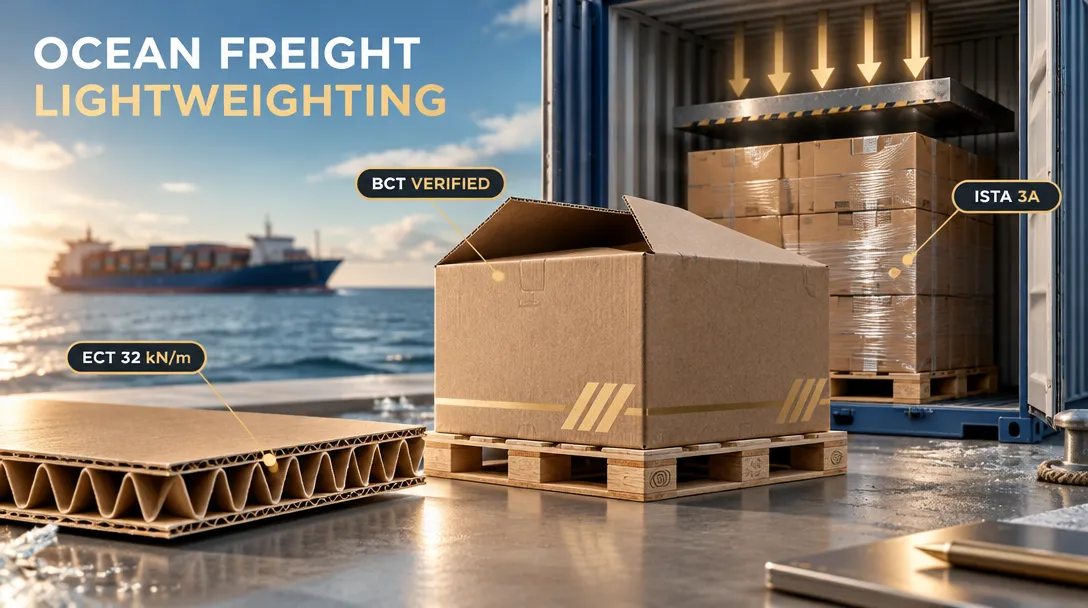
Ocean freight exposes corrugated packaging to sustained stacking, humidity cycling, handling impacts, and dimensional-weight economics. Packaging World provides industry context for packaging and testing decisions; the engineering recommendations below translate that context into a buyer-side validation method rather than attributing unpublished or unverified test results to the source.
- Use ECT and box geometry to screen designs with the McKee estimate, then verify compression performance on finished cases.
- ECT-32 and ECT-44 are board grades, not universal guarantees of shipping performance; moisture, dimensions, converting, and stack duration matter.
- Test the actual shipper, product, and unit load with an appropriate ISTA 3A or ASTM D4169 plan before approving a lighter specification.
- Compare total landed packaging and freight cost, including dimensional weight and damage exposure, rather than board price alone.
Ocean freight rewards verified strength per unit of board
Lightweighting is an optimization problem: remove material only when the redesigned package maintains required protection through the actual supply chain. Corrugated performance depends on edgewise compression, board construction, box perimeter, caliper, score quality, joint integrity, and the orientation and duration of stacking. A smaller or better-proportioned case can sometimes retain compression performance with less board, while an oversized design may waste both material and freight cube.
The McKee formula is a screening relationship that estimates box compression strength (BCT) from edge crush resistance (ECT), perimeter, and board caliper. A commonly used form is BCT in pounds-force ≈ 5.876 × ECT in pounds-force per inch × √(perimeter in inches × caliper in inches). Treat this as an estimate, not a certification: flute profile, box style, manufacturing variation, humidity, and loading conditions affect measured results. ASTM D642 provides a method for determining compressive resistance of shipping containers; testing should use representative finished cases and a documented conditioning and loading plan.
ECT-32 and ECT-44 indicate nominal edge-crush classes in common US trade usage, but a grade designation alone does not establish the BCT needed for a specific pallet pattern. E, B, and C single-wall flutes differ in caliper and cushioning behavior; BC double-wall combines flute profiles but adds material and may increase case dimensions. Select construction against both compression and product-protection requirements. TAPPI T811 is a recognized edgewise compression test method for corrugated fiberboard.
For a hypothetical comparison, hold box dimensions and board caliper constant and compare ECT-32 with ECT-44 in the McKee estimate: the higher ECT input raises predicted BCT, but the estimate does not quantify humidity loss or prove passage of a distribution sequence. Conversely, a geometry change that reduces perimeter may lower estimated BCT even when the board grade is unchanged. These relationships help identify prototypes; they do not replace testing.
Humidity and stacking change the usable strength
Ocean transit can expose cartons to moisture from container condensation, rain during handling, and humid port or warehouse conditions. Moisture uptake weakens paper fibers and can reduce compression performance; prolonged stack loads also create creep that a short laboratory compression test may not represent. A nominal dry-condition result therefore should not be treated as the full design allowance for a long international lane.
Specify conditioning and test environments that represent the risk, and record sample orientation, case closure, pallet pattern, top load, and exposure sequence. ISO 187 describes standard atmospheres for conditioning and testing paper, board, and pulps; use the applicable controlled atmosphere and document actual test conditions rather than assuming every supplier uses identical conditioning. Cobb 60, measured using TAPPI T441, characterizes short-duration water absorption of paper and board. It is useful for comparing materials, but no single Cobb 60 value guarantees that a finished case will resist delamination or retain BCT in ocean transit.
For barrier needs, evaluate repulpability and local recycling compatibility alongside moisture performance. PFAS-free barrier coatings can be considered where a coating is justified, but coating claims and recyclability should be substantiated for the actual material and market. Under the EU Packaging and Packaging Waste Regulation, Regulation (EU) 2025/40, packaging design and recyclability obligations are evolving; confirm applicable implementation dates and market-specific requirements with compliance counsel. In the United States, avoid unsubstantiated environmental marketing claims under the FTC Green Guides, 16 CFR Part 260.
At high-humidity coastal ports, allow for a more conservative stacking design than in controlled dry storage; do not apply a universal derating percentage without lane data or validation. For California Inland Empire fulfillment, the Texas DFW distribution triangle, or Rotterdam-connected road and rail movements, model the complete intermodal route. Account for pallet stability, forklift handling, and dwell time in addition to the ocean leg. Amazon FBA dimensional-weight and size-tier charges can make excess external dimensions costly even when the carton itself is inexpensive.
Validate the lightest design against its distribution hazards
Choose a test protocol based on the shipment, not the desired result. ISTA 3A is a general simulation test procedure for individually packaged products shipped through parcel delivery systems; it is not a universal ocean-container test. ASTM D4169 evaluates shipping units through distribution cycles selected for the applicable hazard profile. A parcel shipment that feeds an ocean leg may require a combined, justified sequence or a broader unit-load plan. Include vibration, drops or impacts, and compression hazards as relevant to the actual route and package configuration.
Use a controlled comparison: test the incumbent and proposed lightweight design with equivalent product mass, closure, palletization, and conditioning. Record ECT, caliper, case dimensions, BCT, package damage, and product function. If molded pulp is used as an internal component, specify fit and dimensional tolerances against the product and test for movement after conditioning; the cushioning component does not compensate for a weak outer shipper. Dieline revisions should preserve adequate score-to-slot geometry, joint overlap, and converting registration, with tolerances agreed with the converter and verified on production-representative samples.
Design target: the lowest material specification that passes the agreed distribution protocol with documented margin under representative moisture and stacking conditions. This is more defensible than setting an arbitrary percentage reduction in board weight.
Make procurement savings measurable before release
Compare total cost per successfully delivered unit. A useful hypothetical cost-down model is: annual net value = material savings per case × annual case volume + verified freight savings − incremental tooling, testing, and expected damage cost. Include board consumption, converting yield, pallet count, cube utilization, dimensional-weight effects, and claims exposure. Do not enter a current market price unless it is supported by a supplier quotation for the relevant grade, region, and order volume; paper and freight pricing vary by contract and lane.
Procurement should request matched quotations for the current and proposed dielines, specifying board grade, flute combination, caliper tolerance, print coverage, annual volume, order releases, and delivery location. Ask converters to disclose whether the quoted grade is an ECT specification and how it is verified. A lower unit price is not a saving if increased case dimensions trigger freight charges or reduced compression causes product loss.
Use this four-step release SOP:
- Step 1 — Define the load: document gross product mass, case dimensions, pallet pattern, maximum stack height, transit duration, and known moisture exposures.
- Step 2 — Screen the design: compare ECT-32, ECT-44, flute options, and candidate dielines using a McKee BCT estimate; label all calculations as preliminary.
- Step 3 — Prototype and test: build production-representative samples, verify dimensions and closure, then test compression and the selected ISTA 3A or ASTM D4169 distribution sequence.
- Step 4 — Approve procurement controls: set board and dimensional acceptance criteria, confirm supplier test records, and review damage and freight data after launch.
For a design-specific review, TadaPack can support custom structural packaging and CAD prototyping. Use the TadaPack calculation tools to check preliminary carton and freight scenarios, then confirm assumptions with converter samples and formal testing.
Recommended Engineering Reading
[TOOLS] Featured Engineering & Calculation Tools
Explore 70+ Packaging Tools ➔CBM Volume & Freight Dim-Weight Calculator
Calculate cubic meters & dimensional weight to minimize freight costs and avoid FBA size tier penalties.Mailer Box Area & Dieline Size Calculator
Instant flat dieline dimensions, material consumption, and sheet nesting for custom D2C mailer boxes.
