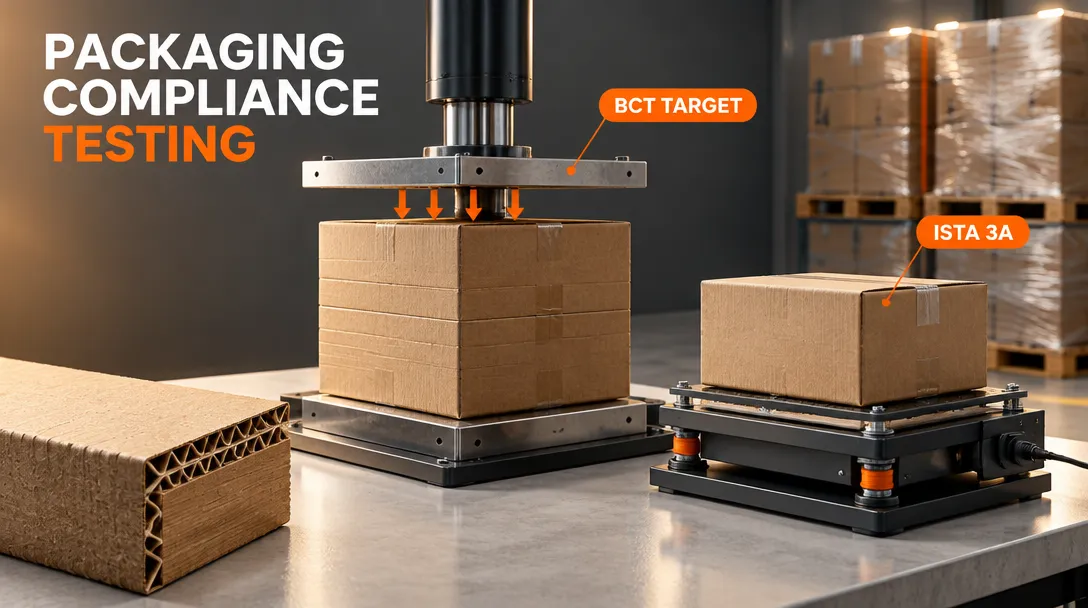
A compliant shipper needs a defined material specification, a load-based compression target, and distribution testing matched to its parcel or freight route; ECT-32 and ECT-44 are board grades, not guaranteed box BCT values. Use McKee only for preliminary sizing, then validate the production configuration with ISTA 3A for applicable parcel shipments or a suitably selected ASTM D4169 distribution cycle.
Packaging World is a trade publication of PMMI Media Group that reports on packaging technology, manufacturing, and testing practice. This article uses that publication as industry context, not as a substitute for a controlled standard, a laboratory report, or a regulatory determination. The engineering recommendations below are a secondary synthesis: confirm test scope, specimen conditioning, acceptance criteria, and applicable regional obligations with the customer, laboratory, and current standard text.
What changed in packaging compliance, and why should buyers separate rules from tests?
Packaging compliance is not one universal pass/fail test. Buyers must distinguish regulatory obligations—such as packaging waste and recyclability requirements—from performance verification, which asks whether a specific pack survives its distribution hazards. A package can pass a drop sequence and still fail a recyclability claim review; conversely, recyclable materials do not establish transit protection.
For European procurement, Regulation (EU) 2025/40 on packaging and packaging waste (PPWR) entered into force on 11 February 2025 and generally applies from 12 August 2026, subject to its specific provisions and transition rules. It creates a changing compliance landscape around packaging minimization, recyclability, and documentation. Determine the requirement applicable to the product, packaging component, placing-on-market date, and responsible economic operator rather than treating one date as a blanket deadline. In the US, packaging claims also need substantiation; the FTC Green Guides, 16 CFR Part 260, address environmental marketing claims, including recyclability claims.
Performance standards answer different questions. ISTA 3A is a general simulation test for packaged products shipped through individual parcel-delivery systems; it is not a universal certification for every parcel, freight lane, or package configuration. ASTM D4169 provides a framework for performance testing of shipping containers and systems using distribution cycles selected for the hazard. ASTM D642 measures compressive resistance of shipping containers, while TAPPI T810 addresses bursting strength of paperboard and corrugated board. Name the method and configuration in the purchase order: “tested to standard” without the package, conditioning, sequence, and acceptance criteria is incomplete.
Who and what should a packaging compliance specification cover?
A useful specification covers the complete shipped system: primary product, cushioning or molded pulp, inner supports, corrugated shipper, closure, labels, and palletization where relevant. Record product mass and dimensions; package orientation; shipper internal and external dimensions; closure method; board grade and flute; insert material; and the distribution channel. Include the bill of materials and approved CAD dieline revision so that the tested sample can be reproduced.
Board ECT is a material edge-compression property, commonly specified in lb/in in the US. ECT-32 and ECT-44 identify different edge-crush performance grades; neither alone predicts box compression strength. BCT is the load at which a complete box fails in compression. The McKee relationship is a preliminary estimate connecting box compression to ECT, board caliper, and box perimeter. A commonly used simplified form is BCT (lbf) ≈ 5.87 × ECT (lb/in) × √(caliper in × box perimeter in). This is an estimate, not a guaranteed design value: dimensions, score lines, openings, joint, moisture, print, stacking duration, and converting quality affect actual performance. Use measured or supplier-declared inputs and validate the finished box using ASTM D642 when compression performance is a critical requirement.
Hypothetical worked example: For an illustrative regular slotted container with ECT 32 lb/in, 0.16 in board caliper, and 60 in perimeter, the simplified McKee estimate is about 1,090 lbf. This is not a test result or a design acceptance value. If the box must support a sustained stack, apply an explicit safety factor for warehouse time, humidity, pallet overhang, and load distribution, then confirm the design on representative production samples. Do not infer that an ECT-44 board automatically permits a thinner box without checking geometry and conversion effects.
Material controls matter as much as the calculation. Record the nominated flute—E, B, C, or BC—and supplier caliper range; caliper is a board property, not a fixed universal value for each flute construction. For a printed folding carton, 350 gsm CCNB may be a candidate facing stock, but its suitability depends on stiffness, print, barrier, and product contact requirements. Cobb 60, measured under ISO 535 or TAPPI T441, quantifies water absorption over the specified test exposure; set a project-specific limit based on exposure and adhesion risk instead of presenting one universal failure threshold. PFAS-free barrier coatings should be supported by supplier declarations and claims documentation, not inferred from the word “paper.”
For molded pulp, define the drawing datum, critical dimensions, nesting, fit, and allowable variation with the converter. Tolerance is design- and process-specific; do not assume molded pulp has the same dimensional capability as a machined component. A CAD dieline and physical prototype should confirm clearance, compression zones, closure, and insertion sequence before tooling release.
When should you use ISTA 3A, ASTM D4169, or a material test?
Select testing from the distribution profile, not from whichever test name appears most often in a supplier quotation. ISTA 3A is appropriate to evaluate applicable packaged products moving through parcel-delivery systems, with the test configuration selected for the shipment category. ASTM D4169 is useful when the distribution cycle and assurance level can be selected to represent the intended shipping environment. A lab should confirm the current procedure, sample configuration, conditioning, and sequence before a protocol is written into a contract.
Use ASTM D642 for box compression, ASTM D5276 for free-fall drop testing where applicable, and ASTM D999 for vibration testing of shipping containers. These material or hazard-specific tests can support diagnosis, but do not automatically replace a distribution simulation. Condition samples consistently: ASTM D685 covers standard conditioning and testing atmospheres for paper, board, pulp handsheets, and related products. The often-used paper atmosphere of 23°C ± 1°C and 50% ± 2% relative humidity is associated with ISO 187; verify the applicable method and tolerance in the current standard before specifying it. Conditioning is important because moisture can reduce corrugated compression performance and contribute to adhesive or coating failures.
Field testing supplements controlled laboratory work. Log shipment route, carrier, package orientation, temperature and humidity exposure where available, damage mode, product function, and photographs. Keep the sample identity and production revision traceable. A field failure is evidence to investigate, not proof that a particular standard was violated: inspect whether the tested and shipped package had the same board, dimensions, closure, inserts, and process settings.
Practical decision rule: use ECT and caliper to screen board choices, McKee to compare preliminary box concepts, Cobb 60 and supplier coating data to screen moisture risk, then test the completed package against the distribution hazard. Amazon FBA dimensional-weight charges and size tiers can make oversizing costly, but current fees vary by marketplace, category, and program. Check the applicable seller fee schedule; reduce dimensions only after clearance, protection, and test performance remain acceptable.
What should procurement and engineering do now to verify compliance?
Put a controlled verification plan into the RFQ and release process. Request the material declarations, board grade, flute construction, caliper range, recycled-content or recyclability substantiation where claimed, and any barrier or PFAS-related documentation required for the intended market. Require the converter to identify substitutions before production. For structural packaging, TadaPack can support custom dieline development and prototyping; its online calculation tools at tadapack.com/tools can help teams screen design inputs before laboratory verification.
- ☐ Define shipped-product mass, dimensions, orientation, destination markets, distribution channel, and worst-case credible hazards.
- ☐ Freeze the CAD dieline and BOM revision; specify ECT grade, flute, caliper range, closure, insert, and approved substitutions.
- ☐ Document the McKee estimate and assumptions; set a compression acceptance criterion using the real stacking load, duration, humidity, and safety margin.
- ☐ Set a project-specific Cobb 60 or other moisture-performance requirement when exposure or adhesive integrity makes water uptake relevant.
- ☐ Select ISTA 3A or an ASTM D4169 distribution cycle with the laboratory; state conditioning, sample count, sequence, and functional pass criteria.
- ☐ Test production-representative packs, review field data, and requalify after material, dimension, closure, or supplier changes.
- ☐ Review EU PPWR obligations and environmental claims for each market and effective provision; retain substantiation and supplier records.
Verification timeline:
- 11 February 2025 — Regulation (EU) 2025/40 entered into force.
- 12 August 2026 — The PPWR generally begins to apply, subject to specific provisions and transition rules.
For a cost-down, compare total landed cost rather than board price alone. A lighter or smaller shipper may reduce material and dimensional freight cost, but can increase damage, returns, and rework. Use the same product, route assumptions, acceptance criteria, and test configuration when comparing candidates. Where no evidence exists, label the comparison as a design estimate—not a measured saving. The release decision should be supported by a traceable specification, engineering rationale, and test report for the approved pack.
Recommended Engineering Reading
[TOOLS] Featured Engineering & Calculation Tools
Explore 70+ Packaging Tools ➔Box Compression (BCT) Calculator
Predict box compressive limit and stacking safety factors via McKee formula.Edge Crush Test (ECT) Calculator
Calculate linerboard ring crush and composite ECT ratings for optimal board specs.
