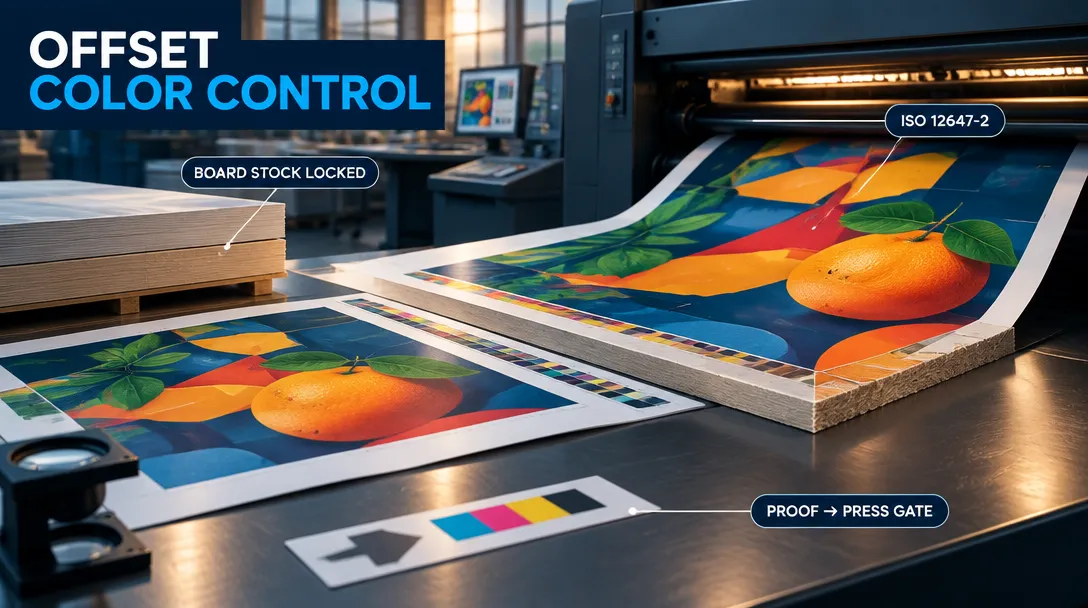
- ISO 12647-2:2013 explicitly applies to printing on cardboard material for packaging and covers colour separation, proof production, forme making, OK print and production printing.
- A standard is a process-control framework, not a guarantee that two different cardboard stocks will look identical or behave identically in finishing.
- Approve colour on the intended production substrate, then verify the converted and finished package—not only a flat press sheet.
- Keep print acceptance, structural performance and freight testing as separate but coordinated procurement gates.
Packaging artwork is only one input to a repeatable production result. Substrate shade, surface, print sequence, drying method, coating and converting can all affect the appearance or usability of a carton. The practical engineering task is to translate an offset-printing standard into a controlled specification that links the approved image to the actual board, dieline and supply chain.
1. Treat ISO 12647-2 as a process framework, not a universal colour promise
ISO 12647-2:2013 specifies process parameters and values for producing colour separations, printing formes and print production for four-colour sheet-fed and web-fed offset, excluding coldset offset lithography on newsprint. Its scope includes colour separation, proof production, forme making, OK print and production printing on commercially available production substrates. It is directly applicable to press proof prints, can apply to processes with more than four process colours where direct analogies to four-colour printing are maintained, and applies to packaging cardboard and drying methods including heat-set, infrared and ultraviolet. It also provides references for quality assurance and quality management. The ISO page identifies a fourth edition under development as a committee draft under ISO/TC 130; that is not a published replacement in the cited source.
For procurement, the key distinction is scope versus outcome. The standard gives a shared process reference; a buyer still needs to identify the board grade, print condition, proof type, finishing operations and acceptance approach for the specific job. A change from a coated folding carton board to a recycled or uncoated grade should trigger review rather than an assumption of visual equivalence.
2. Freeze the cardboard specification before approving colour
Write the substrate into the purchase specification by commercial grade and supplier, not merely as “cardboard.” Record whether the construction is folding carton board such as CCNB, solid board, or a corrugated combination; state the printable face, nominal basis weight or caliper where supplier data supports it, and identify any coating or recycled-content variation. As an illustrative procurement scenario, a 350 gsm CCNB callout is not enough on its own: the board maker, surface finish, reverse-side construction and allowed substitutions should also be named or controlled.
Board shade and surface alter the perceived result even when the ink film and press setup are held constant. Therefore, establish an approved reference on the intended stock. If production may use more than one source, request representative material from each source and assess it under the same viewing and approval process. Do not silently transfer a proof made on a different substrate and treat it as a final production target.
For corrugated packs, printing may occur on a liner or a separate litho-laminate. Identify the actual print surface and the converting route. E-, B-, C- and BC-flute constructions have different geometry and compression behaviour; their presence in the package design does not establish a colour tolerance. Keep the print appearance specification separate from the ECT requirement and the box-compression objective.
3. Make the proof-to-press handoff an explicit control gate
Define what “approved” means before artwork release. A controlled handoff should identify the colour-managed file, the proof type, the substrate used for proofing, the named approval authority, and how production compares with the approved reference. The cited ISO scope includes proof production and is directly applicable to press proof prints; in practice, buyers should state whether they are approving a contract proof, a press proof or an OK print. These are not interchangeable approval labels.
At press start, retain the approved OK print as the production reference and record the job identity, board lot or supplier designation, ink set, press line, drying method and finishing path. This is a recommended traceability practice, not a claim that the cited ISO page specifies these particular records. Agree with the converter how colour deviations will be handled: stop and correct, seek written approval, or segregate affected output. Avoid vague instructions such as “match previous run” unless the previous run is itself documented and the substrate and finish remain comparable.
For graphics with brand-critical solids, fine type, overprints or large areas of dark coverage, include those features in the approval review. Evaluate registration and legibility at production scale. If the package will be laminated, varnished, foil-stamped or otherwise finished, assess a finished sample before release: the visual and functional target is the converted pack, not simply the unconverted sheet.
4. Separate print acceptance from structural and transit qualification
Colour approval does not demonstrate that the package protects the product. Specify print appearance controls alongside, but independently from, structural measures such as ECT, box compression and distribution testing. ECT-32 and ECT-44 are common corrugated board strength designations in commercial discussions; they must be confirmed against the supplier’s board specification and the applicable test method rather than inferred from a printed pack sample.
McKee-style box-compression estimates can help screen a corrugated design using board edge crush strength, caliper and box geometry. Treat such calculations as estimates, not guaranteed box performance: dimensions, converting quality, load duration, humidity, stacking pattern and package openings affect the result. If the shipment risk justifies it, define an appropriate distribution test plan, for example using an agreed ASTM D4169 distribution cycle or an applicable ISTA 3A procedure. Select the protocol and acceptance criteria for the shipment profile; do not claim compliance merely because a test name appears in a purchase order.
Likewise, a Cobb 60 water-absorption result may inform moisture-risk decisions for paper-based materials, but it is not a substitute for evaluating the complete package. Establish limits from the board supplier’s data, product exposure and transit needs; do not apply an invented universal delamination threshold. For e-commerce packs, test the complete packed configuration and assess dimensions and mass against the relevant carrier or fulfillment program’s current rules. Dimensional freight charges can make an oversized design costly even when its print quality is excellent.
5. Control converting interactions in the production specification
Offset printing and carton conversion meet at practical process interfaces: sheet layout, grain direction, registration, creasing, folding, glue areas and surface finishing. Use the approved dieline as the shared production reference and ensure that artwork, print marks and finishing layers align to the converter’s released file. Any dieline revision should be rechecked against artwork and structural samples; a nominally minor panel adjustment can move a logo, barcode or critical copy into a crease or glue zone.
Specify where ink or coating is restricted, particularly in adhesive areas and folds where the finish may affect bond or cracking. Request production samples that show the actual print, crease, fold and glue operations. For a high-volume job, agree on a sampling and sign-off plan with the converter before the run begins. Tolerances for registration, die position and fold performance must be stated by the buyer and supplier for the specific equipment and design; do not copy a generic numeric tolerance into a contract without confirming capability.
When changing coatings, including barrier coatings marketed as PFAS-free, confirm the exact supplier declaration and assess printability, adhesion, folding and end-of-life claims for the intended market. A marketing description is not a performance specification. Coordinate material documentation with the brand’s regulatory and sustainability teams, and avoid claiming recyclability or compliance based solely on the coating name.
6. Use a release checklist that links press, package and purchase order
The most reliable update is a controlled specification revision, not an informal request to “use the latest offset standard.” Assign ownership for the print reference, substrate approval, structural design and shipment qualification. On each change, identify whether it affects artwork, material, print conditions, finishing, carton strength or the distribution test plan.
- ☐ Cite ISO 12647-2:2013 as the agreed offset process reference where applicable, and verify any newer edition directly with ISO before contract revision.
- ☐ Name the exact cardboard grade, printable face, supplier or substitution rules, and finishing route.
- ☐ Identify the proof and OK-print approval method, approved reference and responsible signatories.
- ☐ Review the converted sample for colour appearance, registration, legibility, folding, adhesive performance and finish.
- ☐ Specify ECT or other structural requirements independently; calculate BCT only as a screening estimate and confirm with a suitable test plan.
- ☐ Select distribution testing and acceptance criteria for the actual shipment profile; record the relevant protocol in the purchase order.
- ☐ Recheck package dimensions, packed weight and freight implications when the dieline or board construction changes.
Bottom line: ISO 12647-2:2013 is directly relevant to offset printing on packaging cardboard, but repeatability comes from controlling the production substrate, proof-to-press approval and converting route as one documented workflow. TadaPack can support custom structural packaging and prototyping to align the printed pack with its dieline and shipping requirements; use the TadaPack calculation tools at tadapack.com/tools for preliminary engineering checks, then confirm critical performance with your supplier and an appropriate test plan.
Recommended Engineering Reading
[TOOLS] Featured Engineering & Calculation Tools
Explore 70+ Packaging Tools ➔Box Compression (BCT) Calculator
Predict box compressive limit and stacking safety factors via McKee formula.Edge Crush Test (ECT) Calculator
Calculate linerboard ring crush and composite ECT ratings for optimal board specs.
