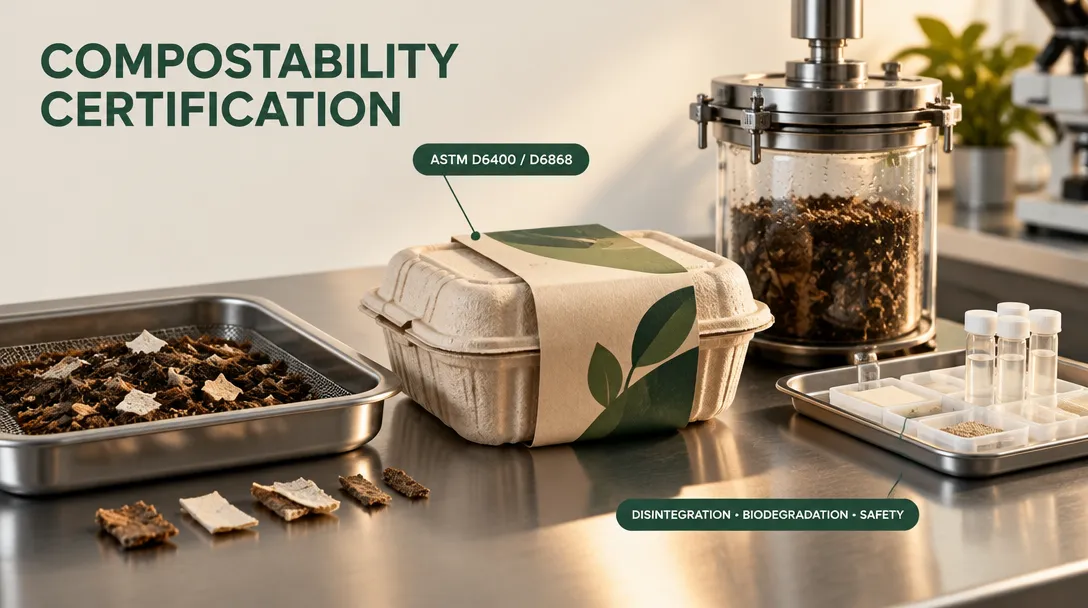
BPI certification depends on a material’s intended use: ASTM D6400 applies to plastics, while ASTM D6868 applies to coatings on paper and fiber. The cited BPI explanation describes disintegration within 12 weeks alongside biodegradation and safety checks; certification does not replace separate package strength, transit, or market-acceptance validation.
For packaging buyers, the engineering decision is not simply whether a resin or coating is bio-based. It is whether the complete package is eligible for the relevant compostability pathway, can be substantiated through certification, and still protects the product through converting, fulfillment, and transport. BPI describes commercial compostability certification around ASTM D6400 and ASTM D6868; structural design remains a separate workstream that can use ECT, McKee-based compression estimates, and distribution testing such as ASTM D4169.
What does BPI compostability certification actually require?
The BPI source distinguishes “compostable” from a broad “biodegradable” claim. Its explanation identifies three central checks: disintegration within 12 weeks, microbial biodegradation into carbon dioxide, water, and biomass, and eco-toxicity testing that includes heavy-metal screening. It also describes third-party review in accredited laboratories and field validation. These are source-reported points, not measurements by TadaPack.
The source identifies ASTM D6400 as the route for plastics and ASTM D6868 for coatings on paper and fiber. That distinction matters at the package-system level: a fiber substrate does not automatically establish that its coating, adhesive, ink, or other component is suitable for the intended certification. Confirm the scope of the candidate product and the exact construction with the certification program before freezing a bill of materials (BOM). Do not infer that certification of one material automatically covers a finished package or a different formulation.
BPI describes certified products as designed for aerobic, thermophilic commercial composting conditions. It separately describes its Home Compostability Certification as using time-based disintegration testing for lower-temperature backyard systems. These are different environments and claims; a commercial certification should not be presented as proof of home compostability. The source also warns that uncertified “biodegradable” or “plant-based” materials may fragment into persistent microplastics. For procurement, request evidence for the actual product and claim rather than relying on a feedstock description or supplier assurance alone.
The stated process sequence is useful for material selection: hydrolysis and enzymatic action support breakdown, microbial metabolism follows, and compost maturity and safety checks include seed germination, plant growth, and heavy-metal screening. In other words, visible fragmentation alone is not the performance endpoint described by the source. Buyers should keep certification evidence, material identity, intended disposal route, and finished-package specification aligned.
Who and what should packaging makers include in the scope?
Start with the sellable package as a bill of materials, not with the headline substrate. Map each component that could affect the claim: plastic film or formed plastic, paper or fiber, coatings, labels, closures, adhesives, and inks. This is a practical scoping method, not a claim that every listed component has an identical test requirement. Ask the certification body which components and configurations are covered and whether changes in supplier, formulation, color, thickness, or converting process require a scope review.
Separate the compostability evidence from the mechanical performance specification. For corrugated shipping cases, ECT-32 and ECT-44 are common edge-crush design references, but the correct board depends on box geometry, payload, distribution, and stacking. A McKee-based estimate can help screen box compression performance using board edge crush and box dimensions; treat it as an estimate, not a substitute for a finished-box compression test or shipment validation. A stronger grade can increase material cost and dimensional weight without solving a weak closure, poor fit, or an unprotected product.
For paper-based formats, specify the actual board construction and converting details, including basis weight, flute profile where applicable, crease geometry, adhesive, coating, and print coverage. A nominal 350 gsm CCNB facing or E-, B-, C-, or BC-flute construction is a design input, not evidence of compostability or a guaranteed strength value. Likewise, molded pulp needs supplier-specific dimensional tolerances and a fit check against the product; do not assume an interchangeable fit across tooling or production sources.
Build two acceptance plans. The first addresses the certification pathway and claim scope. The second addresses package function: dimensional inspection, closure integrity, compression risk, and distribution simulation appropriate to the channel. ASTM D4169 can be selected as a distribution testing framework, while ISTA 3A may be relevant to parcel-distribution validation; neither establishes compostability certification. For moisture-sensitive paper structures, assess coating and converting effects, and consider Cobb 60 water-absorption testing as a material-control measure where appropriate. Set pass/fail limits from the product and package requirements rather than borrowing an unsupported universal threshold.
What dates and decision points should procurement track?
The cited BPI page is the evidence base for this explainer. Its publication date is the only dated event available in the supplied source information; it does not establish a future compliance deadline or a revision timetable for the cited ASTM standards. Avoid putting an unverified certification deadline into a supplier contract. Instead, ask suppliers and the certification body to confirm current program requirements and the status of the specific product listing at the point of purchase.
- 2026-05-04 — The cited BPI document date supplied for this review; it explains the certification distinctions and testing concepts summarized above.
For a launch, use project gates rather than an assumed regulatory date: scope the intended claim, confirm the applicable standard and certification route, lock the package construction, and then complete structural and distribution validation. Maintain a change-control trigger for any alteration to formulation, coating, adhesive, or component supplier. A changed BOM can create a gap between the tested or reviewed article and the production article; ask the certifier whether the change affects coverage before release.
For cost review, compare total delivered performance rather than unit material price alone. A useful procurement model is: annual package spend = unit package cost × forecast units + tooling amortization + expected freight and damage costs. This is an illustrative calculation framework, not a TadaPack quotation or market price benchmark. Build scenarios using supplier quotes, forecast volumes, actual dimensions, and your own damage assumptions. Reducing board grade or coating weight should be evaluated against fit, product protection, certification scope, and distribution results—not treated as a guaranteed cost-down.
What should packaging makers do now to qualify a design?
Use a documented sequence that keeps claims, material scope, and physical performance connected. First, write the intended disposal claim and market use in the design brief. Second, identify whether the construction is a plastic route or a paper-and-fiber coating route, then verify the appropriate certification scope. Third, freeze a controlled BOM and produce production-representative prototypes. Fourth, assess structural and transit performance independently, recording the test method and acceptance criteria agreed with the brand and supplier.
For structural optimization, compare candidate designs with the same product, internal dimensions, and distribution assumptions. A hypothetical example: if a case moves from ECT-32 to ECT-44, do not assume the higher ECT alone guarantees a successful shipment; use the change as an input to a McKee-based screening estimate, then verify the finished case and distribution performance. Likewise, a material reduction that lowers package mass may affect compression, converting yield, moisture response, or fit. The engineering objective is the least-cost qualified design, not the lowest nominal board grade.
Buyer checklist:
- ☐ Define the exact compostability claim and intended disposal environment: commercial composting or home composting.
- ☐ Confirm whether ASTM D6400 or ASTM D6868 is the relevant pathway for the proposed material construction.
- ☐ Request current certification evidence and confirm that the product identity and BOM match the offered production package.
- ☐ List paper, plastic, coatings, labels, adhesives, inks, and closures for scope review with the supplier or certification body.
- ☐ Specify structural requirements separately, including dimensions, ECT target where applicable, closure design, and distribution test plan.
- ☐ Use ASTM D4169 or ISTA 3A only as an appropriate distribution-validation choice, not as proof of compostability.
- ☐ Review Cobb 60 or other moisture-related controls when paper performance and the intended route make them relevant; establish project-specific limits.
- ☐ Compare supplier quotations using total package cost, tooling, freight implications, and validated performance—not unverified 2026 price averages.
- ☐ Reassess certification scope after any material, supplier, formulation, or construction change.
TadaPack can support custom structural packaging development and prototyping to evaluate fit, board construction, dielines, and transit requirements alongside a separately managed certification review. Use the TadaPack calculation tools at https://tadapack.com/tools to support preliminary packaging calculations; confirm design decisions with supplier specifications and appropriate testing. No TadaPack laboratory measurements or customer test records are asserted here.
Recommended Engineering Reading
[TOOLS] Featured Engineering & Calculation Tools
Explore 70+ Packaging Tools ➔CBM Volume & Freight Dim-Weight Calculator
Calculate cubic meters & dimensional weight to minimize freight costs and avoid FBA size tier penalties.Mailer Box Area & Dieline Size Calculator
Instant flat dieline dimensions, material consumption, and sheet nesting for custom D2C mailer boxes.
