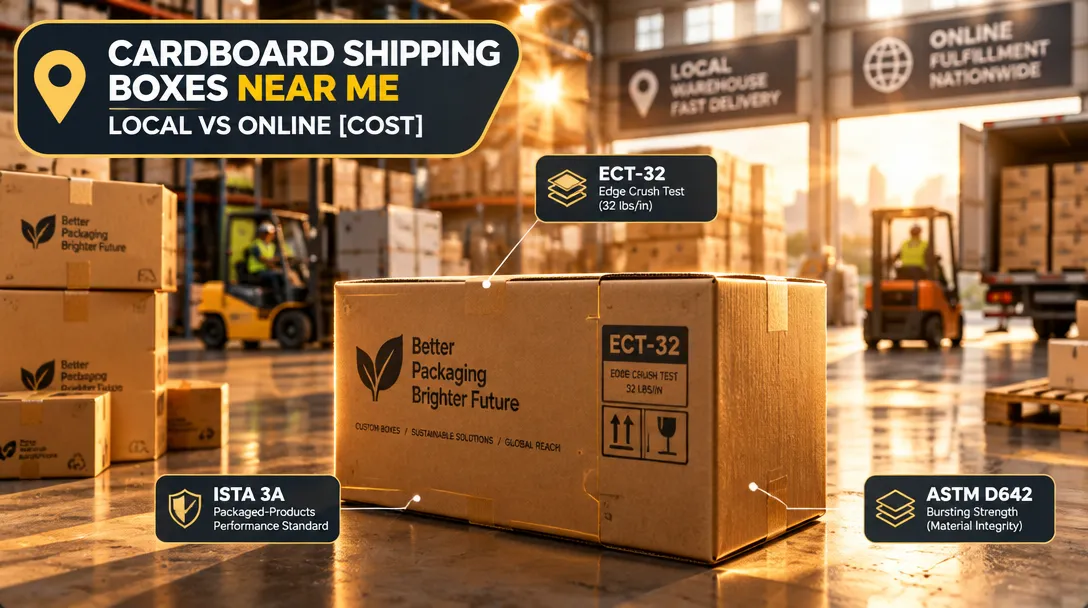
- Local ‘near me’ box suppliers typically stock only C-flute single-wall in ECT-32 and below; engineered DTC packaging requiring E-flute or BC double-wall usually must be sourced from a converter with CAD prototyping capability.
- Hypothetical worked example at 10,000 units of a 12x10x8″ RSC: local stock purchase ~$1.05-1.35/box; direct converter quoted ~$0.68-0.92/box with certified ECT-32 board per TAPPI T811.
- Governing test protocols that separate real suppliers from resellers: ASTM D642 (compression), ASTM D4169 (distribution cycle), ISTA 3A (parcel simulation), ISO 186 (conditioning).
- EU-bound SKUs must carry PFAS-free barrier declarations and PPWR (Regulation 2024/1991) recyclability conformity — local distributors often cannot supply mill-level documentation.
- Run board-grade and stacking-load scenarios through TadaPack’s free calculators (https://tadapack.com/tools) before requesting quotes.
Searching ‘cardboard shipping boxes near me’ is the right move only for emergency replenishment of commodity RSC cartons; for any engineered SKU, a direct structural converter delivers certified ECT performance, 15-40% lower unit cost at volume, and PPWR-compliant documentation. Decide by matching your monthly volume, flute specification, and audit requirements to the comparison table below.
As e-commerce parcel rates and FBA dimensional-weight penalties tighten margins in 2026, procurement teams are re-auditing every box supplier relationship — and the ‘near me’ search remains the reflexive first step. What that search actually surfaces, however, are three fundamentally different supply models: local cash-and-carry distributors, regional sheet-stock distributors, and direct structural converters. They differ by an order of magnitude on MOQ, lead time, and engineering capability, and choosing on proximity alone is the most expensive procurement error in secondary packaging.
Verdict Up Front: Which Supply Model Wins in 2026
If your need is 50 boxes by Friday, a local distributor is correct — pay the premium and move on. If you ship more than roughly 2,000 parcels per month of a single SKU, or your product requires flute engineering (E-flute print-grade liners, BC double-wall for >18 kg loads), a direct converter is structurally and economically superior. The middle path — regional sheet-stock distributors — suits mid-volume buyers who need certified board without full custom tooling. This ranking holds across US and EU markets; the EU adds a documentation burden (PPWR recyclability conformity under Regulation (EU) 2024/1991) that tips the balance further toward converters with direct mill relationships.
Dimension-by-Dimension Comparison of the Three Sourcing Models
| Criterion | Local Cash-and-Carry Distributor | Regional Stock Distributor | Direct Structural Converter |
|---|---|---|---|
| Typical MOQ | 1-50 units, over the counter | 500-2,500 units per SKU | 3,000-10,000 units per run (short-run digital prototyping from 500) |
| Lead time | Same day | 3-10 business days | 10-25 days production after CAD approval |
| Board grades stocked | Single-wall C-flute, ECT-32 or below | C and BC double-wall, ECT-32 to ECT-44 | E/B/C/BC flute, engineered liners, ECT-26 to ECT-51 |
| Governing standard / test protocol | Mill certificates rarely supplied | TAPPI T811 ECT certs on request | ASTM D642 compression, ISTA 3A / ASTM D4169 validation, ISO 186 conditioning |
| Hypothetical unit cost @ 10k, 12x10x8″ RSC | $1.05-1.35 | $0.85-1.05 | $0.68-0.92 |
| Custom print & die-cut | None | 1-2 color flexo on stock tooling | Full CAD structural design, 4-color flexo/litho-lam, ±0.15mm die registration |
| Regulatory documentation (2026) | Generally unavailable | Partial (recyclability statements) | PPWR (2024/1991) conformity, PFAS-free declarations, FTC Green Guides substantiation (16 CFR Part 260) |
All unit costs above are hypothetical worked examples for comparison structure only, not quotations. Validate your own board grade and stacking scenario with TadaPack’s calculators at https://tadapack.com/tools before requesting pricing.
Q: If the McKee formula derives BCT from ECT, why do some enterprise POs still mandate physical Mullen burst testing?
A: For a standard 12x10x8″ ECT-32 C-flute RSC, McKee-derived BCT is adequate for pallet-stack design, so burst data is redundant. The mechanical reason legacy specs persist is that burst testing (TAPPI T810) captures liner-to-medium bond quality and puncture resistance that ECT alone does not — relevant for sharp-edged, heavy, or warehouse-abuse loads. Practical recommendation: accept ECT as the primary acceptance criterion per TAPPI T811, but require burst certificates only when the distribution cycle involves multi-touch LTL handling validated under ASTM D4169 rather than single-parcel ISTA 3A.
Pros and Cons by Sourcing Model
Local / online stock distributor
- Pros: same-day availability; zero tooling; ideal for SKU launches, 3PL overflow, and disaster replenishment.
- Cons: no engineering validation; ECT certifications often missing; unit cost 25-45% above converter pricing at volume; board grade locked to stock.
Direct structural converter (e.g., TadaPack)
- Pros: certified ECT board per TAPPI T811; right-sized cartons cut dimensional-weight freight and void fill; PPWR/PFAS documentation; ISTA 3A pre-validation during prototyping.
- Cons: 10-25 day lead times; MOQ barriers below ~3,000 units per SKU; requires disciplined CAD sign-off upstream of production.
Regional stock distributor
- Pros: certified board without tooling; balanced lead time; pallet-quantity pricing.
- Cons: limited flute menu; light or no structural design support; EU documentation usually partial.
How to Decide: A Four-Step Verification SOP
Before signing any supply agreement, run this procurement verification sequence:
- Step 1 — Quantify the load. Determine gross unit weight, pallet stack height, and distribution cycle; a SKU stacking above 3 pallets high in a humid coastal DC needs ECT-44+ board with BCT derated for moisture (Cobb 60 absorption held below ~35 g/m² on liners to prevent transit delamination).
- Step 2 — Demand board certificates. Require TAPPI T811 ECT values and mill origin for every stock grade; condition samples per ISO 186 (23°C ± 1°C, 50% ± 2% RH) before any comparative test.
- Step 3 — Validate the box, not the board. For new SKUs, run ISTA 3A parcel simulation (or ASTM D4169 for palletized LTL) on the converter’s prototype — 10-15% liner basis-weight reduction after right-sizing typically pays back tooling within one quarter on high-volume SKUs.
- Step 4 — Audit documentation. For EU shipments, obtain PPWR (2024/1991) recyclability conformity and PFAS-free barrier declarations; for US claims, verify any recycled-content or recyclable statement meets FTC Green Guides (16 CFR Part 260) substantiation thresholds.
Where supply continuity matters, run a dual-source structure: converter for the primary volume, local distributor as emergency bridge stock — the cost premium is cheap insurance against a line stoppage.
Common Defects When Buying From Unverified ‘Near Me’ Stock
Two failure modes dominate commodity stock purchases. Flap popping / seam gapping: usually caused by worn creasing or moisture loss in long-warehouse-stored board; corrective action is rejecting lots with visible liner whitening at creases and specifying boxes manufactured within 90 days. Stack creep collapse: stock boxes rated nominally ECT-32 frequently measure 8-12% lower without certificates — under a 70%-of-BCT warehouse stacking rule, that margin alone converts a compliant carton into a 30-day creep failure. If your supplier cannot produce a current TAPPI T811 certificate, treat the stated ECT as unverified.
The Decision Framework Summarized
Match sourcing model to the four variables that actually matter — monthly volume, engineering requirement, documentation need, and urgency. The figure below encodes this comparison as relative capability scores (0-5) across the axes that drive total landed packaging cost.
Recommended Engineering Reading
[TOOLS] Featured Engineering & Calculation Tools
Explore 70+ Packaging Tools ➔CBM Volume & Freight Dim-Weight Calculator
Calculate cubic meters & dimensional weight to minimize freight costs and avoid FBA size tier penalties.Mailer Box Area & Dieline Size Calculator
Instant flat dieline dimensions, material consumption, and sheet nesting for custom D2C mailer boxes.
