- SPC is useful for sustainability strategy and packaging-system context; it does not replace ASTM, TAPPI, ISO, or ISTA test methods.
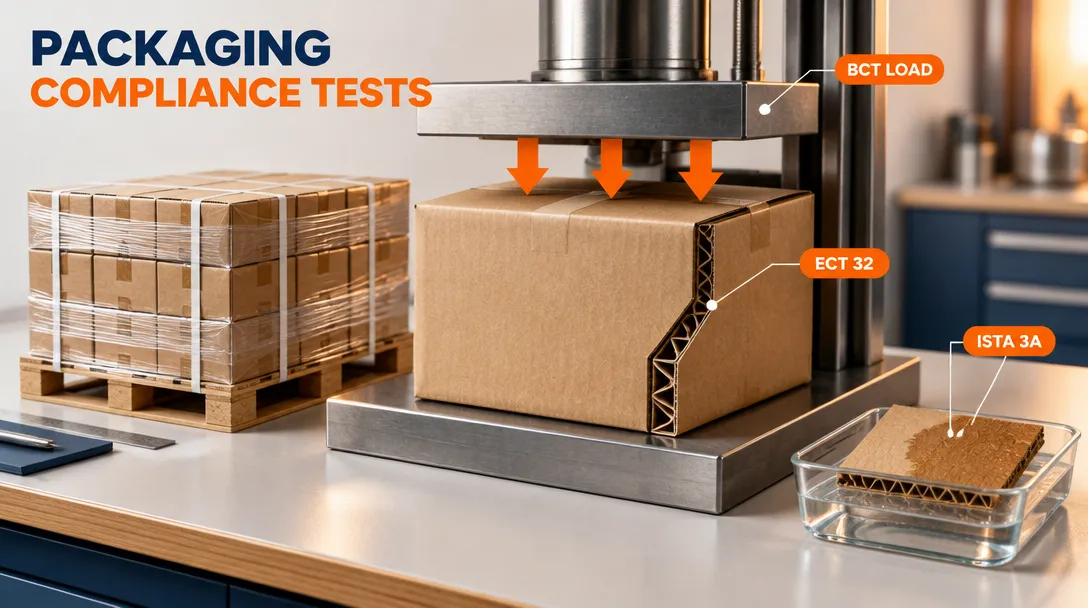
- Use ECT as a board edge-compression input and McKee BCT as an initial box-compression estimate—not as a shipment pass certificate.
- Compare Cobb 60 results and moisture controls when storage or transit humidity could weaken corrugated board or cause coating delamination.
- Validate the production-intent pack and distribution hazards with an applicable protocol such as ISTA 3A or ASTM D4169.
Choose a compliance route that separates sustainability from performance
Verdict: There is no single “SPC-compliant” test that establishes a package is safe for distribution. SPC, an initiative of GreenBlue, provides a sustainability-oriented body of work and resources for packaging professionals. A buyer should use that context to frame material and end-of-life decisions, then write measurable acceptance criteria against recognized test methods and the shipment’s actual risks.
This distinction matters commercially. A recyclable construction can still fail a compression or drop sequence; a high ECT board can still arrive damaged if the box dimensions, closure, cushioning, pallet pattern, or moisture exposure are wrong. Conversely, passing a lab protocol does not independently substantiate a broad environmental claim. In the US, review applicable claim language against the FTC Green Guides (16 CFR Part 260); for European packaging, assess the EU Packaging and Packaging Waste Regulation (EU) 2024/1991 alongside applicable implementation and market requirements. Confirm legal applicability with qualified counsel rather than treating a material test as regulatory approval.
Build a compliance matrix around four separate questions: what the package is made of, whether its environmental claims are supportable, whether its structural design meets the load case, and whether the finished shipping system survives distribution. Record the method, conditioning, sample configuration, acceptance limit, and responsible party for each. If a customer specification names a method, do not silently substitute a superficially similar test.
Compare the tests by the failure mode they measure
ECT, burst, compression, moisture absorption, and distribution simulation answer different questions. ECT is an edgewise compression property of corrugated board, commonly specified by grade such as ECT-32 or ECT-44. TAPPI T811 is a recognized edgewise compressive strength method. TAPPI T810 measures burst resistance; it is not an interchangeable proxy for ECT or box compression. ASTM D642 evaluates compressive resistance of shipping containers, while ISTA 3A provides a general simulation sequence for individually packaged products shipped through parcel delivery systems. ASTM D4169 evaluates shipping units through distribution-cycle testing. Choose the method that represents the risk, not the one that is easiest to quote.
| Dimension | ECT-led corrugated specification | BCT / ASTM D642 verification | Moisture and distribution validation | Governing standard / protocol |
|---|---|---|---|---|
| Primary question | Does board edge compression meet the specified grade? | Can the finished box resist a defined compressive load? | Does the package retain function after moisture and shipping hazards? | TAPPI T811; ASTM D642; ISTA 3A or ASTM D4169, as applicable |
| Typical input | ECT-32 or ECT-44 board, flute construction, caliper and box geometry | Box dimensions, board strength, closure, orientation, and load condition | Conditioning, exposure, packaging configuration, and distribution profile | Test method and customer distribution specification |
| Best use | Material purchasing control and preliminary structural sizing | Check a finished box against a defined compression requirement | Assess parcel or broader distribution performance and moisture-sensitive risks | ISTA 3A for applicable parcel systems; ASTM D4169 for defined distribution cycles |
| Key limitation | Does not by itself establish finished-box stack performance | Does not reproduce every vibration, shock, or environmental hazard | A passing result applies to the tested configuration and chosen sequence | Report method, configuration, conditioning, and acceptance criteria |
| Moisture screen | Specify board and barrier performance where exposure warrants it | Compression can fall as board moisture rises | Cobb 60 screens water absorption; it is not a complete humidity-aging test | TAPPI T441 (Cobb test); condition specimens per applicable method |
McKee’s equation is commonly used for a first-pass estimate of box compression strength (BCT) from board edge compression and box perimeter, with board caliper as an input. It is an empirical estimate, not a universal guarantee: geometry, score lines, hand holes, print coverage, joints, humidity, and manufacturing variability affect the result. A hypothetical worked example should therefore state its assumed ECT, caliper, dimensions, and safety factor, then be confirmed by physical compression testing where consequences justify it. Do not present a calculated BCT as an actual test result.
Engineering comparison: ECT-44 is a higher edge-crush grade than ECT-32, but it is not automatically the lower-cost or lower-impact choice. A correctly sized ECT-32 design may outperform an oversized ECT-44 design on cost and material use, while a tall stack or humid route may justify more reserve capacity. BCT must be evaluated against top load, stacking duration, load sharing, and a justified derating factor; no single generic safety factor fits every supply chain.
Translate board, moisture, and dieline choices into a testable pack
Start with the product envelope and shipping configuration, not a catalog box. A CAD dieline should capture internal dimensions, board caliper, flute direction, score and slot geometry, closure overlap, and assembly tolerances. Common corrugated constructions include E-flute for compact presentation and print definition, B-flute for general-purpose protection, C-flute for cushioning and stacking balance, and BC double-wall for heavier or more demanding loads. Caliper varies with paper, flute profile, and converting; use a supplier’s controlled specification rather than assigning a universal value to a flute name.
For retail-facing liners or folding components, 350 gsm CCNB may be considered where print surface and converting requirements fit the application, but grammage alone does not establish stiffness, moisture resistance, or recyclability. Likewise, molded pulp is a formed-fiber option whose fit depends on part geometry, draft, fiber distribution, moisture, and dimensional tolerance. Set a drawing tolerance from supplier capability and product criticality, then inspect fit against the actual component. Avoid assuming that molded pulp and corrugated provide equivalent cushioning or dimensional repeatability.
Cobb 60, measured using TAPPI T441, quantifies water absorbed by a paper or board surface over a specified test period. It is a screening value, not a direct prediction of ocean-transit survival. Elevated moisture can soften flutes, reduce compression capacity, weaken adhesive bonds, and contribute to delamination. If exposure is credible, specify the board’s Cobb acceptance criterion with the supplier, assess coatings or liners, and test the finished pack after relevant conditioning. PFAS-free barrier coatings may support material and regulatory objectives, but their water resistance, repulpability, seal performance, and claim substantiation must be verified for the specific formulation and market.
Use a prototype-to-production loop: freeze the product and pack configuration; review dieline fit and closure; make production-representative samples; test against the chosen standard; then record deviations and revise the drawing or specification. For printing and die-cut conversion, communicate registration and score tolerances as supplier-agreed limits rather than assuming a universal ±0.15 mm capability. A tolerance is meaningful only when the measurement datum, inspection method, and acceptance rule are defined.
Use test evidence to select the economical option
The lowest quoted board grade is not necessarily the lowest landed cost. Compare material price, pack weight, dimensional freight, damage exposure, assembly labor, and the cost of testing or corrective action. For DTC and marketplace shipments, external dimensions can affect dimensional-weight billing and Amazon FBA fee bands; model the actual current carrier and marketplace rules at quote time. A small dieline reduction may save freight, but only if protective clearance and test performance remain acceptable.
Hypothetical procurement example: a buyer compares an ECT-32 single-wall option with an ECT-44 alternative for the same product. The ECT-32 design has the lower board specification, but its smaller, better-supported footprint may meet the calculated compression target; the ECT-44 option may be justified if a higher stacking load or moisture exposure reduces the available margin. Neither decision is defensible from grade alone. Request supplier board data, calculate a preliminary McKee estimate, then verify representative finished packs using ASTM D642 and the appropriate distribution protocol. The scenario is illustrative, not a test record or market-price quote.
For a procurement cost-down, request like-for-like quotations with the same dimensions, print coverage, board construction, order quantity, and delivery terms. Compare total unit cost at the actual MOQ and annual volume; include setup, tooling, freight cube, and expected damage cost. Reducing board weight is a valid target only when the revised design passes the agreed performance criteria and environmental claims remain supportable. Use TadaPack’s online calculation tools for preliminary sizing and cost checks, then engage TadaPack for custom structural packaging and production-representative prototyping where geometry, protection, or freight constraints need iteration.
| Option | Advantages | Trade-offs |
|---|---|---|
| ECT-led material control | Clear supplier grade target; useful for board procurement and initial design screening | Does not replace finished-box compression or distribution testing |
| Finished-box compression validation | Directly evaluates a defined box and load condition | Requires representative samples and does not cover all shipping hazards |
| Distribution and moisture validation | Connects the package to a declared shipment profile and environmental risk | More configuration-specific; results should not be generalized to an untested pack |
Decision rule: write the specification around the failure mode and distribution route, use calculations to narrow prototypes, and test the final production-intent configuration. That gives procurement an auditable basis for comparing suppliers without confusing a sustainability framework, a board grade, and a shipping-performance result.
Recommended Engineering Reading
[TOOLS] Featured Engineering & Calculation Tools
Explore 70+ Packaging Tools ➔CBM Volume & Freight Dim-Weight Calculator
Calculate cubic meters & dimensional weight to minimize freight costs and avoid FBA size tier penalties.Mailer Box Area & Dieline Size Calculator
Instant flat dieline dimensions, material consumption, and sheet nesting for custom D2C mailer boxes.
