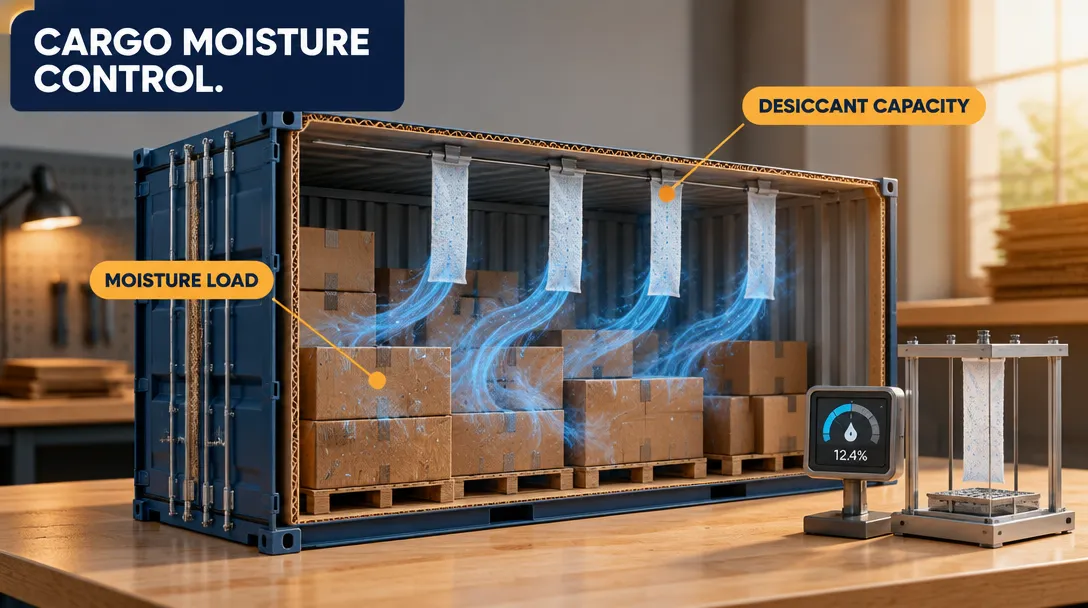
Container desiccants reduce cargo moisture risk by adsorbing water vapor, but their required capacity depends on the cargo, packaging, initial humidity, leakage and transit duration—not just container size. Treat ASTM D4169 as a distribution test framework, not a desiccant-sizing method; calculate the moisture load, specify a validated desiccant system and verify performance with shipment-representative monitoring.
Container desiccants control moisture when cargo and packaging create a vapor load
Container desiccant cargo moisture control is a system-design problem: water vapor enters or is released inside a closed freight container, then may condense on cool surfaces or be absorbed by vulnerable products and packaging. A desiccant provides a sink for some of that vapor. It does not stop liquid water ingress, repair wet cargo, eliminate poor container condition or guarantee that every location in a load remains dry.
The issue becomes material when a shipment has long transit or dwell time, repeated temperature cycling, moisture-sensitive goods, hygroscopic packaging, or a large amount of humid air trapped at loading. Ocean freight is especially exposed to changing temperatures and container “rain,” in which moisture condenses on the container roof and may drip onto cargo. Risk depends on route, season, loading conditions, container integrity and cargo thermal mass; there is no universal fixed transit duration or desiccant quantity that is safe for every lane.
For procurement, the consequence is broader than a product claim. Moisture can corrode metal, degrade electronics, cake powders, deform paper-based packs and soften corrugated board. If carton strength is already marginal, moisture may further reduce stacking reliability. ECT-32 and ECT-44 corrugated grades are common strength categories, not guarantees of a particular box compression performance; box dimensions, board construction, joints, humidity and stacking geometry also matter. Amazon FBA dimensional freight charges are a separate cost exposure: reducing moisture damage does not itself reduce dimensional weight or fees, so package dimensions still need an independent freight review.
DIN 55473 is relevant to desiccant products and their performance classification; it does not replace shipment-specific validation. ASTM D4169 provides a distribution-testing framework for shipping units and systems, but it is not a desiccant capacity calculation. Keep those roles distinct in specifications and supplier qualification.
Size capacity from the moisture load and the shipment profile
First define the protected condition. Identify the product’s moisture sensitivity, allowable humidity or water activity where established, the primary pack’s barrier properties, and whether the desiccant sits inside a product pack, a pallet wrap or the container itself. A container-hung unit and a sachet inside a sealed product pack serve different control volumes. Do not assume that a container unit can protect a poorly sealed individual package.
Then build a moisture budget. Relevant contributors include water vapor present in air at loading, moisture released by wood pallets, cartons or other hygroscopic materials, water permeating through packaging over time, and moisture entering through leaks or operational events. The budget should also account for the transit and dwell profile, expected temperature cycling, initial loading humidity and the desiccant’s usable capacity under the actual conditions. Supplier-rated capacity is not necessarily the working capacity in a specific temperature and humidity range.
A useful procurement calculation is: required working capacity equals the estimated moisture load over the protection period multiplied by a documented safety factor. The safety factor should reflect uncertainty in inputs and the consequence of failure; it should not be selected as an unexamined universal multiplier. Ask the supplier to state the test method, capacity basis, operating conditions, attachment method, saturation behavior and any liquid-brine or leakage risk. Where data are uncertain, run a controlled pilot with shipment-representative packaging and humidity loggers, then adjust the specification from observed evidence.
Positioning matters. Distribute units so vapor can reach them and so they cannot fall, block ventilation or contact sensitive goods. Follow the product’s installation limits and avoid placing a unit where condensate, if the chemistry can produce liquid, could damage cargo. Establish an inspection and replacement rule for reusable or multi-leg logistics. A humidity indicator can help flag exposure, but it is not a substitute for a calibrated logger or product-specific acceptance criteria.
| Design input or component | Typical industry reference values or selection basis | Engineering use | Governing standard / test protocol |
|---|---|---|---|
| Desiccant classification | Specify by declared type, adsorption capacity and stated test conditions; values vary by chemistry and supplier | Compare like-for-like capacity and performance claims | DIN 55473 |
| Moisture-load estimate | Use measured or documented cargo, packaging, loading and transit inputs; no universal capacity per container | Determine working capacity and documented safety margin | Shipment-specific engineering calculation; DIN 55473 for product characterization |
| Corrugated shipping case | ECT-32 and ECT-44 are common edge-crush categories; select to load and distribution conditions | Maintain stacking performance with correct board and box design | ASTM D4169 distribution testing; ECT method per applicable board specification |
| Paperboard moisture screening | Cobb 60 water absorptiveness is measured over 60 seconds; acceptance limit depends on the board and use | Evaluate water uptake risk, not vapor-barrier performance by itself | ISO 535 |
| Protective packaging verification | Test the configured shipping unit and distribution hazards, not a material coupon alone | Assess vibration, shock and other selected hazards | ASTM D4169 |
These are reference values and selection categories, not guaranteed performance limits. A Cobb 60 result is a water-absorption measure and cannot establish water-vapor transmission or prove that a desiccant quantity is adequate. For export cartons, specify board performance and moisture testing together with the complete shipping-unit test when risk warrants it.
Choose the desiccant chemistry and packaging around the failure mode
Common desiccant choices include silica gel, molecular sieve, activated clay and calcium-chloride-based products. Their moisture uptake behavior, capacity profile, physical form, dust generation and response to changing humidity differ. Selection must follow the product’s declared performance data and compatibility requirements. A high stated capacity does not automatically mean the best system: uptake speed, low-humidity performance, temperature range, containment integrity and the risk of liquid formation can be more consequential.
Silica gel is widely used for package-level moisture control, while molecular sieve may be selected where lower humidity targets are important. Activated clay can suit some cost-sensitive applications subject to the required conditions. Calcium-chloride systems can capture substantial moisture in certain container applications, but the design must safely contain any liquid or gel produced and prevent leakage or contact with cargo. Do not place loose or uncontained desiccant in a shipment; use a qualified carrier or sachet format appropriate to the load and handling risks.
Desiccant is only one layer in a moisture-control architecture. Start with a dry, intact freight container and dry cargo. Reduce avoidable vapor sources by specifying suitable pallet and packaging moisture conditions, closing primary packs correctly and limiting humid air introduced during loading. A barrier liner may reduce vapor exchange, but its seals and puncture resistance are critical. In a paper-based pack, a 350 gsm CCNB component or an E-, B-, C- or BC-flute corrugated structure should be selected for its structural and converting needs, not assumed to be a moisture barrier. PFAS-free barrier coatings may be considered where a coating is needed, subject to substantiated performance, recyclability and market requirements.
Evaluate corrugated board under expected humidity because moisture can reduce compression performance. ASTM D4169 can help structure distribution testing of the shipping unit; use the applicable test plan and acceptance criteria for the distribution cycle. If molded pulp is part of the pack, specify its dimensional and moisture tolerances with the converter and validate fit and protection in the assembled pack. There is no single molded-pulp tolerance that applies across tooling, geometry and product risk.
In Europe, assess packaging materials and claims against applicable EU packaging rules, including the Packaging and Packaging Waste Regulation, Regulation (EU) 2025/40, and relevant national obligations as they apply to the product and market. In the United States, substantiate environmental claims under the FTC Green Guides, 16 CFR Part 260. Neither a desiccant inclusion nor a recyclable-material claim alone demonstrates whole-package compliance. Ask suppliers for current composition, safety documentation and end-of-life compatibility evidence.
Validate the complete load and specify supplier evidence
Qualification should join the desiccant, pack, product and distribution profile. Request a technical data sheet with capacity versus relative humidity and temperature, test method, declared usable capacity, packaging integrity, recommended placement and handling instructions. Confirm that the product is suitable for the intended cargo and that its safety documentation meets applicable transport and workplace requirements. For procurement comparisons, normalize offers by usable capacity under stated conditions, unit configuration, attachment method, freight cost and disposal requirements—not by nominal unit weight alone.
Use a risk-based test plan. Record initial conditions at loading, place calibrated humidity and temperature loggers at representative risk locations, and inspect packaging and cargo after transit or a representative trial. Test the shipping unit for relevant distribution hazards under ASTM D4169 where appropriate; this assesses distribution performance, not desiccant chemistry. A container humidity logger can show exposure trends but cannot prove that a product’s internal moisture limit was maintained unless paired with suitable product or package measurements.
For adjacent structural risks, verify carton strength and package dimensions independently. ECT-32 or ECT-44 board selection does not replace box compression testing or distribution validation. ASTM D4169 helps test a complete distribution system; ASTM D642 is applicable when determining compressive resistance of shipping containers. If paper water uptake is a concern, ISO 535 Cobb testing can inform the board specification, but the acceptance criterion should be set for the design rather than borrowed as a universal threshold.
For design iteration, TadaPack’s custom structural packaging and prototyping services can help assess the fit between protective components, carton geometry and production constraints. Use the TadaPack calculation tools at https://tadapack.com/tools for interactive packaging checks, then confirm critical assumptions through supplier data and physical testing. This is particularly important where an added liner or desiccant changes pack dimensions, assembly time, palletization or Amazon FBA dimensional freight exposure.
Answer the questions buyers ask before approving a desiccant specification
How many container desiccant units should we use?
There is no reliable universal unit count based only on container size. Calculate the moisture load from air, cargo, packaging and expected exposure, then divide by the product’s usable capacity at the relevant conditions and apply a documented safety margin. Verify unit placement and the result in a representative shipment or controlled trial.
Can a container desiccant prevent container rain?
It can reduce available water vapor, but it is not a guaranteed cure for condensation or liquid-water ingress. Dry loading practices, sound container condition, suitable packaging and control of vapor sources remain essential. Validate the complete load with monitoring, especially when cargo is moisture-sensitive.
Which standard should appear in our purchase specification?
Use DIN 55473 when specifying relevant desiccant classification and performance evidence, and ASTM D4169 when defining distribution testing for the configured shipping unit. Add a stated supplier test method and conditions for capacity; neither standard should be represented as a universal container-sizing formula.
Will stronger ECT board replace desiccant?
No. ECT-32 or ECT-44 board addresses edge-crush performance, while a desiccant addresses water vapor. Moisture can still affect board performance, and higher ECT does not prevent condensation, corrosion or product moisture uptake. Specify structural strength and moisture control as separate, coordinated requirements.
What should we request from suppliers in 2026?
Request current technical and safety documentation, capacity data with test conditions, installation guidance, composition information, and evidence supporting any environmental claims. Confirm applicability of EU Regulation (EU) 2025/40 and relevant national rules for European markets, and substantiate US environmental claims under FTC Green Guides, 16 CFR Part 260. Require shipment-representative validation where failure consequences justify it.
Recommended Engineering Reading
[TOOLS] Featured Engineering & Calculation Tools
Explore 70+ Packaging Tools ➔Box Compression (BCT) Calculator
Predict box compressive limit and stacking safety factors via McKee formula.Edge Crush Test (ECT) Calculator
Calculate linerboard ring crush and composite ECT ratings for optimal board specs.
Frequently Asked Technical Questions (FAQ)
How many container desiccant units should we use?
Can a container desiccant prevent container rain?
Which standards belong in a container desiccant specification?
Will ECT-44 corrugated board replace a desiccant?
What supplier evidence should buyers request in 2026?
