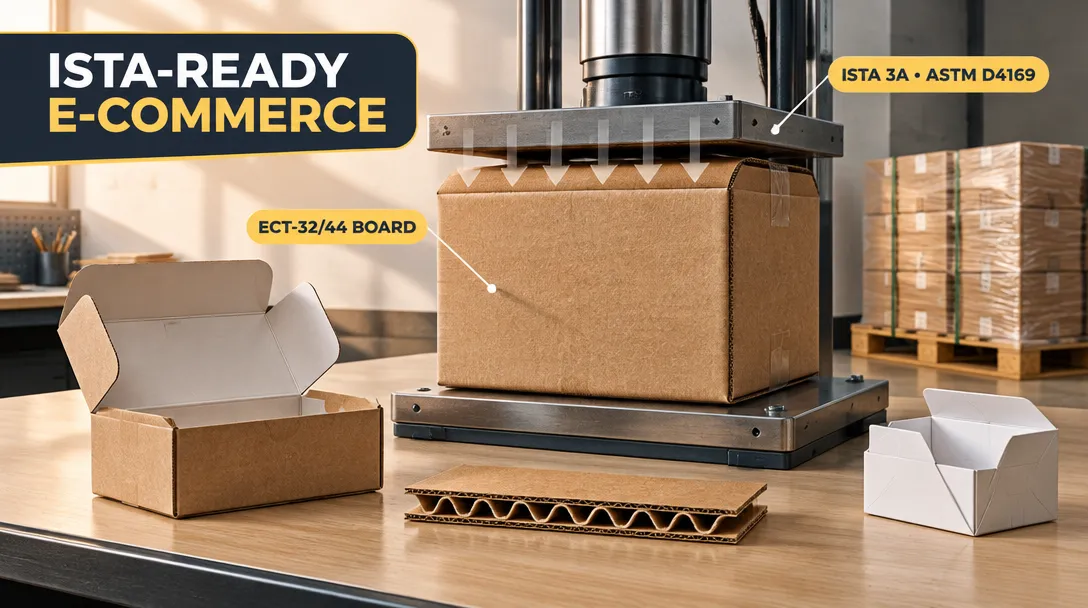
- Specify shipper performance by the packed product, distribution route and test protocol—not by ECT value alone.
- Use ECT-32 or ECT-44 as starting material specifications, then validate compression, vibration and drop performance on the finished pack.
- For mono-material retail cartons, control paperboard, adhesives, windows and barrier coatings as a single recyclability system.
- For urgent booth builds, prioritize a CAD-reviewed, production-representative prototype before committing to a short-run VIP box or display shipper.
PACK EXPO teams often have less than 48-72 hours between a final packaging decision and booth setup, while samples may face parcel drops, vibration and repeated handling. The engineering response is measurable: select ECT-32/ECT-44 corrugated by load case, evaluate E/B/C/BC flute construction, and use ASTM D4169 or the applicable ISTA procedure to assess the complete pack; control Cobb 60 moisture exposure and molded-pulp fit where relevant, and check packed dimensions against Amazon FBA dimensional freight rules.
1. Define the shipment before choosing the board grade
A shipper that survives a controlled test can still fail in distribution if the test profile does not represent its actual pack-out. Record the product mass, center of gravity, fragility, primary-pack geometry, shipment mode, parcel or palletized handling, and expected stacking exposure. For direct-to-consumer parcels, consider whether the pack will be shipped individually or consolidated; that distinction changes exposure to drops, vibration and compression.
ECT-32 and ECT-44 describe edgewise compressive strength of corrugated board, not a guaranteed box compression value or an ISTA pass. Box performance also depends on box dimensions, flute construction, board caliper, converting quality, humidity and load distribution. E-flute can support compact, high-graphics retail packs; B- or C-flute may provide more cushioning depth; BC double-wall can be considered for heavier or more demanding loads. These are design directions, not universal pass/fail prescriptions.
Use ASTM D4169 to structure distribution-cycle testing when appropriate, or select the applicable ISTA protocol for the intended shipping system. ISTA 3A is a general simulation test for individual packaged-products shipped through a parcel delivery system; it is not interchangeable with every distribution profile. Confirm the current protocol scope and sequence with the test lab before freezing the design.
2. Treat the prototype as a test article, not a visual mock-up
Structural CAD should describe the production-intent blank, scores, slots, closures, internal retention and assembled dimensions. A display sample that looks right but uses a different board grade, insert fit or closure cannot reliably establish transit performance. For fragile booth samples, create restraint around the product’s actual impact-sensitive areas and avoid relying on a loose void fill that can migrate during vibration.
Where molded pulp is used, specify fit and contact zones as well as the material. The insert should restrain the sample without concentrating force on fragile edges, connectors or display surfaces. Confirm its dimensional tolerance with the supplier and prototype; there is no universal molded-pulp tolerance that suits every geometry. For a fast booth deadline, share product CAD or measured dimensions, packed weight, quantity, destination and setup deadline at the start of the request. TadaPack’s structural CAD prototyping can help screen folding and fit risks before sampling; the stated 24-48 hour service is a prototyping option, not a guarantee of production or carrier delivery timing.
For high-end VIP cartons in short runs, request a sample route that avoids plate or mold charges where feasible, and compare the resulting decoration and finish to the approved specification. Confirm lead time, sample count, print method and freight cutoff in writing; a no-tooling-fee sample does not mean that production setup, finishing or freight is free.
3. Make mono-material a verified bill-of-materials decision
“Mono-material” should mean that the carton’s major components are compatible with the intended paper recycling stream—not merely that the outer wrap is paper. Review the board, adhesive, inks, coatings, labels, windows, tear strips and any attached insert as one bill of materials. A plastic window, laminated film or incompatible adhesive can undermine a paper-based recycling claim even when the carton body is fiberboard.
For retail cartons, a common construction may use folding boxboard or a 350gsm CCNB specification, but grammage by itself does not establish stiffness, crease performance or recyclability. Validate the finished structure and converting quality. Where moisture resistance is needed, consider a PFAS-free barrier coating and obtain supplier documentation for the specific formulation and intended use; “PFAS-free” should be substantiated, not inferred from a marketing description.
For EU-bound packaging, assess design and material choices against Regulation (EU) 2025/40 on packaging and packaging waste (PPWR), including applicable recyclability and packaging-minimization obligations as they take effect. Requirements can depend on packaging category, timing and implementing measures, so verify the current legal text and market-specific guidance before making a compliance claim. In the United States, substantiate recyclability claims under the FTC Green Guides, 16 CFR Part 260, and account for local collection realities. Do not label a pack recyclable solely because its main panel is paper.
4. Control moisture, compression and dimensional freight exposure
Corrugated strength and paperboard converting can be affected by humidity. A wet or damp board can lose compression performance, while moisture-sensitive coatings or adhesive interfaces may delaminate. Specify storage and transit conditions, protect samples from rain and condensation, and test the finished pack after conditioning representative of the intended environment. Cobb 60 water absorptiveness can inform paper surface moisture assessment, but it does not alone predict a shipper’s performance in a humid route.
Use ASTM D642 to evaluate compression resistance where applicable, and use the selected distribution protocol to expose the complete pack to its intended hazards. Do not substitute a board coupon result for a full-package test. Likewise, calculate packed external dimensions—not just the product dimensions—before choosing a shipper. Oversized packaging can increase dimensional freight charges, including Amazon FBA-related charges that depend on current program rules and package attributes. Recheck the current carrier or marketplace fee schedule; do not rely on a legacy dimension threshold.
TadaPack’s online calculation tools at https://tadapack.com/tools can support early sizing and cost comparisons. Treat calculated outputs as screening inputs: confirm board specifications with suppliers and verify performance with physical testing.
5. Close the design with a production-representative verification checklist
Before approving a trade-show shipper or retail carton, document the version-controlled drawing, material specification, pack-out and acceptance criteria. Keep the test configuration aligned with the actual production construction, including inserts, closures and labels.
- ☐ Record product mass, fragile zones, packed dimensions, destination and expected shipping mode.
- ☐ Specify corrugated grade (such as ECT-32 or ECT-44), flute construction, board caliper and supplier tolerances.
- ☐ Confirm insert retention, closure security, score behavior and assembly on a production-representative sample.
- ☐ Select the applicable ISTA or ASTM D4169 test profile with a qualified lab; define conditioning and acceptance criteria before testing.
- ☐ Review compression needs under ASTM D642 and evaluate moisture risks, including Cobb 60 relevance, without treating either as a substitute for distribution testing.
- ☐ Audit every carton component and support environmental claims against EU PPWR or FTC Green Guides requirements for the destination market.
- ☐ Recheck final pack dimensions, shipping cost assumptions and booth delivery cutoff before release.
For a deadline-driven booth pack, make the first prototype answer a specific question—fit, retention, assembly or damage risk—rather than attempting to perfect every finish at once. TadaPack can support custom structural packaging, rapid CAD iteration and short-run sampling; send the product dimensions, weight, shipping scenario and required arrival date for a scoped review.
6. Choose the engineering route by the failure risk
The core decision is whether the dominant risk is parcel handling, retail presentation or a compressed event deadline. For parcel exposure, prioritize a representative packed shipper and the appropriate test protocol. For retail shelves, prioritize a complete materials review and converting validation. For a booth deadline under 48-72 hours, simplify the structure, lock the critical dimensions and obtain a production-representative sample as early as possible.
Engineering conclusion: specify the actual pack, test the actual pack, and substantiate the actual material claim. Board grade, a recyclable-looking surface and a fast prototype are useful only when tied to the product’s load case, supply route and acceptance criteria.
Recommended Engineering Reading
[TOOLS] Featured Engineering & Calculation Tools
Explore 70+ Packaging Tools ➔CBM Volume & Freight Dim-Weight Calculator
Calculate cubic meters & dimensional weight to minimize freight costs and avoid FBA size tier penalties.Mailer Box Area & Dieline Size Calculator
Instant flat dieline dimensions, material consumption, and sheet nesting for custom D2C mailer boxes.
Frequently Asked Technical Questions (FAQ)
Does ECT-44 automatically make an e-commerce shipper ISTA 3A compliant?
Which test standard should a parcel shipper use?
What makes a retail carton mono-material?
Can TadaPack prototype packaging for a PACK EXPO deadline?
