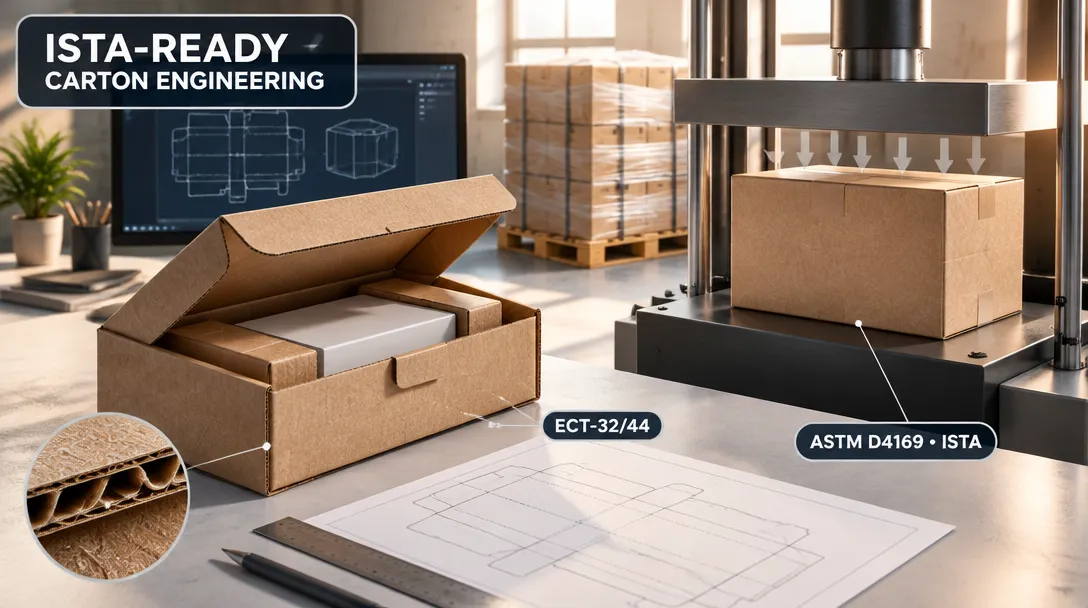
- Treat the display sample, retail carton, and outer transit pack as one engineered distribution system; a retail-ready carton is not automatically a shipper.
- Choose ECT-32 or ECT-44 corrugated by load, stack, and handling conditions, then verify the complete package using a relevant ISTA or ASTM distribution test protocol.
- Mono-material paperboard can support recycling objectives, but coatings, adhesives, labels, and local collection rules affect the outcome.
- When booth setup is less than 48-72 hours away, lock artwork and dimensions early and prioritize a structurally representative CAD prototype over cosmetic iteration.
PACK EXPO deadlines make prototype readiness a packaging control
PACK EXPO International brings packaging buyers, machinery teams, and brand owners together under hard booth-installation deadlines. For an exhibitor shipping fragile display samples or sourcing a VIP retail box, the operational risk is concentrated: a late structural change can miss production, while an unvalidated pack can arrive crushed, scuffed, or unusable. The engineering response is not to substitute appearance for testing; it is to define the distribution path, package function, and approval gates before the sample is made.
Start with the actual unit: mass, center of gravity, fragile features, orientation constraints, and the number of units per shipper. Record whether the pack travels parcel, palletized freight, or as checked/hand-carried exhibit material. These routes create different shock, vibration, compression, and handling exposures. Use ISTA 3A when the parcel-delivery simulation is appropriate to the packaged-product distribution system; use ASTM D4169 when a distribution-cycle evaluation based on the selected assurance level and sequence is required. Neither standard can be reduced to a generic “drop test.” Select the procedure to match the shipping profile and document the configuration tested.
Transit design begins with restraint and clearance. A fragile sample must not gain momentum inside its pack, but excessive compression can damage the product or deform a premium carton. E-flute or B-flute may suit compact retail packs; C-flute or BC-flute can provide greater cushioning or stacking capability in a shipping case, depending on board construction and design. These flute names do not guarantee a performance value: specify board grade, dimensions, conversion quality, and test criteria with the supplier.
For corrugated strength, ECT-32 and ECT-44 are common edge-crush ratings used to characterize board. They are inputs to a box design, not proof that a finished package will survive a specific route. Box geometry, score quality, humidity, print coverage, closure, and stacking duration all influence performance. Use ASTM D642 for compression evaluation where appropriate, and use the chosen distribution protocol to assess the assembled pack’s overall response. Do not infer a pass result from an ECT number alone.
Retail compliance depends on the whole mono-material construction
“Mono-material” is a design direction, not a universal certification. A paperboard carton made principally from fiber may still include a plastic window, film lamination, dissimilar-material label, or adhesive that complicates sorting or recycling. Map every component in the bill of materials (BOM), including inks, barrier coatings, closures, and labels. Confirm compatibility with the target market’s collection and sorting infrastructure rather than making an unqualified recyclability claim.
For European packaging placed on the market, assess applicable requirements under EU PPWR (2024/1991), including the regulation’s packaging waste and design framework, and check implementation details and obligations for the relevant product and market. In the US, environmental benefit claims should be substantiated and qualified as necessary under the FTC Green Guides (16 CFR Part 260). Regulatory review is distinct from package performance testing: a transit test cannot establish recyclability, and a fiber-based material choice does not by itself establish legal compliance.
For a retail carton, define the required presentation, opening behavior, dimensions, print finish, and distribution role before selecting board. A 350gsm CCNB (coated clay natural back) may be considered for a printed carton where its caliper, stiffness, and converting performance suit the format; grammage alone is not a structural specification. If the carton itself is expected to protect a fragile item, test it in the actual packed configuration. If it is a display carton inside a protective shipper, keep those functions separate in the design brief.
Moisture is a frequent weakness in fiber packaging. Cobb 60 is a water-absorption test method for paper and board; use it to compare substrate or coating behavior under the method’s defined conditions, not as a direct predictor of whole-package survival. Humidity can soften corrugated flutes, reduce compression strength, and contribute to adhesive or label problems. Specify PFAS-free barrier coatings where appropriate to the product and market, and validate both barrier performance and end-of-life compatibility. Avoid adding a barrier layer that undermines the mono-material objective without a documented need.
Test the complete pack and control the urgent build
For a show-bound package, engineering approval should cover both the shipping configuration and the booth-ready presentation. A shipper with an inner suspension or molded pulp insert can absorb handling energy while preserving a high-end carton. Molded pulp tolerances must be agreed with the supplier against the product geometry and assembly method; do not assume a universal tolerance. Design clearance and contact zones from measured product dimensions, then inspect first articles for fit, retention, and removal force.
Run a design review against a short list: product orientation, restraint, cushioning travel, closure integrity, stacking load, carton dimensions, and damage acceptance criteria. Where Amazon FBA is part of the later fulfillment plan, verify current program packaging and dimensional measurement requirements directly; dimensional freight or fulfillment costs can change with outer dimensions and package configuration. Do not size an exhibit shipper solely to minimize a retail carton’s footprint.
When the schedule is under 48-72 hours before booth setup, reduce avoidable loops. Freeze the product envelope and copy, use CAD to review dielines and assembly, and identify which prototype features must represent production materials. A rapid CAD sample can reveal interference, poor retention, and assembly problems, but a paper mock-up is not a substitute for a transit test. TadaPack’s 24-48 hour structural CAD prototyping and zero tooling fee sampling support short-run evaluation, including VIP boxes where conventional plate or mold charges would be disproportionate. Confirm availability, specification, and shipping timing with the supplier before relying on a deadline.
Recommended action: assign one owner to approve the tested package configuration, and preserve a sample or specification record of the exact board, insert, closure, and pack-out. Use TadaPack’s online calculation tools for preliminary sizing and cost checks, then confirm design decisions with supplier data and physical testing. Calculations are screening aids, not certification.
Recommended Engineering Reading
[TOOLS] Featured Engineering & Calculation Tools
Explore 70+ Packaging Tools ➔CBM Volume & Freight Dim-Weight Calculator
Calculate cubic meters & dimensional weight to minimize freight costs and avoid FBA size tier penalties.Mailer Box Area & Dieline Size Calculator
Instant flat dieline dimensions, material consumption, and sheet nesting for custom D2C mailer boxes.
Frequently Asked Technical Questions (FAQ)
Does ECT-44 guarantee that a PACK EXPO shipment will pass transit testing?
Should a retail carton also serve as the transit shipper?
Is a fiber carton automatically mono-material and recyclable?
What should an exhibitor prioritize when booth setup is less than 72 hours away?
