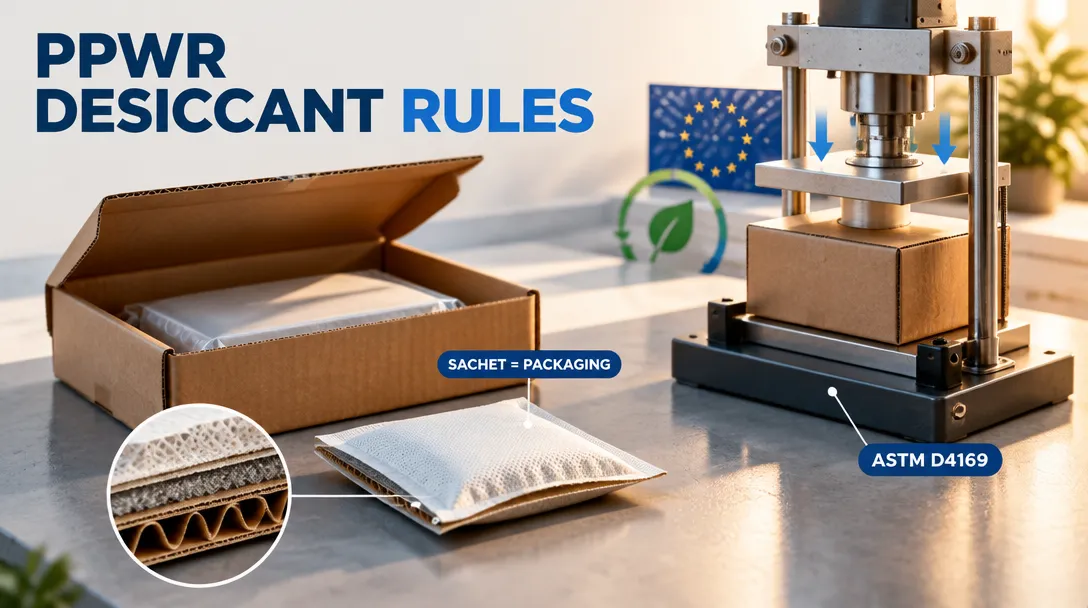
Desiccant sachets and canisters are packaging components, so assess them alongside the primary pack for material, recyclability, chemical and substantiation requirements; the EU PPWR generally applies from 12 August 2026. Specify only the moisture-control capacity needed, validate the complete pack’s distribution performance under ASTM D4169, and document recyclability and environmental claims for each market.
What changed for sustainable desiccant packaging in 2026?
The main regulatory change for packaging buyers is the EU Packaging and Packaging Waste Regulation, Regulation (EU) 2025/40, commonly called the PPWR. It generally applies from 12 August 2026 and establishes a directly applicable EU framework covering packaging placed on the market, including packaging components. A desiccant sachet or canister does not become exempt simply because it protects the product rather than containing it.
That distinction matters in procurement. A complete shipping unit may combine a paperboard carton, flexible barrier pouch, desiccant sachet, labels and cushioning. Assess each component’s function, material and route through collection and sorting, then assess the assembled pack. Do not assume a recyclable outer carton makes a mixed-material sachet recyclable with it, or that an individual component’s low mass removes it from compliance consideration.
PPWR is not a blanket ban on desiccants, silica gel, clay or molecular sieve. Nor does it mean a buyer should remove moisture control where doing so creates product degradation, corrosion, mold risk or returns. The engineering objective is to achieve the documented protection requirement with the least material and complexity that remains safe and effective, while designing the whole package for applicable market requirements.
In the United States, there is no single federal packaging-EPR regime equivalent to the PPWR. State requirements differ and continue to evolve; check the states where the product is sold and the responsible producer’s obligations rather than treating one state’s rule as a nationwide standard. For environmental marketing, the FTC Green Guides, 16 CFR Part 260, remain relevant to substantiating claims such as “recyclable.” A claim about the outer carton does not automatically substantiate a claim about a sachet or the complete pack.
Who and what does the PPWR cover when a pack contains desiccant?
The regulation is relevant to economic operators placing packaged goods on the EU market, including brands, importers and other parties with producer or packaging responsibilities under applicable rules. Confirm the legal role for each sales route and country with qualified regulatory counsel. For engineering and sourcing, the practical unit of review is the packaging system: primary product packaging, secondary carton, transport packaging and any protective component supplied with them.
Classify the desiccant format accurately. A paper sachet containing beads, a polymer sachet, a plastic canister and a loose insert have different material profiles and end-of-life implications. Request a current bill of materials, material identification, supplier declarations and instructions for handling or disposal. Where the sachet is laminated or combines paper and polymer, obtain evidence about its actual construction rather than relying on a generic material name.
Recyclability must be treated as a system property. A component may be technically recyclable in a specialist stream but not accepted in the collection and sorting systems relevant to the target market. Ask suppliers for evidence tied to the exact structure and market; do not substitute “contains recycled content,” “bio-based” or “plastic-free” for evidence of recyclability. If a claim is used on pack or in marketing, substantiate its precise meaning and scope.
Chemical compliance also needs a specific review. Check applicable restrictions for the product category, market and material, including food-contact rules where the desiccant or its packaging could contact food. PFAS-free barrier coatings may be a useful specification where they are technically suitable, but “PFAS-free” is not a universal PPWR requirement for every desiccant package. Confirm supplier declarations against the applicable law and the intended use; do not infer compliance from a marketing label.
Fit the sustainability specification to the protective function. Establish the product’s moisture sensitivity, package barrier properties, storage conditions and distribution duration before choosing desiccant type or quantity. Avoid adding excess sachets as a substitute for an inadequate moisture barrier. Conversely, reducing desiccant without validating performance can increase damage and waste. Use packaging prototypes to check fit, seal integrity and placement, then assess the complete shipping configuration using an appropriate distribution test plan such as ASTM D4169.
Structural choices still matter. ECT-32 and ECT-44 corrugated board are examples of edge-crush ratings, not direct guarantees of package performance; select board strength against box geometry, stacking and the distribution hazard. A 350 gsm CCNB carton or E-, B-, C- or BC-flute construction should likewise be specified by functional performance and validated in the finished configuration. ASTM D4169 can guide distribution simulation; it does not certify recyclability or replace material-composition evidence. For paper conditioning, ISO 186 provides a relevant standard reference.
What are the key dates for EU packaging compliance?
Use the following milestones to sequence supplier data collection, design review and market readiness. The application date is a compliance planning trigger, not a claim that every detailed PPWR requirement has identical timing. Check the final text and applicable implementing measures for the specific obligation affecting your packaging.
- 11 February 2025 — Regulation (EU) 2025/40 entered into force.
- 12 August 2026 — The PPWR generally begins to apply.
- 2030 — The regulation establishes future packaging-related requirements and targets with 2030 milestones; confirm the specific obligation and applicability for each packaging format.
For companies selling in both Europe and the US, use separate market checks. The EU regulation does not replace US federal or state requirements, and a US claim accepted under one context does not establish that the same wording is appropriate in Europe. Record the destination market, responsible entity, packaging configuration and supporting evidence in the procurement file.
What should procurement and engineering teams do now?
Start with a controlled packaging bill of materials, not a broad sustainability pledge. Record each desiccant’s format, substrate, active material, unit mass, supplier and function. Link it to the product’s moisture-protection requirement and the barrier performance of the enclosing package. This makes it possible to identify avoidable material, unresolved declarations and design changes that could affect shelf life or transit protection.
- [ ] Map each package component, including sachets, canisters, labels, coatings and transport packaging, to its material and supplier.
- [ ] Confirm EU and US market destinations, relevant producer responsibilities and the applicable legal review owner.
- [ ] Obtain composition, chemical and end-of-life documentation for the exact desiccant format; identify unresolved mixed-material construction.
- [ ] Define the moisture-risk requirement and check whether the barrier pack, seal design and desiccant quantity work as a system.
- [ ] Review all environmental claims for precise scope and substantiation, including whether they concern the sachet, carton or complete pack.
- [ ] Validate package fit, protection and distribution performance in the intended shipping configuration; use ASTM D4169 where appropriate.
- [ ] Recheck the specification when a supplier, substrate, coating, desiccant format or market changes.
For development, TadaPack’s custom structural packaging and prototyping services can support a review of component fit and the assembled pack before a production change is approved. Use the TadaPack calculation tools at https://tadapack.com/tools for applicable packaging calculations; calculations support engineering decisions but do not replace regulatory review, supplier declarations or physical validation.
The decision rule is straightforward: retain desiccant where the product risk requires it, but make its composition, quantity, claims and end-of-life route explicit. Buyers who document those choices alongside structural performance will be better positioned to respond to EU PPWR application and varying US state requirements without trading away product protection.
Recommended Engineering Reading
[TOOLS] Featured Engineering & Calculation Tools
Explore 70+ Packaging Tools ➔Box Compression (BCT) Calculator
Calculate box compression and stacking strength for transit safety.All-in-One Packaging Engineering Hub
Explore 70+ professional packaging calculators and prepress engineering tools.
Frequently Asked Technical Questions (FAQ)
Does the EU PPWR prohibit desiccant sachets?
When does the EU PPWR generally apply?
Does ASTM D4169 prove that desiccant packaging is recyclable?
Are PFAS-free coatings required for every desiccant package?
