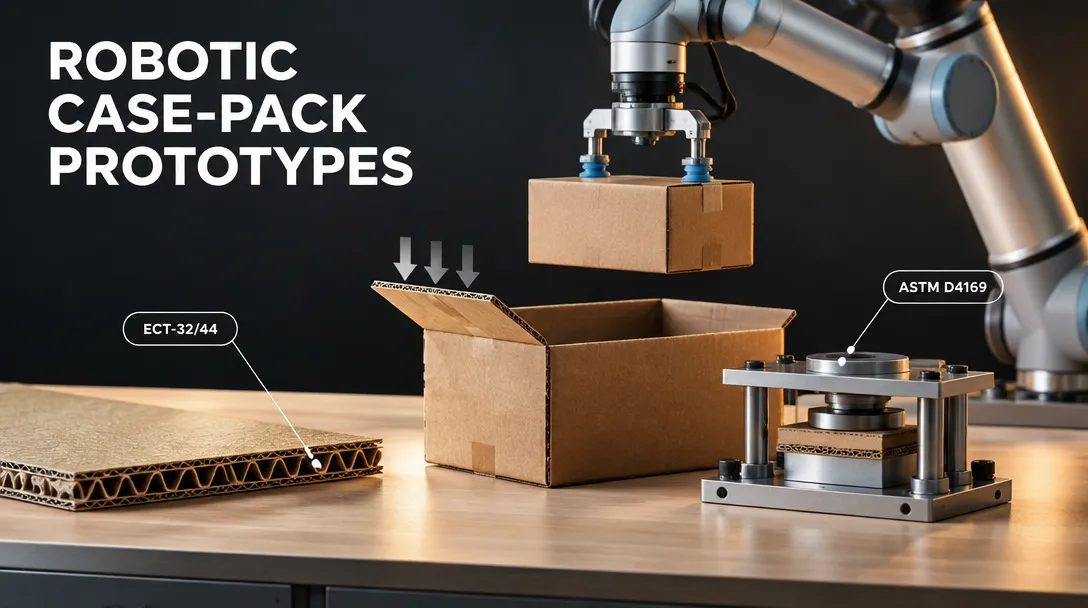
At PACK EXPO, a case that looks convincing on a display table can still fail at the robot: a poorly located seam, loose product, or out-of-square blank can interrupt a demonstration in front of buyers. When booth setup is less than 48–72 hours away, the engineering objective is not to skip validation; it is to separate rapid fit-and-function learning from formal distribution qualification.
For robotic case-packing demos, specify product and gripper interfaces, case dimensions, board grade, and assembly sequence before CAD release. ECT-32 and ECT-44 are common corrugated design inputs, not guarantees of a finished case’s compression performance. ASTM D4169 provides a framework for distribution-cycle testing; it does not certify an untested show sample. For fragile display units, include molded-pulp or other engineered supports where geometry permits, control moisture exposure that can weaken paperboard, and check packed dimensions against shipping and Amazon FBA dimensional-weight or fee rules when relevant.
1. Lock the demo brief before requesting a prototype
Start with the actual item and line conditions, not a product photograph or an unverified nominal dimension. A useful brief lets the structural designer create geometry that can be checked against the robotic motion and the booth schedule. State whether the sample will be handled only at the booth or transported as freight; the latter requires a separate protective-packaging assessment.
- Define the payload. Provide product length, width, height, mass, orientation, fragile zones, and any permissible contact surfaces. Measure representative units; record each dimension to the nearest 0.5 mm as a project input, not a manufacturing tolerance.
- Define the robot interface. Supply the gripper or vacuum-cup contact area, pick direction, approach clearance, allowable presentation angle, and case-loading sequence. Mark no-contact surfaces and identify whether the robot handles a bare product, primary pack, or bundle.
- Define the case and demo constraints. Provide target internal dimensions, case style, closure method, cases per minute if known, and whether the display must open cleanly for repeated resets. Identify booth setup, sample arrival, and freight handoff deadlines.
- Release one controlled CAD brief. Name the approved drawing revision and list assumptions that remain unverified. Request a 24–48-hour structural CAD prototype only after the designer has the critical inputs; confirm whether that turnaround refers to design, sample production, or dispatch.
Key tolerance: Do not treat a nominal case dimension as a fit allowance. Establish the product-to-case clearance from measured product variation, board caliper, folding geometry, and robot pick tolerance; confirm it physically on the selected prototype.
2. Engineer the case around the robot, not just the display
Translate the motion into package geometry. A robot may need a clear top opening, a repeatable product datum, and enough clearance to avoid catching a flap or deforming a retail pack. A display-ready opening can conflict with compression resistance, so agree on whether the demo case is a non-shipping fixture, a transport shipper, or a single structure expected to perform both roles.
- Choose the board basis. ECT-32 or ECT-44 corrugated can be evaluated for the case, but select grade against payload, stacking, closure, and distribution conditions—not by ECT number alone. Consider E, B, C, or BC flute construction where caliper, cushioning, print surface, and stiffness trade-offs matter; obtain the supplier’s actual board specification.
- Set the loading and closure geometry. Dimension flaps, hand access, and tape or adhesive zones so they do not intrude into the robot’s path. A short-run VIP or retail presentation box may use printed paperboard or wrapped rigid board, but demonstrate that structure separately from the protective transport shipper if the two have different duties.
- Protect fragile samples at contact points. Use shaped corrugated inserts, dividers, or molded pulp to restrain the item without loading delicate edges, screens, or display features. Specify molded-pulp fit and release requirements with the supplier; do not assume a generic insert has a universal tolerance.
- Control moisture-sensitive design risks. If exposure is credible, assess board and coating choices and avoid unsupported water-resistance claims. Cobb 60 water absorptiveness testing can inform paper/board water uptake; it is not, by itself, a pass/fail guarantee against delamination in every transit environment. Ask suppliers for relevant test data and evaluate the full construction.
Where coated or barrier-treated paperboard is proposed, specify the intended function and request evidence for claims such as PFAS-free or recyclable. In Europe, consider the EU Packaging and Packaging Waste Regulation (EU) 2025/40 alongside applicable national requirements and the packaging’s intended market. Regulatory applicability and implementation details should be checked for the specific product and sales date; a prototype alone cannot establish compliance.
Q: Can an ECT-44 case be assumed to pass a robotic demo and freight testing?
No. ECT describes edgewise compressive strength of board; finished-case performance also depends on dimensions, score quality, joints, orientation, and loading. For the demo, verify robot clearance and packed-case fit on the physical sample; for distribution, define the hazards and an applicable ASTM D4169 test plan rather than using ECT as a shipment pass claim.
3. Run the 24–48-hour prototype workflow with explicit gates
A rapid schedule works only when decisions, artwork, and samples are available at the start. TadaPack can support structural packaging and rapid prototyping requests; confirm current capacity, shipping cutoff, prototype method, and what is included in any zero-tooling-fee sample offer. “Zero tooling fee” does not necessarily mean zero sample, freight, or engineering cost.
- Step 1 — Intake and feasibility gate. Send measured payload data, photos or CAD, robot interface, case target, material preference, and deadline. Tolerance: list unresolved dimensions explicitly; do not release a fit-critical design with an assumed product envelope.
- Step 2 — CAD and structure review. Review internal dimensions, fold sequence, closure, insert restraint, and robot access. Tolerance: use the approved CAD revision and confirm critical dimensions against the brief before sample conversion; the prototype’s measured fit, rather than an unverified screen dimension, is the acceptance gate.
- Step 3 — Sample and robot dry run. Assemble the prototype, load actual product, and run the intended pick, place, and case-close sequence at the planned demo settings. Tolerance: require zero unintended contact, product escape, flap interference, or closure obstruction across the agreed demo sequence; record any adjustment and repeat the sequence.
- Step 4 — Release or revise. Approve the demo sample only for its stated use. Tolerance: freeze the drawing revision and bill of materials for the booth build; any change to product, board, insert, or closure triggers a fit recheck.
These are project acceptance gates, not claims of universal dimensional manufacturing tolerances. Die-cut conversion tolerances vary by equipment, substrate, and supplier; obtain the converter’s capability limits for the selected construction instead of inserting an unsupported generic ± value into the drawing.
4. Verify demo readiness separately from transit protection
A booth demonstration and a freight shipment have different acceptance criteria. A prototype that loads consistently at the robot may still lack adequate cushioning or stacking strength for transport. Conversely, a robust shipper can be awkward for a fast pick-and-place sequence. Define the use case on the drawing and packaging specification.
- Fit: Check product orientation, insert seating, lid or flap clearance, and the robot’s actual approach path using the production-representative item.
- Repeatability: Run the agreed demo sequence more than once, including removal and reset. Watch for shifting, snagging, crushed corners, and closure changes after handling.
- Fragile-sample protection: Inspect contact points and restraint after the demo and after any planned transport. For a shipping design, set a separate distribution test plan; ASTM D4169 is a recognized framework for evaluating shipping units against defined distribution hazards. Select its assurance level and sequence with the responsible packaging engineer and customer requirements.
- Board and moisture: Confirm supplier documentation for the selected ECT grade and construction. Where moisture is a risk, consider conditioning and relevant water-absorption evaluation; do not infer finished-package performance from a single board property.
- Commercial practicality: Check packed external dimensions and gross weight against the carrier’s current rating rules and, when applicable, Amazon FBA dimensional measurements. A larger protective case can increase freight charges even when the contents are unchanged.
For a short-run high-end VIP box, compare printed paperboard, wrapped rigid board, and a separate corrugated shipper as distinct costed options. Avoid amortizing plates or molds that the chosen prototype process does not use; request a written quote defining sample charges, repeat-sample pricing, tooling status, and production minimums. Validate final retail packaging claims and transit performance on the production-intent construction.
5. Check the result, correct common failures, and freeze the build
Use a signed-off checklist to keep a late booth change from silently invalidating the sample. Photograph the loaded case, note the drawing revision, and record the exact item and insert used. If a failure appears, correct the geometry or process and repeat the affected check; do not conceal a defect with tape or a last-minute hand trim without updating the controlled design.
- ☐ Actual product dimensions and mass match the prototype brief.
- ☐ Robot pick and placement clear the case, inserts, and flaps without unintended contact.
- ☐ Product remains restrained through the agreed demo and reset sequence.
- ☐ Closure, opening, and presentation work as specified; no sample is represented as transit-qualified without appropriate testing.
- ☐ Board grade, flute construction, insert material, drawing revision, and supplier quote are recorded.
- ☐ Freight dimensions and any market-specific regulatory or recyclability claims have been reviewed separately.
Common failure—product catches a flap: The likely cause is insufficient robot clearance, an inconsistent fold, or an opening that intrudes into the pick path. Recheck the robot envelope with the assembled case, revise the flap or datum in CAD, and repeat the dry run.
Common failure—fragile sample shifts or arrives damaged: The likely cause is inadequate restraint or using a demo-only insert as a shipping cushion. Add or reshape supports at suitable contact zones, separate the display structure from the shipper if necessary, and qualify the shipping configuration against its defined distribution hazards.
Use TadaPack’s online packaging calculation tools as a planning aid for dimensional and structural decisions, not as a substitute for supplier data or physical validation. For a compressed schedule, send the same controlled brief to the structural packaging team and name the decision-maker who can approve CAD changes promptly.
Recommended Engineering Reading
[TOOLS] Featured Engineering & Calculation Tools
Explore 70+ Packaging Tools ➔CBM Volume & Freight Dim-Weight Calculator
Calculate cubic meters & dimensional weight to minimize freight costs and avoid FBA size tier penalties.Mailer Box Area & Dieline Size Calculator
Instant flat dieline dimensions, material consumption, and sheet nesting for custom D2C mailer boxes.
Frequently Asked Technical Questions (FAQ)
What should be supplied to start a 24–48-hour robotic case-packing prototype?
Does an ECT-44 case guarantee a successful robot demo or safe shipment?
Can a 24–48-hour prototype be called transit-qualified?
How can an exhibitor protect fragile samples without slowing the robot?
