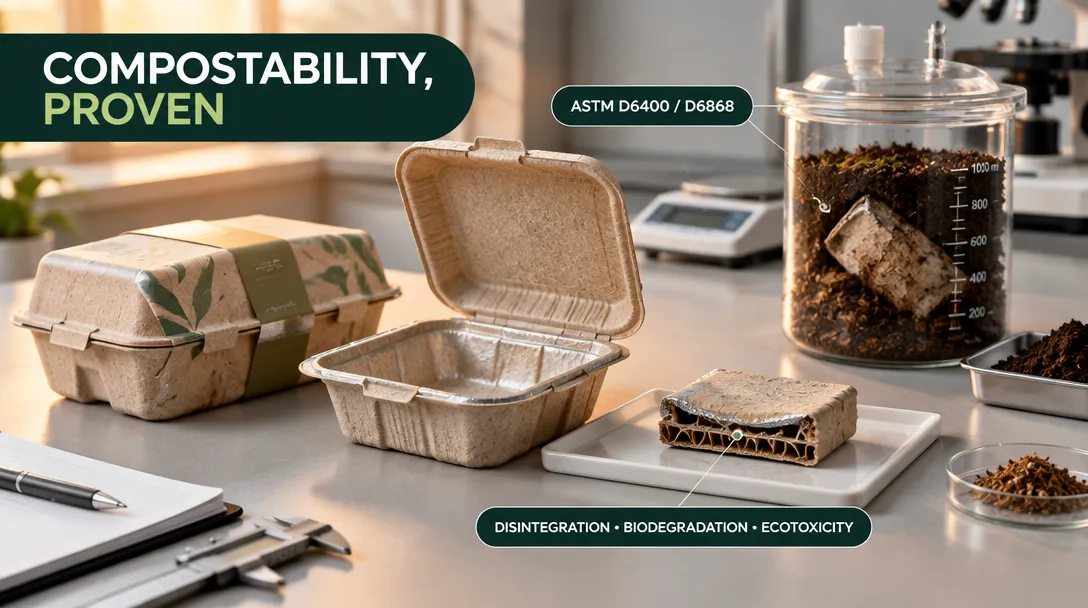
- Certification addresses disintegration, full biodegradation into carbon dioxide, water and biomass, and ecotoxicity checks under defined conditions.
- Fragmentation is not proof of biodegradation; confirm the claim against the certified product and the intended disposal route.
- Compostability certification does not establish shipping strength: test the package structure and distribution system separately.
- Use clearly labeled hypothetical calculations and actual supplier specifications to compare cost, strength and protection.
For packaging buyers, the consequential distinction is between a material that breaks into pieces and a finished package that meets a compostability assessment. BPI describes compostability as a measured biological outcome, not a material category, and identifies ASTM D6400 and ASTM D6868 as testing frameworks. The guide below turns that distinction into a procurement and structural-engineering workflow without treating a certification claim as a transit-performance guarantee.
1. Treat certification as a finished-product evidence check
BPI describes three relevant checks: disintegration, full biodegradation into carbon dioxide, water and biomass, and ecotoxicity, all within defined timeframes. It also explains that breakdown proceeds through fragmentation and enzymatic hydrolysis of polyester ester bonds, microbial metabolism, and final mineralization. These are scientific context, not interchangeable marketing terms.
The practical procurement unit is the specific finished article or covered product configuration—not a generic resin family. Ask the supplier for the third-party certificate or listing, its scope, and confirmation that the supplied construction and intended claim match that scope. Do not infer certification from a resin name, a supplier’s use of “bio-based,” or a statement that something is biodegradable. BPI specifically cautions that biodegradation can take a very long time without appropriate conditions and that disposal environment affects breakdown.
ASTM D6400 and ASTM D6868 are the standards identified in the cited BPI document. Use the applicable standard and certification program’s current requirements for the product being assessed; this article does not add test limits or claim that a particular package passes.
2. Separate compostability evidence from package performance
Certification answers a biological-performance question under defined test conditions. It does not supply an ECT value, compression rating, water-absorption result, dieline tolerance or parcel-shipping qualification. Set up two independent acceptance tracks: one for substantiated compostability claims and one for packaging function.
For a corrugated shipper, specify the board construction and supplier-reported edge crush test (ECT) rating. ECT-32 and ECT-44 are common trade designations, not guaranteed box-compression results. Flute choice—E, B, C or BC—affects caliper, cushioning and converting geometry; qualify the actual board rather than selecting by flute letter alone. ASTM D642 can be specified for container compression testing, and ISTA 3A for packaged-products parcel-distribution simulation when appropriate to the shipping system. Neither standard certifies compostability.
For paper-based barrier constructions, assess moisture exposure and adhesive compatibility. Cobb 60 is a water-absorption test designation commonly associated with TAPPI T 441; set an acceptance limit from the application and supplier capability rather than assuming a universal pass/fail value. A PFAS-free barrier claim also needs supplier documentation and applicable market review; it does not itself prove compostability or moisture performance.
3. Use McKee as a screening estimate, not a certificate
A preliminary box-compression estimate can help compare board concepts before physical testing. The simplified McKee relationship is commonly expressed as BCT ≈ 5.876 × ECT × √(perimeter × board caliper), using compatible customary units: ECT in pounds per inch, perimeter and caliper in inches, and predicted BCT in pounds. Treat this as a screening model, not a guaranteed result or a substitute for ASTM D642 testing. Box geometry, joints, scores, moisture and manufacturing variation can change performance.
Hypothetical worked example: assume a regular slotted container has a 20-inch perimeter, 0.16-inch board caliper and ECT-32 board. The estimate is 5.876 × 32 × √(20 × 0.16), or approximately 336 lbf. This is a model output, not a test result. With the same assumed geometry and caliper but ECT 44, the estimate is approximately 462 lbf. The ratio—44/32, or 1.375—shows the model’s sensitivity to ECT; it does not establish that either box safely carries a particular stack load.
For an initial procurement screen, compare predicted compression with the required load, then apply a project-specific safety allowance for storage duration, humidity, stacking pattern and handling. Validate the design using the actual box and distribution protocol. Include Amazon FBA dimensional freight exposure in the cost comparison: reducing external dimensions may lower billed dimensional weight, but only if cushioning and required protection remain adequate. Verify current carrier and marketplace rules before quoting savings.
4. Engineer the dieline around converting and fit
Build the CAD design from measured board caliper and converter capability, not a nominal flute label. E-flute may support compact print-focused formats; B- or C-flute may suit different cushioning or stacking needs; BC double-wall adds structure but increases thickness and blank size. These are design directions, not universal performance rankings. Obtain the converter’s dieline, score and glue specifications, and confirm that the selected substrate and barrier construction can run on its equipment.
Set tolerances with the supplier as project-specific targets. For a hypothetical prototype plan, a team might begin by requesting ±0.5 mm on critical cut dimensions and ±1 mm on noncritical overall dimensions, then revise after the factory confirms process capability. These are illustrative procurement targets, not industry guarantees. Check erected internal dimensions against product envelope, protective clearance and closure geometry; assess molded-pulp components separately because their tolerances and surface variation differ from paperboard.
Cost down by comparing total delivered packaging cost rather than board price alone: material area, print and finishing, tooling, pack-out labor, protective inserts, freight cube, damage exposure and disposal-claim requirements. A thinner or smaller blank can reduce material and freight, but a redesign that raises damage or assembly time can erase the saving. TadaPack’s custom structural packaging and prototyping support can help translate a CAD concept into a manufacturable sample; use the online tools at tadapack.com/tools to support preliminary calculations.
5. Qualify distribution separately from compostability
For parcel shipments, select ISTA 3A when its scope matches the distribution system and product package. The protocol is a test plan, not a blanket assurance that every route or fulfillment configuration is covered. Where compression risk is material, pair distribution testing with ASTM D642 container compression as a separately defined test. Record package dimensions, product mass, closure method, cushioning configuration and conditioning plan so comparison samples are equivalent.
Do not describe a material as “compostable in transit,” and do not assume that compostability results predict performance after moisture exposure. If a shipment faces humid warehousing or long transit, evaluate board strength retention, Cobb 60 behavior, glue joints and barrier performance under a buyer-defined conditioning plan. ASTM D685 is a paper-and-paperboard conditioning reference; specify the actual conditions in the test request rather than implying that a conditioning standard certifies the package.
Engineering decision rule: approve a design only when its claim evidence, converting feasibility, protection requirement and logistics cost have separate documented acceptance criteria. Certification addresses the biological claim; ISTA, compression and moisture evaluations address other engineering questions.
6. Turn supplier claims into a verifiable purchase specification
Use this checklist before releasing a purchase order or approving a public compostability claim:
- ☐ Obtain third-party certification evidence for the supplied finished product and verify the certificate scope against the actual construction.
- ☐ Identify whether the claim is tied to ASTM D6400 or ASTM D6868, as applicable, and confirm the intended disposal environment and claim wording.
- ☐ Request board grade, ECT, flute combination, caliper, barrier and adhesive specifications; do not substitute a material-family statement for package data.
- ☐ Define dimensional tolerances, dieline revision, print and closure requirements with the converter; approve a representative production-intent sample.
- ☐ Set test methods and acceptance criteria for distribution, compression and moisture exposure; use ISTA 3A, ASTM D642 or Cobb 60 methods only where relevant.
- ☐ Compare landed cost, pack-out labor, freight cube and damage risk, and revalidate dimensional-weight assumptions against current fulfillment rules.
- ☐ Keep claim substantiation and packaging performance records distinct; neither one substitutes for the other.
For a project-specific design, TadaPack can support structural packaging development and prototyping; use TadaPack’s calculation tools for preliminary sizing and cost comparisons, then confirm assumptions with the converter and appropriate tests.
7. Make the approval decision on evidence, not vocabulary
The central engineering decision is straightforward: require third-party evidence for the compostability claim, and independently qualify the package for its manufacturing and distribution job. Disintegration alone is not biodegradation, and a certification result is not a substitute for ECT, compression, moisture or parcel testing. Bring the certificate scope, supplier specifications, CAD dieline and distribution requirements into one procurement review, while preserving separate pass criteria for each.
Recommended Engineering Reading
[TOOLS] Featured Engineering & Calculation Tools
Explore 70+ Packaging Tools ➔Box Compression (BCT) Calculator
Calculate box compression and stacking strength for transit safety.All-in-One Packaging Engineering Hub
Explore 70+ professional packaging calculators and prepress engineering tools.
