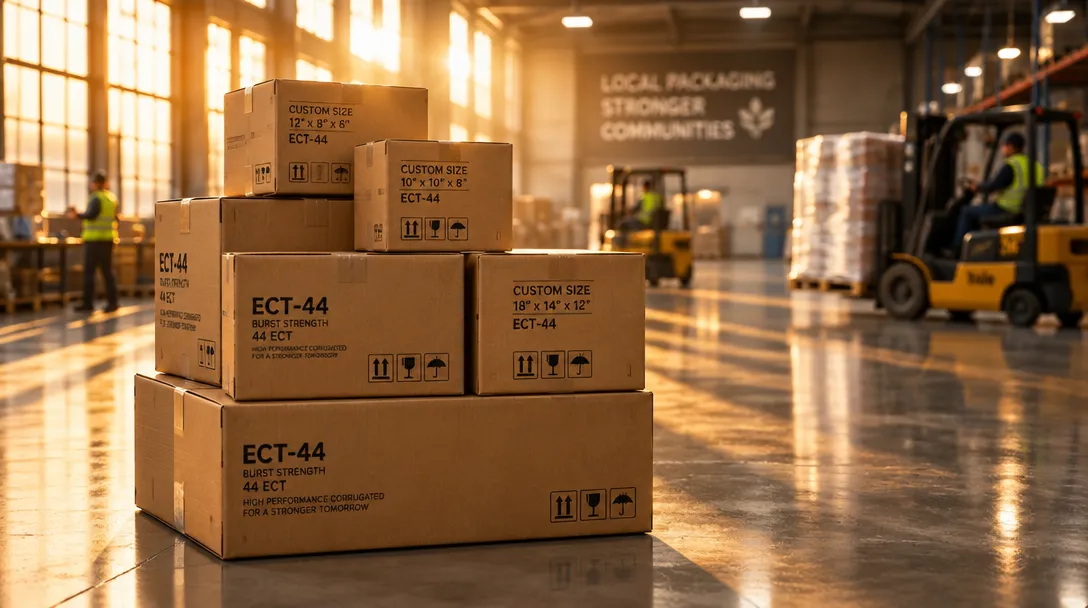
Searching for “shipping cardboard boxes nearby” should never end with a stock purchase based on wall thickness alone. Specify by Edge Crush Test class (ECT-32 minimum for 40 lb loads, ECT-44+ or BC-flute double-wall for warehouse stack heights above 60 inches), condition samples at 23°C ± 1°C / 50% ± 2% RH per ISO 187, and validate compression with ASTM D642 before committing to any local distributor’s inventory.
- Stock box grades carry a Box Maker’s Certificate (BMC) stamp: match ECT class to your stack load, not to gross weight alone.
- Dimensional weight (dim weight) pricing means an oversized local stock box can cost more in freight than the box itself — right-size first.
- Per EU PPWR (Regulation 2024/1991), all corrugated shipping packaging must be recyclable-by-design; avoid mixed-material local stock without fiber documentation.
- Validate any local supplier’s claim with ASTM D642 compression and ISTA 3A drop/vibration sequences before scaling POs.

1. Decode the Box Maker’s Certificate Before You Buy Local
Every corrugated box manufactured in the US and EU carries a Box Maker’s Certificate (BMC) stamp on the bottom flap. This is your first engineering filter when evaluating a “nearby” supplier’s shelf stock. The BMC specifies the construction class (single-wall, double-wall, triple-wall), the flute profile (B ≈ 3.0 mm caliper, C ≈ 4.0 mm, E ≈ 1.5 mm), the ECT or Mullen burst rating, and the size limit and gross weight limit per the carrier classification rule.
The critical procurement insight: modern corrugated engineering has shifted from Mullen burst (TAPPI T810) to ECT as the governing metric because stacking failure is an edge crush phenomenon, not a burst phenomenon. A 275# burst single-wall box and an ECT-44 single-wall box are not interchangeable despite similar nominal weights — the ECT-44 board will typically outperform in column stacking by a significant margin.
2. Match ECT Class to Your Actual Stack Load — Not Gross Weight
Most procurement errors in local box buying come from specifying by “pound rating” printed on the BMC. That rating assumes a specific storage scenario. Use the McKee formula to derive an estimated box compression strength (BCT) from ECT, then apply a safety factor for humidity, storage time, and pallet overhang:
BCT ≈ 5.874 × ECT × √(board caliper in inches × box perimeter in inches)
For a hypothetical worked example: an ECT-32 C-flute box, 16 × 12 × 12 inches (perimeter 112 in, caliper 0.157 in), yields an estimated BCT of roughly 870 lbf. With the industry-standard 5:1 safety factor for 90+ day warehouse storage, your safe stacking load per box drops to ~174 lbf — meaning only 3-4 cartons high, not the 8-high stack your floor manager assumes. Local stock boxes bought without this calculation routinely fail ISTA 3A compression-in-transit sequences.
Q: If McKee derives BCT from ECT, why do enterprise POs still mandate Mullen burst testing?
A: Direct answer: legacy carrier classification rules and long-standing internal QA specs still reference burst grades (200#, 275#), and Mullen testing per TAPPI T810 catches linerboard tensile-tear weaknesses ECT ignores. Mechanical reason: burst measures the multi-directional rupture resistance of the facings under hydraulic pressure — relevant for sharp-object puncture in mixed-freight handling, while ECT models column loading. Procurement recommendation: specify ECT as your primary structural grade, and require Mullen only when your distribution channel involves sharp-edged co-mingled freight; document both on the BMC to satisfy both QA and carrier requirements.
3. Right-Size Against Dimensional Weight Before Buying Stock
Local availability is seductive, but stock boxes force your product to fit the box, not vice versa. Under 2026 US carrier dim-weight divisor rules (139 cubic inches per pound for retail rates) and equivalent volumetric schemes across EU parcel networks, every cubic inch of void inside your carton is billed freight. A hypothetical worked example: shipping 10,000 units/year in a 16 × 12 × 12 local stock box versus an optimized 14 × 10 × 10 custom carton saves roughly 2,912,000 billed cubic inches annually — at a 5 lb dim-billed weight per parcel, that can mean 15-25% freight savings in typical scenarios.
Verify your cube utilization with TadaPack’s free calculation tools (tadapack.com/tools): the carton-volume and pallet-load calculators model 48 × 40 GMA pallet patterns, corrugated caliper stacking tolerance, and intermodal clearance before you commit to a die-line. For DTC brands, even a 0.25-inch reduction on each panel can shift a SKU into a lower dim-weight tier — a structural decision, not a packaging afterthought.
4. Audit Local Supplier Board Quality: Four-Step Verification SOP
Local distributors buy from converting plants of variable quality. Before placing volume POs on nearby stock, run this four-step verification SOP:
- Step 1 — Conditioning: Pre-condition samples at 23°C ± 1°C, 50% ± 2% RH for a minimum of 24 hours per ISO 187 / TAPPI T402 standard atmosphere. Cold-storage or trailer-hot board tested without conditioning produces ECT readings up to 20% off-spec.
- Step 2 — Caliper and flute verification: Measure combined board caliper per TAPPI T411 with a dead-weight micrometer; accept ±0.15 mm variance on C-flute (nominal 4.0 mm). Crushed flutes from aggressive printing nip pressure reduce caliper and void the ECT stamp.
- Step 3 — Compression validation: Test five conditioned boxes on a compression tester conforming to ASTM D642. Reject the lot if mean BCT falls below the McKee-derived estimate by more than 10%.
- Step 4 — Transit simulation: Run ISTA 3A (General Simulation) drop, vibration, and compression sequences on packed boxes for parcel-channel distribution, or ISTA 3E for unitized pallet loads. Document results in your supplier qualification file.
5. Diagnose the Two Most Common Local-Stock Transit Failures
Failure mode 1 — Flute crushing and delamination in high-humidity corridors. Boxes staged near coastal ports or in unconditioned regional warehouses absorb moisture; when Cobb 60 water absorption of the linerboard exceeds ~35 g/m² range, interfacial starch-bond strength drops and delamination follows during 30-day ocean transit (Pacific and Atlantic container-sweat conditions). Corrective action: specify moisture-resistant WBI (water-resistant barrier) starch or PFAS-free functional barrier coatings — mandated to be fluorine-free under current US state-level restrictions and EU PPWR phase-outs — and request Cobb test data per TAPPI T441 from your local converter.
Failure mode 2 — Flap popping and seam gapping. Stock boxes filled near their volume limit at cold storage, then moved into warm transit, build internal pressure as trapped air expands and board stiffens. Root causes: insufficient flexo slot-to-crease registration (target ±1 mm), worn creasing matrices, and over-fill beyond 85% cube utilization. Corrective action at the floor level: reduce fill height, verify manufacturer’s joint (stitch or tape lap ≥ 1.25 in per RSC convention), and switch to a one-size-up carton or an H-style inner fitment.
6. When Local Stock Wins — and When to Move to Custom Structural
Local “nearby” sourcing is engineering-defensible in three cases: (a) short-run replenishment under 500 boxes where plate and die amortization cannot be recovered; (b) standard 12 × 12 × 12-type RSC geometries where your cube utilization already exceeds 80%; and (c) emergency bridging stock while custom production runs. In all three, insist on the BMC and audit-grade board.
Move to custom structural packaging when any of the following is true: cube utilization below 70%, stack heights above 5 cartons, international ocean distribution, or brand-critical unboxing (E-flute mailers with litho-lamination, snap-lock trays with grayboard). TadaPack’s custom structural prototyping service delivers CAD die-lines and short-run prototypes with full ECT/BCT specifications, so your final production carton is engineered against ASTM D4169 distribution cycles — not reverse-fitted from a distributor’s shelf. Use the free calculators at tadapack.com/tools to quantify the freight and material crossover point between stock and custom before the decision, not after the claims.
7. 2026 Compliance Checklist for Any Nearby Box Purchase
Tick through this before releasing the PO to your local supplier:
- BMC stamp present and legible; ECT class matches your calculated stack requirement
- Samples conditioned at 23°C/50% RH per ISO 187 before any acceptance testing
- ASTM D642 compression validation on 5-box sample; mean BCT within 10% of McKee estimate
- ISTA 3A (parcel) or ISTA 3E (palletized) transit simulation on packed configuration
- Board confirmed single-fiber recyclable per EU PPWR (Regulation 2024/1991) design-for-recycling criteria if shipping to EU markets
- Recyclability claims substantiated per FTC Green Guides (16 CFR Part 260) for US consumer-facing labeling
- Barrier coatings PFAS-free; Cobb 60 absorption data available from converter
- Dim-weight cube analysis completed against carrier divisors — TadaPack tools verification logged
The Procurement Bottom Line
“Nearby” is a logistics attribute, not an engineering specification. Buy local stock only against a verified BMC, a McKee-derived BCT calculation, and an ASTM D642/ISTA 3A validation file — and shift to engineered custom corrugated the moment cube utilization, stack height, or ocean distribution demand it. TadaPack’s structural engineering team and free calculation toolkit exist to make that crossover decision data-driven.
Recommended Engineering Reading
[TOOLS] Featured Engineering & Calculation Tools
Explore 70+ Packaging Tools ➔CBM Volume & Freight Dim-Weight Calculator
Calculate cubic meters & dimensional weight to minimize freight costs and avoid FBA size tier penalties.Mailer Box Area & Dieline Size Calculator
Instant flat dieline dimensions, material consumption, and sheet nesting for custom D2C mailer boxes.
