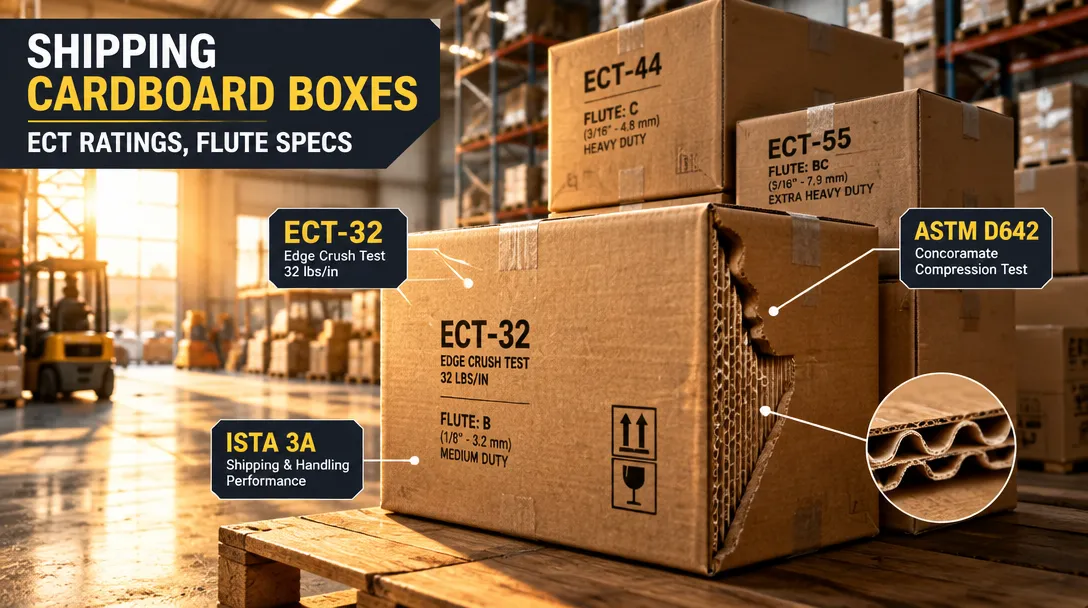
A shipping cardboard box is a corrugated fiberboard container whose performance is defined by measurable parameters: ECT rating (ECT-32 single-wall is the North American e-commerce default), flute profile (B, C, or E with calipers from ~1.5 mm to 4.0 mm), and burst strength per TAPPI T810. Specify the board, validate compression with ASTM D642 and transit robustness with ISTA 3A, then cross-check stacking safety factors with the McKee-derived BCT estimate — all calculable in minutes at https://tadapack.com/tools.
E-commerce parcel surcharges and 2026 dimensional-weight recalibration have pushed shipping boxes from commodity afterthought to line-item engineering decision. Under EU Regulation (EU) 2024/1991 (PPWR), all shipping packaging placed on the EU market must be recyclable at scale and must move toward minimum recycled-content thresholds by 2030, which is already reshaping board sourcing for European DCs. Everything below anchors to the numbers that actually govern whether a box survives the network.
What a Shipping Cardboard Box Actually Is and When the Specification Matters
A shipping cardboard box is a corrugated fiberboard container (CFC): two linerboards bonded to a fluted corrugating medium, die-cut and converted into a slotted, telescoping, or wraparound style. The dominant styles are RSC (Regular Slotted Container, FEFCO 0201) for e-commerce and LTL, HSC (Half Slotted Container) for tray-and-lid systems, and double-wall FOL (Full Overlap, FEFCO 0203) where drop and compression exposure is severe.
The specification matters whenever three conditions intersect: (1) unit weight exceeds roughly 9 kg (20 lb), (2) pallet stacks exceed four layers, or (3) the distribution cycle includes parcel networks with automated sorting, which imposes dynamic compressive and impact loads that a hand-carry channel never sees. Under these conditions, choosing board by price per square meter instead of ECT-per-dollar is the single most expensive error in corrugated procurement.
How Box Performance Works: ECT, BCT, and the McKee Relationship
Box performance in the warehouse is a stacking problem, not a carrying problem. The governing relationship is the McKee formula, which estimates box compression strength (BCT) from ECT, caliper, and box perimeter:
BCT ≈ 5.87 × ECT × √(caliper × perimeter) (imperial units), with a metric-form variant used across European labs. As a hypothetical worked example: an ECT-32 (32 lb/in ≈ 5.6 kN/m) C-flute RSC with 4.4 mm caliper and 1,524 mm (60 in) perimeter yields an estimated BCT in the 3,100–3,400 N range before humidity derating. Safety-factor practice is then applied: a factory stack factor of 4–5 for static storage in controlled climates, derated to 3 or lower where ambient humidity exceeds 70% RH for extended periods — because kraft liner can lose 25–50% of compression strength above 80% RH per moisture-aging studies aligned to ISO 187 conditioning practice.
| Parameter | Typical Range (Reference Values) | Governing Standard / Test Protocol |
|---|---|---|
| ECT rating, single wall | ECT-23 to ECT-48 (kN/m equivalents 4.0–8.4) | TAPPI T811 / ISO 3037 |
| Mullen burst, single wall | 175–350 lb/in² (1,207–2,413 kPa) | TAPPI T810 |
| Flute caliper | E ≈ 1.5 mm; B ≈ 3.0 mm; C ≈ 4.0 mm; BC double wall ≈ 6.5–7.0 mm | TAPPI T411 (micrometer) |
| Box compression strength (BCT) | 2,000–9,000 N depending on style/board | ASTM D642 / ISO 12048 |
| Conditioning atmosphere | 23°C ± 1°C, 50% ± 2% RH, min. 24 h | ISO 187 / ASTM D685 |
| Dimensional tolerance, RSC die-cut | ±1.5 mm (±1/16 in) on internal dims; glue flap 32–40 mm | Converter tolerance practice (FEFCO/ESBO alignment) |
| Transit simulation (parcel) | Drop, vibration, compression sequence pass | ISTA 3A / ASTM D4169 DC-13 |
Material and Flute Choices: Matching Board Physics to Load Path
Flute architecture is the first engineering fork. C-flute (~4.0 mm caliper, ~39 flutes per 300 mm) is the universal shipping default because it balances vertical cushioning, print surface, and stacking economy. B-flute (~3.0 mm) resists flat crush better and suits canned goods and litho-laminated shippers. E-flute (~1.5 mm) is the parcel-optimized thin profile for subscription and retail-ready e-commerce where dimensional weight dominates. BC double-wall is the choice above roughly 23 kg unit loads or five-layer stacks, where the double-wall ECT rating (commonly ECT-44 to ECT-48) plus two load-bearing flute columns materially raises BCT.
Linerboard selection follows. 2026 sourcing reality favors high-recycled kraft test liners (roughly 150–200 g/m² per liner) for cost and PPWR recycled-content trajectory, with virgin kraft liner specified where repeated humidity cycling, ocean exposure, or heavy stitching is expected. Water-resistant formats — wax-free, PFAS-free barrier coatings and wet-strength mediums — now replace legacy wax dips for cold-chain and coastal lanes, both because of performance and because PFAS restrictions in several US states and the EU REACH restriction pipeline make fluorinated treatments a compliance liability.
Q: If the McKee formula derives BCT from ECT, why do export POs still mandate Mullen burst testing (TAPPI T810)?
A: Because burst measures multi-directional rupture resistance, not just vertical column strength. McKee predicts top-to-bottom compression well, but rough-handling puncture, corner impacts, and stitch pull-through load the liner through-plane, where burst (or the puncture-resistance analog per ISO 3036) is the relevant metric. For rough LTL export lanes, specify both: ECT for stack design, burst ≥ 200 lb/in² (≈1,379 kPa) as the abuse floor. Procurement recommendation: accept ECT-only grading for parcel networks with automated sortation and clean pallet cycles; require dual ECT + burst certification whenever the lane includes hand-stack breakbulk or ocean container stuffing.
Box style completes the load path. An RSC concentrates compression at the corners; full-overlap and one-piece folder styles distribute load across larger panel areas and typically deliver 10–25% higher BCT on identical board (style-dependent, typical design observation). Handholes cut into panels can reduce local compression capacity by 20% or more and must be engineered away from corner load paths or reinforced.
Validation Protocols: From Incoming Inspection to Lane Certification
Formal validation follows a documented sequence. ASTM D642 (compression resistance of shipping containers) or ISO 12048 establishes the measured BCT against the McKee estimate; a gap larger than ~15% between estimated and measured BCT flags liner, adhesive, or conversion issues. ISTA 3A provides the parcel-network simulation sequence — conditioned atmospheric pre-exposure, drop shock to faces/edges/corners, random vibration, and loaded compression — and is the de facto acceptance gate for FBA-bound DTC SKUs. ASTM D4169 with the DC-13 distribution cycle is the broader-freight alternative for LTL and mixed-pallet programs. Environmental conditioning at 23°C ± 1°C, 50% ± 2% RH per ISO 187 / ASTM D685 precedes all mechanical testing; testing unconditioned board is the most common lab-report invalidator we see in vendor disputes.
Step-by-step inbound verification SOP:
- Step 1 — Condition and caliper. Condition samples 24 h at 23°C/50% RH; measure caliper per TAPPI T411; reject lots exceeding nominal caliper by more than ±0.15 mm, which shifts flute geometry and undermines the McKee inputs.
- Step 2 — ECT spot check. Cut and test 10 edgewise specimens per TAPPI T811; the lot mean must meet the spec grade, and any single specimen below 90% of the mean triggers full retest.
- Step 3 — Dimensional and glue-line audit. Verify internal dimensions within ±1.5 mm and inspect glue flap bonding for full-surface adhesive transfer with fiber tear on failure — starved glue flaps are the leading cause of transit panel opening.
- Step 4 — Compressive sanity check. Run an ASTM D642 compression test on three finished boxes; measured BCT should fall within 85–115% of the McKee estimate derived at https://tadapack.com/tools, else quarantine the lot pending board mill certification review.
Typical Applications by Lane, Weight Class, and Freight Model
Parcel e-commerce (under 9 kg, single-unit shippers): E-flute or B-flute RSC, ECT-23 to ECT-32, validated to ISTA 3A; the design driver is dimensional-weight economics, so internal void reduction and right-sizing (on-demand fan-fold systems) typically return more savings than board downgauging. Unit loads at 9–23 kg: C-flute ECT-32 to ECT-44 RSC or HSC with cap, four-layer pallet maximum, safety factor 4 against measured BCT. Heavy industrial over 23 kg or five-plus stacks: BC double-wall ECT-44/ECT-48, consideration of one-piece folders and corner posts. Cold chain and humid coastal lanes: wet-strength medium and PFAS-free barrier liner, with BCT derated 30–40% against the 23°C/50% RH baseline for stack calculations. EU-bound programs must additionally document recyclability per PPWR and substantiate any recyclability claims per FTC Green Guides (16 CFR Part 260) for US marketing use.
Follow-Up Questions Buyers Ask Before Committing an MOQ
How much ECT headroom is enough? Specify against the worst-case stack condition (fully loaded pallet, highest-humidity warehouse, longest dwell), not average. If the safety factor against derated BCT is under 3, upspec the board or change the style; do not buy margin with print coatings or heavier liners alone.
Is double-wall always safer? No — beyond the stack requirement, double-wall adds dimensional weight, freight cost, and cube inefficiency. It pays when unit weight, stack height, or corner-abuse exposure actually demands it; otherwise a well-converted single-wall at the right ECT outperforms on total landed cost.
Can we downgauge to hit 2026 sustainability targets without field failures? Often yes, because over-specification is endemic: many programs run ECT-44 where ECT-32 with a redesigned style meets the same safety factor. The path is measurement, not assumption — pull your worst-lane BCT requirement, run the derated stack math, and prototype at the lower grade before committing.
What tolerance should the PO carry? ±1.5 mm on internal dimensions, ±0.15 mm on caliper, ECT lot conformance to the named grade, and glue flap width per drawing (typically 32–40 mm). Anything vaguer transfers engineering risk back to your fulfillment team.
TadaPack supports the full loop here: custom structural design and short-run prototyping to validate a downgauged or restyled shipper before mass tooling, plus free stack-load and BCT estimation at https://tadapack.com/tools so procurement can pressure-test supplier quotations against independent math.
Frequently Asked Questions
Q: What ECT rating do I need for a 15 kg shipping box stacked four high on a pallet?
A: As a hypothetical worked example: 15 kg × 4 layers = ~588 N total stack load; with a safety factor of 4 and a 30% humidity derating, the required BCT is roughly 3,400 N — typically satisfied by a C-flute ECT-32 to ECT-44 RSC depending on perimeter. Always confirm with a measured ASTM D642 test on the actual style.
Q: Does higher burst strength mean a stronger box than a higher ECT rating?
A: No. Burst (TAPPI T810) measures multi-directional rupture resistance; ECT (TAPPI T811) predicts vertical stacking strength via the McKee relationship. For warehouse stacking, ECT governs; for puncture and rough-handling abuse, burst or puncture resistance matters. Modern procurement grades on ECT, adding burst only for rough LTL or export lanes.
Q: How much compression strength does a box lose in humid conditions?
A: Typical design practice derates kraft corrugated compression by 25–50% above 80% RH, and a further 10–20% for long-dwell ocean transit with container sweat. Stack calculations for coastal ports and 30-day ocean lanes should use the fully derated BCT, verified under conditioned testing per ISO 187.
Q: What is ISTA 3A and is it mandatory for e-commerce shipping boxes?
A: ISTA 3A is a General Simulation Performance Test for parcel-delivered packaged products, including atmospheric conditioning, drop, random vibration, and compression sequences. It is not legally mandatory, but most major e-commerce programs and 3PLs require it as a vendor acceptance gate, and it dramatically reduces damage-claim exposure compared with unvalidated designs.
Q: Are standard corrugated shipping boxes compliant with the EU PPWR?
A: Corrugated fiberboard is among the most readily recyclable packaging materials, so standard boxes are generally well-positioned for PPWR recyclability-at-scale requirements under Regulation (EU) 2024/1991. However, barrier coatings, laminations, and heavy wax or PFAS treatments can compromise recyclability grading — specify PFAS-free, repulpable barrier systems and request recyclability documentation from your supplier for EU-bound SKUs.
Recommended Engineering Reading
[TOOLS] Featured Engineering & Calculation Tools
Explore 70+ Packaging Tools ➔CBM Volume & Freight Dim-Weight Calculator
Calculate cubic meters & dimensional weight to minimize freight costs and avoid FBA size tier penalties.Mailer Box Area & Dieline Size Calculator
Instant flat dieline dimensions, material consumption, and sheet nesting for custom D2C mailer boxes.
