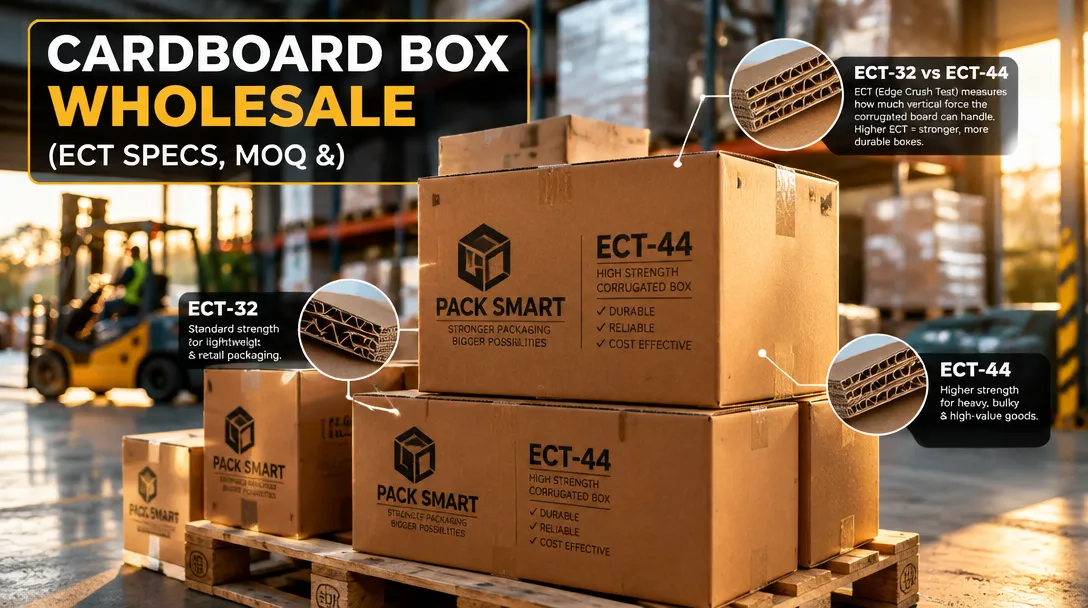
Wholesale corrugated box procurement in 2026 hinges on specifying the correct ECT rating (ECT-32 for single-wall e-commerce loads under 20 kg, ECT-44 or BC double-wall for stacked pallet loads), validating compressive resistance per ASTM D642, and locking MOQ against flexo vs litho-lamination tooling economics. Buyers who skip McKee-formula BCT derating for humidity routinely overbuy board by 10-15% or fail freight audits.
- Specify ECT, not burst: ECT-32 single-wall (C-flute, ~4mm caliper) covers most DTC parcel loads; ECT-44+ or BC double-wall is mandatory for warehouse stacking above ~3 pallet layers.
- Validate box compression with ASTM D642 testing and derive BCT via the McKee formula, then apply a 0.6-0.7 humidity derating factor for 80%+ RH storage environments.
- Wholesale pricing is driven by containerboard index exposure: kraftliner and semichemical medium pricing volatility in 2026 means indexed contracts (e.g., annual price-adjustment clauses) beat fixed quotes for orders above 500,000 boxes annually.
- EU shipments must meet EU PPWR (Regulation 2024/1991) recyclability and packaging-minimization requirements; compliant mono-material corrugated avoids PFAS-coated barrier surcharges.
- Freight math dominates landed cost: dimensional weight under FedEx/UPS 2026 rules and Amazon FBA cube utilization penalties frequently exceed the per-box material cost delta between 32 ECT and 44 ECT board.
Why Wholesale Corrugated Pricing Is Moving in 2026
Three structural forces are reshaping the cardboard box wholesale market for US and European buyers: containerboard price indexation, recycled-fiber furnish competition, and freight dimensional-weight policy. Integrated producers continue to operate indexed contract pricing tied to published containerboard benchmarks, while sheet-feeders and independent converters quote shorter fixed windows. For procurement directors, the practical consequence is that a fixed 12-month quote on high-volume RSC programs now carries meaningful margin-transfer risk in either direction.
On the demand side, e-commerce parcel mix keeps shifting toward smaller, void-optimized cartons. Per FTC Green Guides (16 CFR Part 260) substantiation rules, right-sizing claims must be defensible; under EU Regulation 2024/1991 (PPWR), packaging must be minimized relative to the product and meet recyclability design criteria. Both regulatory frameworks push buyers toward engineer-verified downgauging — replacing a 200 lb burst / ECT-44 box with an ECT-32 box only where the McKee-derived BCT and stacking safety factor allow it.
Spec Selection: ECT Ratings, Flute Profiles and the McKee Compression Path
Correct wholesale specification starts with load case, not with board grade. For parcel-dominant DTC programs (single-box shipment, ≤3 handling drops), a C-flute single-wall ECT-32 box at ~4.0mm caliper is the industry workhorse. For multi-layer pallet stacking, retail club distribution, or ISTA 3E unitized-load validation, double-wall BC flute (~7mm caliper) at ECT-44 to ECT-48 provides the stacking headroom that single-wall cannot.
The engineering chain runs: ECT → Box Compression Test (BCT) → stacking safety factor. Per ASTM D642 (Standard Test Method for Determining Compressive Resistance of Shipping Containers), BCT is measured directly on finished boxes; where physical BCT is unavailable, the McKee formula estimates BCT from ECT, perimeter, and caliper. Under ISTA 3A General Simulation Performance Testing, parcel boxes must then survive the full sequence of atmospheric conditioning, shock, vibration, and drops. The critical procurement error is applying the lab-condition BCT directly to warehouse stacking: conditioning per ISO 187 (23°C, 50% RH) yields values that overstate performance in 85% RH Gulf Coast or summer Rotterdam warehouses, where corrugated loses a substantial fraction of its compression strength. Apply a derating factor of 0.6-0.7 and maintain a stacking safety factor of 3-5x static load.
【💡 Packaging Engineer’s Quick Q&A】
Q: If the McKee formula derives BCT from ECT, why do enterprise POs still mandate direct ASTM D642 compression testing on production samples?
A: Direct answer: McKee is a statistical estimate with real error bands, while ASTM D642 measures the actual finished box, including converting-induced losses. Mechanical reason: slotting accuracy, crease/forming quality, and adhesive bond area between liner and medium all reduce real-world BCT below the McKee prediction — especially on high-speed flexo folders. Procurement recommendation: accept McKee for RFQ-stage board selection, but write the PO to require ASTM D642 verification on the first production run, with conditioning per ISO 187 before testing.
Hypothetical worked example (illustrative, not measured data): a 400 x 300 x 250mm RSC in ECT-32 C-flute has a McKee-estimated BCT in the ~450-500 N range under standard conditions; at 85% RH, a 0.65 derating puts effective stacking capacity near ~300 N. A 12 kg filled box with 3-high pallet stacking needs a static column support of roughly 24 kg-f equivalent — workable, but only if derating and safety factors were engineered in from the start. TadaPack’s free BCT and stacking calculators at https://tadapack.com/tools let buyers run this verification interactively before committing tooling.
Wholesale Cost Structure: Where the Unit Price Actually Goes
For a typical mid-volume RSC program, wholesale unit cost decomposes into containerboard (50-65%), converting (printing, die-cutting, gluing — 15-25%), corrugator waste allowance (5-8%), and freight to the buyer’s dock. Buyers negotiating purely on quoted price miss the two largest controllable levers: board utilization on the sheet (nesting efficiency of the box blank on the corrugator deckle) and dimensional-weight freight exposure.
MOQ economics are tooling-driven. A standard-RSC reorder with existing cutting dies carries little fixed cost, so MOQs of 1,000-5,000 boxes are common. Custom-printed flexo programs add plate costs that amortize over 10,000-25,000 boxes; litho-laminated or preprint programs justify MOQs of 30,000+ units. Short-Run Digital prototyping bridges the gap: TadaPack’s structural prototyping service produces CAD-cut, dimensionally verified samples so tooling commitments are made against a physically validated spec, not a drawing.
| Program Type | Typical MOQ | Flute / ECT Range | Tooling Cost Driver | Governing Standard / Test Protocol |
|---|---|---|---|---|
| Kraft RSC parcel box (DTC) | 1,000-5,000 | C-flute single-wall, ECT-32 | Cutting die (if new size) | ASTM D642 / TAPPI T811 / ISTA 3A |
| Printed flexo shipper | 10,000-25,000 | C or BC, ECT-32-ECT-44 | Flexo plates + die | ASTM D642 / ISTA 3A |
| Double-wall pallet/club shipper | 5,000-15,000 | BC double-wall, ECT-44-ECT-48 | Die + stacking validation runs | ASTM D642 / ISTA 3E / ASTM D4169 |
| Litho-laminated retail carton | 30,000+ | E-flute laminate, ECT-32 class | Litho plates + laminating setup | ISO 187 conditioning / EU PPWR (2024/1991) |
The freight overlay often flips spec decisions. Hypothetical example: on a 20 x 16 x 12in box shipping to Amazon FBA (Inland Empire nodes such as ONT8), reducing outer dimensions by one inch can drop the billable dimensional-weight tier; on a 50,000-unit annual program this frequently outweighs the entire per-box cost delta between ECT-32 and ECT-44 board. European buyers routing through the Port of Rotterdam multimodal rail/road network face the same cube-utilization math plus rising humidity-driven derating requirements on coastal storage.
Procurement Actions: Spec Contracts, Compliance and Verification SOP
Recommended actions for 2026 procurement cycles: (1) move volume contracts to indexed pricing with quarterly adjustment caps to hedge containerboard volatility; (2) write ECT, caliper, and Cobb 60 limits into the PO specification rather than relying on supplier data sheets; (3) require PPWR-aligned mono-material declarations for EU-bound packaging and PFAS-free barrier coating statements where grease/water resistance is specified, per FTC Green Guides (16 CFR Part 260) substantiation; (4) mandate first-article verification per the SOP below.
First-Article Verification SOP for Wholesale Box POs
- Step 1 — Caliper and flute geometry: measure caliper at 5 points per blank with a dead-weight micrometer per TAPPI T411; reject lots exceeding ±0.15mm from the specified caliper (e.g., 4.00mm nominal C-flute).
- Step 2 — ECT verification: test 10 edge-crush specimens per TAPPI T811 after conditioning at 23°C ± 1°C, 50% RH per ISO 187; accept at or above the specified ECT class (e.g., 32 lb/in or 5.6 kN/m equivalent).
- Step 3 — Finished-box compression: run ASTM D642 on 6 completed boxes; confirm BCT meets the McKee-estimated target minus an agreed converting loss allowance, and check dimensional tolerance of ±3mm on length/width/depth.
- Step 4 — Transit simulation: for parcel SKUs, run ISTA 3A (or ASTM D4169 Distribution Cycle 13 for palletized freight) with the actual product and void fill; document pass/fail and retain sealed retention samples from the lot.
Common defect diagnostics:
- Flap popping / panel bulge in stacking: root cause is usually compression overload after humidity derating was skipped, or warped blanks from uneven corrugator heat. Corrective action: verify Cobb 60 water absorption on liners (high absorption accelerates strength loss), add inner packing support, or step up one ECT class; also check glue-lap bond width (minimum ~15mm single-face glue line) at the manufacturer.
- Delamination of liner from medium after ocean transit: container sweat during 30-day Pacific or Atlantic crossings drives moisture into the corrugated medium. Corrective action: specify higher wet-strength medium or moisture-barrier coated liner (confirming PFAS-free chemistry), tighten container humidity with desiccants, and re-run ISTA 3A atmospheric conditioning at elevated RH before release.
For buyers consolidating these actions into a single RFQ package, TadaPack offers custom structural packaging engineering and short-run prototyping to validate board grade, flute profile, and geometry before wholesale tooling is cut. Combine this with the free calculation suite at https://tadapack.com/tools (BCT estimation, stacking load derating, dimensional-weight freight checks) to convert every wholesale quote into an engineered specification.
Recommended Engineering Reading
[TOOLS] Featured Engineering & Calculation Tools
Explore 70+ Packaging Tools ➔CBM Volume & Freight Dim-Weight Calculator
Calculate cubic meters & dimensional weight to minimize freight costs and avoid FBA size tier penalties.Mailer Box Area & Dieline Size Calculator
Instant flat dieline dimensions, material consumption, and sheet nesting for custom D2C mailer boxes.
