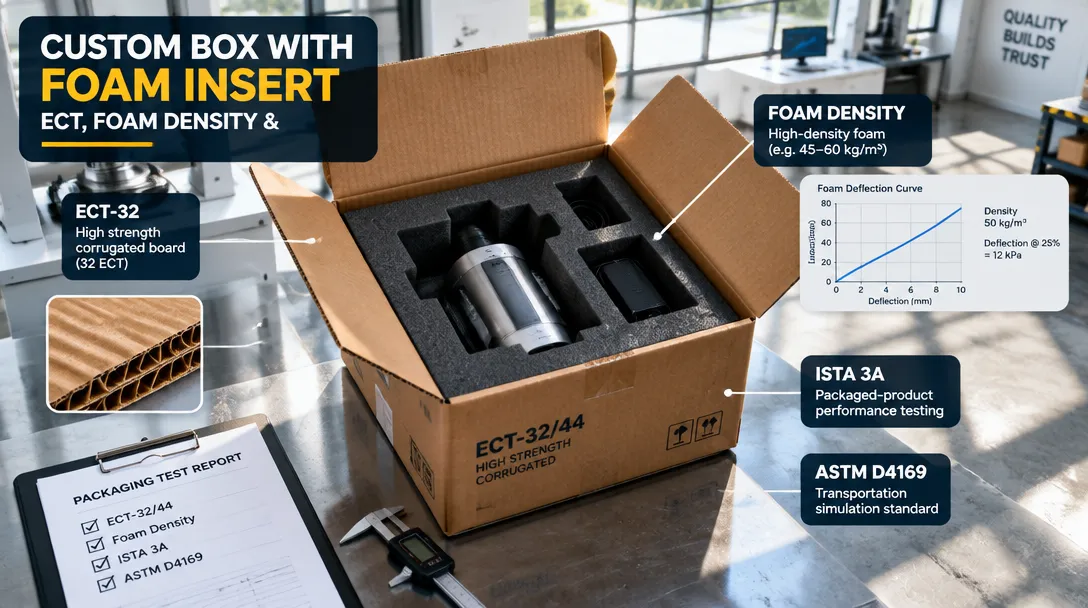
When a Custom Box with Foam Insert Is the Right Engineering Choice
With e-commerce parcel damage claims rising and EU PPWR (Regulation 2025/1892, entered into force 2025) tightening recyclability requirements on composite packaging, procurement teams can no longer treat foam inserts as an afterthought. A custom box with foam insert matters whenever product fragility, mass, or value exceeds what void fill can reliably protect: typically products with fragility ratings below 40g, unit values above roughly $150, or irregular geometry that prevents uniform load distribution.
The decision logic is straightforward. If your product survives a 30-inch drop in a rigid box with 25mm of cushioning on all six faces, a foam insert is engineering insurance. If the product is a 12kg industrial assembly subject to ISTA 3A General Simulation sequences (rotational flat drops, randomized vertical vibration, and concentrated impacts), foam inserts become mandatory rather than optional. Per ISTA 3A, parcels weighing up to 45kg face 10 drop shocks from heights scaled to gross weight, making the foam-box interface — not the box alone — the load path that determines survival.
How the Two-Component System Works: Load Paths, ECT and BCT
A foam-insert packaging system divides labor between two structures. The corrugated shipper resists external compression and stacking; the foam insert manages internal shock and vibration attenuation. Confusing these roles is the most common engineering error: specifying a heavy foam layer to compensate for an under-specified box, or vice versa.
Box side: Compression resistance is quantified by Edge Crush Test (ECT) per TAPPI T811. ECT-32 (32 lb/in) suits single-wall parcels under 9kg; ECT-44 or BC double-wall configurations handle 9-20kg or high warehouse stacking. Box Compression Test (BCT) is verified per ASTM D642, and the McKee formula (BCT ≈ 5.87 × ECT × √(caliper × perimeter)) provides the initial estimate before physical verification. Per ASTM D4169 Distribution Cycle 13, vibration and compression schedules must match the actual distribution environment, not a generic profile.
Foam side: The insert absorbs kinetic energy through controlled cell collapse. Key parameters are density (lb/ft³ or kg/m³), thickness, static stress at rest, and the cushion curve — the plot of transmitted deceleration (g) versus static stress at a given drop height, generated per ASTM D1596. The engineer selects thickness so that deceleration transmitted to the product stays below its fragility rating, with a design safety factor of 1.3-1.5.
Q: If the McKee formula derives BCT from ECT, why do enterprise POs still mandate physical ASTM D642 compression testing?
A: Direct answer: because McKee predicts an idealized column failure and typically overestimates real BCT by 10-20% after humidity conditioning and handling damage. Mechanical reason: McKee assumes uniform panel stiffness and ignores creep, liner delamination, and the stiffness reduction the foam cutouts introduce at load-bearing zones. Procurement recommendation: use McKee for initial spec, then contractually require ASTM D642 verification after ISO 187 conditioning (23°C, 50% RH) before releasing production tooling.
| Parameter | Typical Range | Governing Standard / Test Protocol |
|---|---|---|
| Corrugated ECT (single-wall) | ECT-32 to ECT-44 | TAPPI T811 |
| Box compression (BCT) | 150-450 kgf depending on size/flute | ASTM D642 |
| EPE foam density | 24-32 kg/m³ (1.5-2.0 lb/ft³) | ASTM D3575 |
| PU foam density (fabricated inserts) | 28-40 kg/m³ | ASTM D3574 |
| Cushion thickness (parcels) | 25-50 mm per face | ASTM D1596 |
| Static stress design band | 0.35-1.4 psi (PE foam) | ASTM D1596 cushion curves |
| Design safety factor on fragility | 1.3-1.5× | ASTM D4169 DC-13 / ISTA 3A |
| Conditioning before all tests | 23°C ± 1°C, 50% ± 2% RH | ISO 187 / ASTM D685 |
Material Choices: Foam Types, Flute Profiles and the Box-Foam Interface
Foam selection. Expanded Polyethylene (EPE) dominates mid-range B2B applications: non-abrasive, recoverable after repeated impacts, and laminatable to PP film. Expanded Polypropylene (EPP) offers superior repeated-impact recovery for returnable transport packaging but costs 40-60% more. Fabricated Polyurethane (PU) sheet at 28-40 kg/m³ suits low-volume DTC runs because it die-cuts cheaply without custom molds. Molded EPE tooling carries NRE costs typically between $800 and $3,000 depending on cavity complexity, so it amortizes only above roughly 2,000-5,000 units. For EU-bound packaging, verify the foam is free of PFAS-based surface treatments and document recyclability claims consistent with FTC Green Guides (16 CFR Part 260) for US marketing and EU PPWR recyclability grading schedules.
Board selection. C-flute (3.5-4.0mm caliper) balances cushion gap and print surface for most 5-20kg shipments; B-flute (2.5-3.0mm) suits die-cut inserts needing tighter radii; BC double-wall (6.5-7.5mm) is reserved for heavy industrial assemblies or palletized export where stacking heights exceed 1.2m. If a printed laminate or premium rigid construction is required, remember that laminated constructions shift failure modes — adhesive debonding under 80-90% RH ocean-humidity conditions is the dominant defect, so specify wet-strength adhesives and verify with ISO 2247 vibration testing after conditioning.
Interface geometry. The insert must locate the product rigidly in all six axes while providing clearance at the box walls so the corrugated never touches the product. Minimum foam-to-wall clearance of 5mm prevents flute-edge abrasion; corner ribs should follow radii ≥ 3× foam thickness to avoid stress concentration and tearing during assembly.
Q: Why does a foam insert that passed a 30-inch flat drop fail the same drop at an angle?
A: Direct answer: edge and corner drops concentrate load on a smaller foam area, roughly doubling static stress versus a flat drop. Mechanical reason: cushion curves are generated at fixed static stress per ASTM D1596; edge loading pushes the foam onto the steep, high-g portion of its curve, transmitting 1.5-2× the deceleration. Recommendation: design corner and edge features thicker than face cushions — a common rule is corner thickness equal to 1.5× face thickness — and validate with ISTA 3A’s 10-drop sequence, which includes edge and corner impacts.
Verification SOP: From CAD Prototype to ISTA 3A Release
Short-run prototyping and structured verification prevent the most expensive failure mode — discovering insert problems after the tooling is cut. TadaPack’s structural prototyping service supports the following workflow:
- Step 1 — Define inputs: product mass, fragility rating (g), center of gravity, and contact surfaces. If fragility is unknown, assume 40g for consumer electronics and confirm with the client’s engineering team before design.
- Step 2 — Size the cushion: select foam thickness from published ASTM D1596 cushion curves at the target static stress (0.35-1.4 psi band), applying a 1.3-1.5 safety factor; hold foam-to-wall clearance at 5mm minimum and cut tolerances at ±0.5mm for die-cut PU, ±0.3mm for molded EPE.
- Step 3 — Verify the box: confirm ECT per TAPPI T811 and BCT per ASTM D642 after ISO 187 conditioning; die-cut registration must hold ±0.15mm so insert cavities align with product geometry across the production run.
- Step 4 — Run the distribution test: execute ISTA 3A (or ASTM D4169 DC-13 for palletized freight) on 3 samples minimum; any insert cracking, product migration, or box panel failure returns the design to Step 2 with thickness or geometry adjustments before tooling release.
Defect Diagnostics: Insert Cracking, Set-Down Creep and Humidity Debonding
Insert cracking at fold lines. Root cause: foam bent around radii below 3× its thickness, or EPE density underspecified against unit mass. Corrective action: increase cavity radii, step up one density grade (e.g., 24 → 32 kg/m³ EPE), or switch the cracked feature from a fold to a butt-jointed two-piece construction.
Box crush after ocean transit. Root cause: 30-day ocean transit at 80-95% RH derates corrugated compression by 30-50%; a box passing ASTM D642 at standard conditioning fails under container sweat conditions. Corrective action: apply a humidity derating factor of 0.5-0.6 to warehouse stacking calculations, spec wet-strength liners, and re-test after 72-hour 90% RH conditioning. Stack load verification is available via TadaPack’s free calculation tools at https://tadapack.com/tools, which apply regional derating inputs for high-humidity coastal ports versus dry inland warehouses.
Product migration inside the cavity. Root cause: static stress below the cushion curve’s efficient band, allowing rebound bounce during ISTA 3A random vibration. Corrective action: reduce cavity volume or add positive-locating ribs so the product cannot translate more than 2mm under vibration input.
Typical Applications and Procurement Cost Structure
Where this construction is standard: medical device kits (validated against ASTM D4169 DC-13), precision optics and analytical instruments, consumer electronics retail-plus-parcel dual-duty packs, and automotive components shipped to sequenced plants. For EU fulfillment, note that PPWR recyclability grading penalizes composite constructions; designing the foam insert as a separately removable component (not laminated to the board) preserves the corrugated box’s clean recyclability stream and simplifies compliance documentation.
On cost: the BOM splits into board cost (driven by caliper and liner quality), foam cost (driven by density and volumetric yield), tooling amortization, and assembly labor. Hypothetical worked example: a 400×300×150mm C-flute ECT-32 shipper with a die-cut 30mm PU insert at 32 kg/m³ typically lands 25-40% above the same box with paper void fill at quantities under 1,000 units — but drop-test failure rates on fragile goods can make that premium trivially cheap relative to replacement and claim costs. Procurement directors should request per-quantity break sheets and compare amortized NRE across 1k/5k/10k tiers; TadaPack’s quoting workflow at https://tadapack.com provides tiered unit costs and short-run prototyping options.
Follow-Up Questions Buyers Ask Before Releasing a PO
See the FAQ section below for the questions TadaPack’s engineering desk fields most often — covering fragility data gaps, foam- versus molded-pulp trade-offs, MOQ for molded inserts, and humidity verification. The single most important pre-PO artifact remains documented product fragility data; without it, every downstream cushion calculation is an assumption wearing a specification number.
Recommended Engineering Reading
[TOOLS] Featured Engineering & Calculation Tools
Explore 70+ Packaging Tools ➔Box Compression (BCT) Calculator
Predict box compressive limit and stacking safety factors via McKee formula.Edge Crush Test (ECT) Calculator
Calculate linerboard ring crush and composite ECT ratings for optimal board specs.
