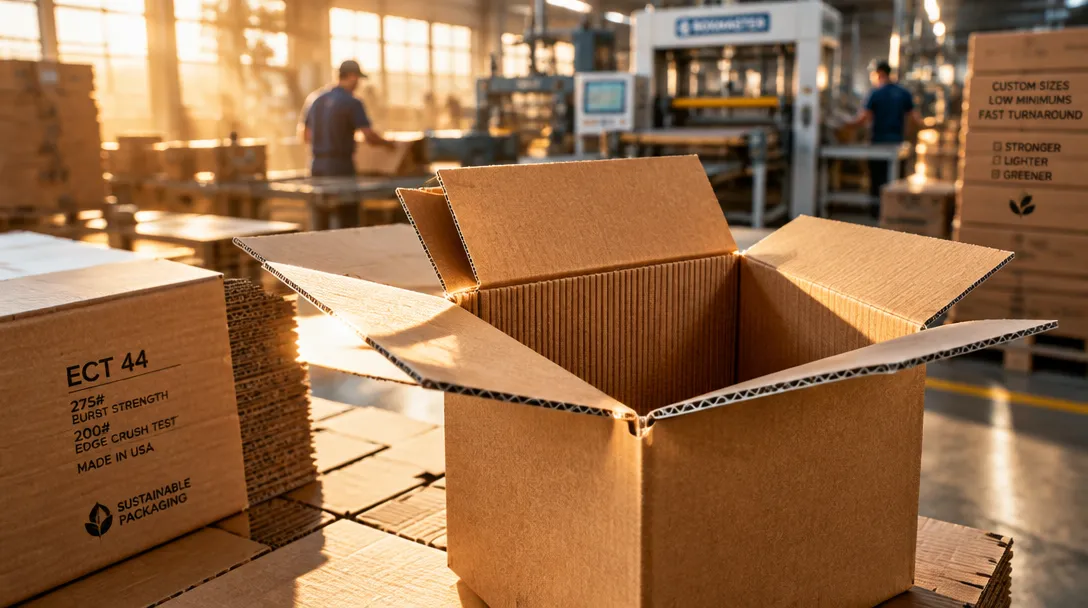
For corrugated box wholesale sourcing, match channel to volume: local distributors serve sub-5,000-unit urgent needs of stock ECT-32/RSC cartons; national wholesalers cover 5,000-100,000 units; direct factory sourcing wins above ~25,000 units on landed cost but adds 3-6 weeks of lead time. Always validate BCT (per ASTM D642) and ECT (per TAPPI T811) against your pallet stack load before signing any MOQ.
- Volume is the decision variable: stock-box distributors (<5k units), national wholesalers (5k-100k), and direct manufacturers (>25k) each dominate a distinct volume band on landed unit cost.
- Never buy on flute name alone: specify ECT (TAPPI T811) or burst (TAPPI T810) values; an ECT-32 C-flute RSC and an ECT-32 BC-flute double-wall behave identically in stacking despite different calipers.
- Stack crush, not box price, drives real cost: a box that fails ISTA 3A or ASTM D4169 transit simulation generates damage claims that erase any per-unit savings; model stacking loads with the McKee formula before comparing quotes.
- Landed cost beats invoice cost: freight class, dimensional weight, pallet utilization, and 2026 EU PPWR recyclability compliance fees must be included in any wholesale comparison.
- Custom structural work changes the channel calculus: die-cut mailers, FOL trays, and multi-color flexo require direct or converter-level sourcing; stock distributors cannot serve them competitively.
The Verdict Up Front: Which Wholesale Channel Wins at Your Volume
The query “corrugated box wholesale near me” implies a local-first sourcing strategy, but proximity is only one of five decision dimensions that matter: landed unit cost, MOQ, lead time, specification control, and customization capability. After modeling hypothetical procurement scenarios across typical US and European order profiles, the engineering verdict is clear:
- Below ~5,000 units (stock RSC cartons, standard ECT-32/ECT-44, no print): a local or regional distributor wins. You avoid freight on bulky cube, get 1-3 day replenishment, and can buy broken pallet quantities.
- 5,000-100,000 units: a national wholesale supplier with regional DCs typically delivers 12-22% lower unit cost than a purely local distributor at equivalent spec, because of volume-converted linerboard pricing.
- Above ~25,000 units, or any custom die-cut/direct-print program: direct factory sourcing (domestic plant or vetted overseas manufacturer) achieves the lowest landed unit cost, often 25-40% below distributor pricing on hypothetical worked examples, but requires managing 3-6 week production plus freight, and enforcing ASTM D642/TAPPI spec compliance via pre-shipment testing.
For DTC brands shipping via Amazon FBA or regional parcel networks, one further constraint dominates: the box must survive ISTA 3A General Simulation and fit dimensional-weight brackets. That strength-vs-cube requirement pushes even modest-volume buyers toward converter-grade sourcing rather than off-the-shelf stock.
Dimension-by-Dimension Comparison of the Three Wholesale Channels
The table below benchmarks the three sourcing channels across the criteria procurement teams should score before issuing a PO. Where a governing standard applies, it is named explicitly.
| Criterion | Local Distributor (Stock) | National Wholesaler | Direct Factory / Converter |
|---|---|---|---|
| Typical MOQ | 50-500 units, broken pallet OK | 2,000-10,000 units | 10,000-25,000+ units (custom tooling) |
| Landed unit cost (hypothetical, ECT-32 RSC 12x10x8″) | $0.90-$1.30 | $0.65-$0.95 | $0.45-$0.75 (volume-dependent) |
| Lead time | 1-3 days (stock) | 1-2 weeks | 3-6 weeks production + freight |
| Spec control | Stock ECT ratings only; no cert per lot | ECT-32/ECT-44 certified per TAPPI T811 | Full spec: ECT, burst (TAPPI T810), caliper (TAPPI T411), Cobb 60 |
| Strength verification | None; rely on stock grade data | Supplier COA; BCT per ASTM D642 on request | Lab-tested BCT/ECT, ISTA 3A / ASTM D4169 transit validation |
| Customization | None (one-color flexo at best) | 1-2 color flexo, standard RSC/HSC styles | Die-cut, FEFCO 0201/0427 styles, litho-lam, PFAS-free barrier coatings |
| Freight profile | Local LTL; low cube cost | Regional DC drop; freight class 70 | Ocean/road full pallets; requires pallet utilization planning |
| Regulatory fit (2026) | Compliant stock (recyclable kraft per EU PPWR 2024/1991; FTC Green Guides 16 CFR Part 260) | PPWR-compliant, recyclability data available | Full PPWR / 94/62/EC Annex II documentation, FSC chain-of-custody |
| Best fit | Urgent replenishment, startups, spec trials | Mid-volume DTC and 3PL replenishment | Established programs, custom structures, cost-optimized scale |
Governing standards referenced: TAPPI T811 (EDG edge crush), TAPPI T810 (Mullen burst), TAPPI T411 (caliper), ASTM D642 (compressive resistance), ASTM D4169 (distribution cycle performance), ISTA 3A (parcel simulation), EU PPWR Regulation (EU) 2024/1991 and Directive 94/62/EC Annex II (recyclability and heavy-metal limits).
Strength Specs Decide Cost Before Price Does: ECT, Burst, and the McKee Relationship
The most common procurement error in wholesale corrugated buying is comparing invoices without comparing stacking performance. A box’s real job is to carry column load through the distribution cycle, and its stacking capacity is governed by edge crush, not flute aesthetics. Per TAPPI T811, ECT-32 is the workhorse single-wall rating for single-parcel e-commerce; ECT-44 and double-wall BC-flute constructions serve >9.1 kg (20 lb) contents or multi-tier pallet stacking. In strict accordance with ASTM D642, boxes are compression-tested at 12.7 mm/min top-load platen speed, and the resulting Box Compression Test (BCT) value, derated for warehouse humidity and storage time, must exceed your stack load.
Engineers commonly estimate BCT from ECT via the McKee formula (BCT ≈ 5.87 × ECT × √(caliper × perimeter)). As a hypothetical worked example: an ECT-32 C-flute box with 4.8 mm caliper and 1,460 mm perimeter yields an estimated BCT of roughly 5.87 × 32 × √(0.0048 × 1460) ≈ 494 N (~50 kgf). After a typical 30-40% humidity/time derating, the safe stack contribution is ~300 N per box. If your warehouse specifies five-high pallet tiers, that math either passes or disqualifies the quote before price is ever discussed.
This is precisely why distributor stock boxes, sold without lot-level certification, carry hidden risk in engineering-critical programs: you inherit their grade data but not your geometry’s verified BCT. TadaPack’s free calculation tools at https://tadapack.com/tools let you run the McKee estimate and pallet stacking derating interactively before requesting quotes from any of the three channels.
Pros and Cons of Each Sourcing Channel
| Channel | Pros | Cons |
|---|---|---|
| Local Distributor | Same-week availability; low MOQ; freight minimized on cube-heavy orders; easy returns of stock grades | Highest unit cost; no custom die-cut; no per-lot certification; pricing volatile on linerboard surcharges |
| National Wholesaler | Certified ECT grades; 12-22% better unit cost; multi-DC replenishment; PPWR documentation available | MOQ 2k-10k; limited structural customization; 1-2 week lead time; less spec flexibility than converters |
| Direct Factory / Converter | Lowest landed unit cost (25-40% on hypothetical scenarios); full ASTM/TAPPI spec control; die-cut and multi-color flexo; PFAS-free barrier options | 3-6 week lead time; tooling cost; requires inbound QC (pre-shipment BCT/ECT per ASTM D642); freight and customs management |
Pros and cons should be weighted against failure cost, not just invoice cost. A single ISTA 3A transit failure producing a 2% damage rate on a 10,000-unit program costs more than the entire price delta between stock and converter-grade sourcing.
Where Each Option Fits: Vertical and Program Scenarios
DTC parcel programs (US/EU e-commerce). If your SKU ships single-parcel, ISTA 3A drop and vibration sequences govern the spec. National wholesalers with certified ECT-32 single-wall and 1-2 color flexo usually suffice at 5k-50k units. Above that, direct sourcing of FEFCO 0201 die-cut mailers with the same ECT grade typically cuts unit cost while adding brand print. Verify dimensional-weight brackets: a 2 mm caliper increase can move a parcel into a higher DIM band, so spec caliper per TAPPI T411 in the PO, not just flute name.
Industrial and FBA replenishment. Distribution to hubs such as the California Inland Empire (FBA ONT8/LGB3) or the Texas DFW triangle rewards pallet-density engineering. Here the direct/converter channel wins because pallet pattern optimization, tie-high/tier counts, and ASTM D4169 truck-schedule stacking validation can be co-engineered with the manufacturer. Stock distributors cannot tune geometry to your pallet, so you pay hidden freight in air.
European distribution under PPWR. From 2026 onward, packaging placed on the EU market must satisfy the recyclability design-for-recycling criteria under Regulation (EU) 2024/1991 (implementing Directive 94/62/EC Annex II obligations), and heavy-metal limits remain enforced. Corrugated kraft is inherently compliant, but adhesives, coatings, and any barrier treatments must be documented. Direct factories supplying full material declarations are the safest channel; demand declarations in the RFQ stage.
Startups and spec trials. Local distributors are genuinely the right first stop: buy 100-unit quantities of three candidate ECT grades, run your own drop checks against ISTA 3A logic, and use the results to write an evidence-based spec before committing to wholesale MOQs. TadaPack’s structural prototyping service can then convert that field-tested spec into production tooling at converter pricing.
How to Decide: A Five-Step Procurement Protocol
- Quantify the stack requirement first. Compute maximum warehouse stack load per box (pallet tiers × box weight + top-load), derate 30-40% for humidity/time, and set a minimum BCT. Use TAPPI T811 ECT data and the McKee relationship via https://tadapack.com/tools to pre-qualify grades before any quote.
- Segment your volume bands. Run 12-month forecast volumes through the channel break points: <5k → local distributor; 5k-25k → national wholesaler; >25k or custom structure → direct factory. Blended strategies (distributor for emergency stock, factory for base load) frequently beat a single-channel PO.
- Normalize quotes to landed cost per shippable unit. Include tooling amortization, freight class, DIM-weight impact, damage-rate allowance, and 2026 PPWR compliance fees. Two invoices never compare cleanly until these are added.
- Write the spec into the PO, not the email. Specify ECT (TAPPI T811) or burst (TAPPI T810), caliper tolerance per TAPPI T411, flute construction, joint type (stitched vs glued), and acceptance testing per ASTM D642 with sampling per your AQL.
- Validate before scale-up. Require pre-shipment compression testing per ASTM D642 and, for new geometries, a lab ISTA 3A or ASTM D4169 distribution-cycle run. Retain packaged retain samples from the first production lot for ongoing referee testing.
Executed in this order, the “near me” question dissolves into a cost-and-risk optimization problem, which is exactly how procurement directors should treat it. Proximity is a logistics convenience; verified compressive strength and landed unit cost are the engineering decisions that determine whether the wholesale program is actually cheaper.
Recommended Engineering Reading
[TOOLS] Featured Engineering & Calculation Tools
Explore 70+ Packaging Tools ➔Box Compression (BCT) Calculator
Predict box compressive limit and stacking safety factors via McKee formula.Edge Crush Test (ECT) Calculator
Calculate linerboard ring crush and composite ECT ratings for optimal board specs.
