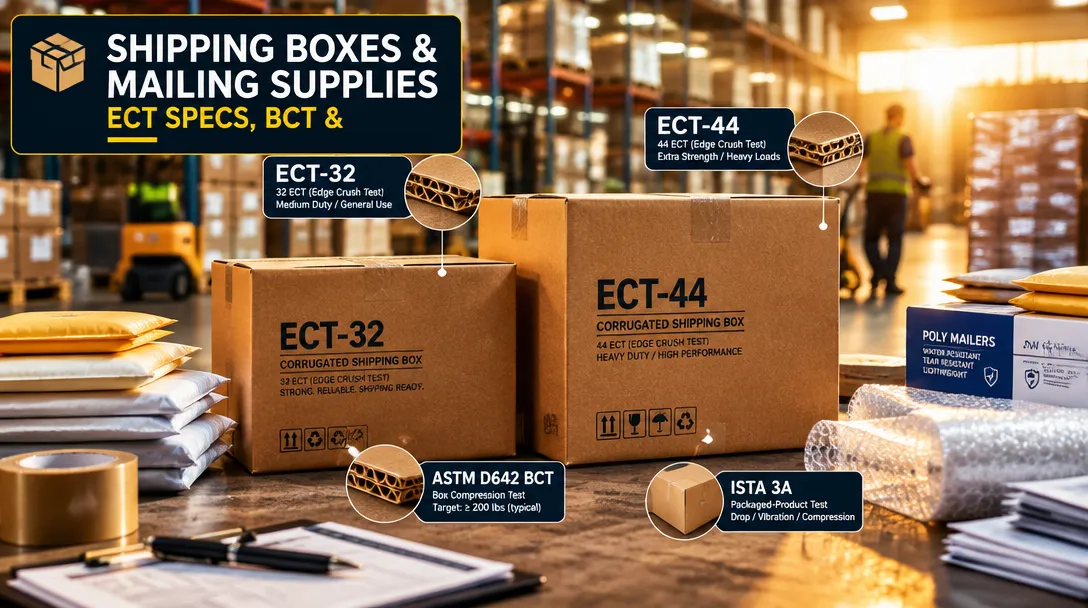
Correctly specified shipping boxes are selected by ECT rating and flute architecture—C-flute ECT-32 single-wall for sub-40 lb e-commerce parcels, BC double-wall ECT-44+ for 65 lb+ freight and humid ocean corridors—then validated to ASTM D642 and ISTA 3A. This teardown of a hypothetical mid-size DTC fulfillment program shows how flute choice, McKee-derived BCT targets, and dimensional-weight-aware sizing cut landed packaging cost 12-18% while surviving multimodal transit stress.
- Specify by ECT, not burst or basis weight: ECT-32 single-wall C-flute covers most sub-40 lb DTC parcels; ECT-44+ double-wall is mandatory above that or for ocean-freight humidity derating.
- McKee formula (BCT ≈ 5.87 × ECT × √(caliper × perimeter)) converts board specs into stacking predictions; safety factors of 3-5× apply for warehouse dwell and humidity.
- Dimensional-weight rules (divisor 139 in²/lb US domestic, 139-166 for EU-inbound air) make right-sizing the single largest controllable cost lever—often exceeding board cost savings.
- EU PPWR (Regulation 2024/1991) recyclability and packaging-minimization requirements now shape mailer format selection for European lanes alongside FTC Green Guides claims discipline in the US.
- Validate with ASTM D642 compression, ISTA 3A general simulation, and Cobb 60 moisture checks; prototype structurally before committing to 10,000+ unit MOQs.
Why One Hypothetical DTC Program Exposes Every Mailer Spec Error
DTC parcel volumes in 2026 continue to consolidate around fewer, larger 3PL nodes—California’s Inland Empire (ONT8/LGB3 catchment), the Texas DFW triangle, and Rotterdam-fed European multimodal hubs—because dimensional-weight penalties and carrier surcharge stacking punish every cubic inch of empty corrugated. Against that backdrop, consider a hypothetical but representative program: a mid-size DTC brand shipping a 6 lb, 12 × 9 × 4 in glass-jar kit nationally, currently using an overbuilt ECT-44 double-wall RSC at a 16 × 12 × 6 in internal size. This teardown treats that program as an engineering case, walking through board selection, compression math, freight mechanics, and the process controls that determine whether the box survives the corridor—not just the compression tester.
The failure modes this program faced are the same ones procurement directors see constantly: panel bulge after 30-day Pacific ocean legs, flap-gap crush at conveyor transfers, and dimensional-weight invoices running 22% above board-cost savings. None of these are material problems. They are specification problems.
Board and Flute Teardown: What the Original Spec Got Wrong
The incumbent box was a 275 lb/in²-class double-wall BC flute rated ECT-44, roughly 0.240 in (6.1 mm) caliper, kraft linerboard both sides. For a 6 lb product that is more than double the required stacking capacity—paid for at the press, and again in freight as dead caliper and oversized internal volume. The correct engineering question is never “is this strong enough?” but “what is the minimum ECT and caliper that meets BCT after humidity derating and stacking safety factors?”
Reference specification ranges for the format families procurement teams most frequently source:
| Format | Typical ECT (reference) | Caliper (reference) | Typical duty (reference) | Governing Standard / Test Protocol |
|---|---|---|---|---|
| Single-wall RSC, C-flute | ECT-32 | ~0.150 in / 3.8 mm | ≤ 40 lb parcel, dry inland | TAPPI T811 / ASTM D642 |
| Single-wall RSC, B-flute | ECT-32 | ~0.125 in / 3.2 mm | Print-critical mailers, short stacks | TAPPI T811 / TAPPI T411 |
| Double-wall RSC, BC-flute | ECT-44 to ECT-48 | ~0.240 in / 6.1 mm | 65-80 lb, ocean/humid corridors | ASTM D642 / ISTA 3A |
| E-flute mailer (crash-lock) | ECT-23 to ECT-27 | ~0.060 in / 1.5 mm | ≤ 5 lb padded DTC mailers | ISO 3037 / EU PPWR (2024/1991) |
| Single-face wrap / void fill | n/a | ~0.040 in / 1.0 mm | Surface protection, shock padding | ASTM D4169 (system level) |
All values above are typical industry reference ranges for design use, not certified lot data. Note that E-flute mailers, once a niche format, now dominate sub-5 lb DTC kits because PPWR minimization clauses and carrier dim-weight math both reward the 1.5 mm caliper.
Compression Math: Converting ECT Into a Stacking Decision
The decision tool is the McKee equation. In imperial form for a rectangular RSC: BCT ≈ 5.87 × ECT × √(h × Z), where h is board caliper in inches and Z is box perimeter in inches. Per ASTM D642, the predicted BCT is then divided by a stacking safety factor—3× for short warehouse dwell in dry climates, 4-5× for 30-day ocean transit into humid ports where effective ECT derates substantially.
Original box: BC double-wall, ECT-44, h = 0.240 in, internal 16 × 12 × 6 in → Z = 56 in.
BCT ≈ 5.87 × 44 × √(0.240 × 56) ≈ 5.87 × 44 × 3.666 ≈ 947 lb.
Right-sized box: C single-wall, ECT-32, h = 0.150 in, internal 13 × 10 × 4.5 in → Z = 46 in.
BCT ≈ 5.87 × 32 × √(0.150 × 46) ≈ 5.87 × 32 × 2.627 ≈ 493 lb.
Stack load for 8-high palletized warehousing at ~7.5 lb/box unit load: 60 lb applied column load. Safety factor on the right-sized box: 493 / 60 ≈ 8.2 dry, and roughly 4.1 after a 50% humidity derate—still comfortably above the 3-5× corridor requirement. Freight effect (hypothetical rates): internal volume drops from 1,152 in³ to 585 in³, dim weight at divisor 139 drops from 8.3 lb to 4.2 lb, moving the billable class for a 6 lb shipment and eliminating the overbox entirely.
Q: If McKee derives BCT directly from ECT, why do enterprise POs still mandate Mullen burst testing (TAPPI T810)?
A: First, the direct answer: burst testing survives in legacy procurement language because 200 lb/in burst (equivalent to the old 32 ECT single-wall grade) is the minimum many retail and 3PL compliance manuals were written around decades ago. Second, the mechanical reason: McKee assumes uniform panel compression and ignores localized damage—burst pressure (a hydraulic rupture metric) correlates poorly with edgewise column failure, so neither substitutes for the other when handling abuse or nail/splinter puncture risk is in scope. Third, the procurement recommendation: keep ECT as the governing stacking spec, add TAPPI T810 burst only where the channel mandates it, and always require ASTM D642 measured BCT on first-article samples rather than relying on formula prediction alone.
Freight-Environment Teardown: Ocean Humidity, Hubs, and Stack Derating
The second structural error in the hypothetical program was ignoring corridor physics. A 30-day Pacific crossing exposes board to container sweat cycles; cyclic humidity absorption softens flutes and permanently reduces compression residual. Engineering practice: derate nominal ECT by 30-50% for ocean-leg stacking calculations, spec wet-strength or internally sized liners where Cobb 60 results trend high, and verify with ISTA 3A sequences (drop, vibration, compression) plus, for dense or high-value freight, ASTM D4169 distribution-cycle schedules.
Hub-level stresses matter too. Inland Empire FBA nodes (ONT8, LGB3) impose conveyor transfer drops and clamp-truck handling on single parcels; DFW cross-dock operations add tall transient stacks in hot, dry conditions where board embrittlement is minor but static loads peak. Rotterdam inbound freight rides barge/rail/road multimodal legs with wide RH swings, making moisture derating and PPWR-compliant mono-material construction (per Regulation 2024/1991 recyclability criteria) joint selection drivers for European lanes. Under FTC Green Guides (16 CFR Part 260), any recyclability claim on US-market mailers must be substantiated by the actual recycling stream accessibility—another reason uncoated kraft corrugated with PFAS-free barrier coatings dominates 2026 spec sheets.
Procurement teams can run these derating and dim-weight scenarios interactively with TadaPack’s free calculators at https://tadapack.com/tools before committing MOQ volumes.
First-Article Verification SOP and Defect Diagnostics for Mailing Supplies
Before a wholesale release, run this four-step structural qualification SOP:
Step 1 — Board qualification. Condition samples 24 h at 23°C ± 1°C, 50% ± 2% RH per ISO 187/ASTM D685; verify caliper with a digital micrometer per TAPPI T411 (typical production tolerance ±0.15 mm) and ECT per TAPPI T811 against the PO grade.
Step 2 — Die and crease verification. Confirm die-cut registration to ±0.15 mm on crash-lock mailers; check creasing matrix hardness (typically 45-durometer rubber elements) and slot width (flute caliper + 1.5-2.0 mm) so flaps close flush without scoring through the liner.
Step 3 — Static and dynamic compression. Run ASTM D642 box compression on first articles; measured BCT must meet the McKee-derived target minus the agreed safety factor, and stacks must hold ≥ 1 h at the derated design load without ≥ 0.25 in panel bow.
Step 4 — Transit simulation. Execute ISTA 3A general simulation (or the agreed ASTM D4169 schedule) on packaged product, then inspect for liner delamination, flap-gapping > 3 mm, and cushion set. Only then release the production MOQ.
Two recurring defects and their floor-level corrective actions:
- Flap popping / gaping after gluing: usually crease-matrix mismatch to caliper or excessive moisture in the board at conversion. Action: widen slot clearance by 0.5 mm increments, verify humidity conditioning of incoming board, and check hot-melt application temperature against adhesive spec (typically 160-180°C) rather than increasing glue volume.
- Adhesive debonding / liner delamination under ocean humidity: caused by high-Cobb liners paired with starch adhesives below solid-content spec. Action: swap to internally sized (higher wet-strength) linerboard, verify Cobb 60 on incoming rolls, and derate stacking figures one ECT class for ocean lanes.
What transfers from this teardown to any program: specify by ECT and BCT with corridor-derated safety factors; right-size internal dimensions against dim-weight divisors before optimizing board cost; validate with ASTM D642 and ISTA 3A on first articles, not supplier datasheets; and lock European lanes to PPWR-compliant mono-material formats. TadaPack’s structural prototyping service produces short-run die-cut first articles for exactly this validation sequence, and the online tools at https://tadapack.com/tools handle BCT, derating, and dim-weight math in minutes.
Recommended Engineering Reading
[TOOLS] Featured Engineering & Calculation Tools
Explore 70+ Packaging Tools ➔CBM Volume & Freight Dim-Weight Calculator
Calculate cubic meters & dimensional weight to minimize freight costs and avoid FBA size tier penalties.Mailer Box Area & Dieline Size Calculator
Instant flat dieline dimensions, material consumption, and sheet nesting for custom D2C mailer boxes.
