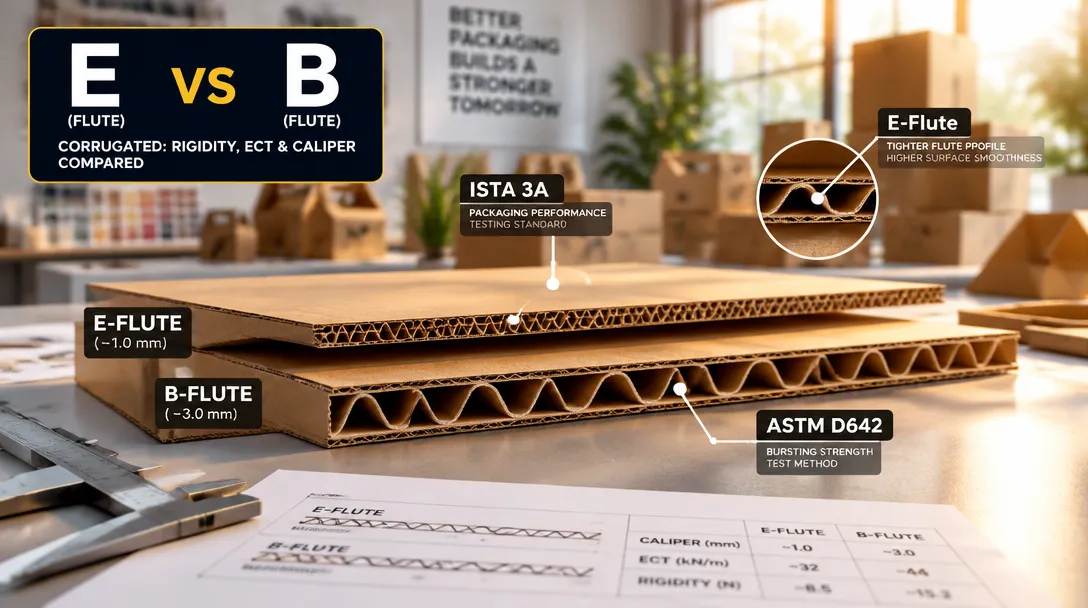
E-flute (≈1.5 mm caliper) delivers superior flat-panel rigidity and print surface for mailers and shelf packaging, while B-flute (≈3.0 mm) provides roughly double the stacking strength and vertical crush resistance for heavier payloads. Choose E-flute below ~5 kg unit weight and B-flute when column stacking height or ASTM D642 BCT targets govern the design.
- E-flute caliper is approximately 1.5 mm versus ~3.0 mm for B-flute — a 2× board-thickness differential that drives the entire rigidity trade-off.
- On equal linerboard (e.g., 33/26/33 lb/1000 ft²), B-flute typically posts a 10–15% higher ECT than E-flute because its taller, wider-fluted corrugating medium resists edge crush more efficiently; ECT is measured per TAPPI T811.
- E-flute wins on flat-panel stiffness-to-weight and flexographic/litho-lamination print quality; B-flute wins on box compression (BCT, per ASTM D642) and puncture tolerance.
- Under the McKee relationship (BCT ∝ ECT × √caliper × perimeter), B-flute’s greater caliper compounds its ECT advantage for stacking-critical designs.
- Procurement rule of thumb for 2026: E-flute for DTC mailers, inserts, and litho-laminated displays under ~5 kg; B-flute for e-commerce shippers, ISTA 3A-tested parcels, and 3–5 tier column stacks.
The Verdict: Rigidity Is Directional — Match Flute Geometry to Load Path
DTC brands shipping lithium-battery-compatible electronics kits and EU PPWR-driven lightweighting mandates have pushed both flutes into the same procurement conversations, but the engineering answer has not changed: corrugated rigidity is a directional property. ‘Rigidity’ in corrugated design splits into two distinct mechanical metrics — flat crushing resistance and vertical panel stiffness — and E-flute and B-flute rank oppositely on each. E-flute’s fine pitch (~0.12–0.14 m flute count per inch range, ~125–140 flutes per 30 cm) gives it exceptional resistance to flat crush and a near-solid surface for high-graphics work. B-flute’s taller arch (~2.5–3.0 mm height) converts vertical loads into arch compression far more effectively, which is why B-flute dominates heavy e-commerce shipper specs.
The headline numbers, as a hypothetical worked example on a common 200 lb/ECT-32-class combination: an E-flute sheet built on 33/26 lb liners with a 26 lb medium may test near ECT-30, while the identical liner combination in B-flute frequently lands at ECT-34 to ECT-36. That gap widens further when the McKee formula’s √caliper term is applied — B-flute’s 2× caliper contributes roughly a 1.4× multiplier to predicted BCT before liner weights are even adjusted.
Dimension-by-Dimension: Caliper, ECT, BCT, Print, and Cost
The table below consolidates the governing specifications. All mechanical values are typical industrial design ranges for standard kraft linerboard combinations — not certified lot data — and must be verified on your specific board grade under ISO 186 sampling and conditioning per ISO 187.
| Criterion | E-Flute | B-Flute | Governing Standard / Test Protocol |
|---|---|---|---|
| Caliper (thickness) | ~1.5 mm (0.059 in) | ~3.0 mm (0.118 in) | TAPPI T411 |
| Typical flutes per 30 cm | ~125–140 (fine pitch) | ~43–50 (coarse pitch) | TAPPI T411 / supplier spec |
| ECT on equal liners | Baseline (reference) | +10–15% typical | TAPPI T811 / ISO 3037 |
| Predicted BCT (McKee) | Lower — penalized by √caliper term | ~1.8–2.0× E-flute at equal linerboard | McKee formula / ASTM D642 verification |
| Flat crush resistance | High — fine pitch distributes load | Moderate — arch prone to fluting deformation | TAPPI T825 / ISO 3035 |
| Print surface quality | Excellent — direct flexo to 85+ lpi; ideal litho-lamination substrate | Good — visible flute telegraphing at high line screens | ISO 12647 (process control reference) |
| Die-cutting tolerance | ±0.3 mm achievable; sharp creases, minimal cracking | ±0.5 mm typical; wider crease matrices required | Converter SOP / ISO 21747 SPC principles |
| Transit test fit | ISTA 3A (parcel ≤ 70 lb) for protected goods | ISTA 3A / ASTM D4169 DC-13 for heavier shippers | ISTA 3A / ASTM D4169 |
| Typical payload ceiling (design guide) | ≤ ~5 kg single-wall | 8–15 kg single-wall | Design range — verify per ASTM D642 |
| Recyclability | Fiber-based, recyclable — PPWR (Regulation (EU) 2025/40) recyclability-by-design classes apply | Fiber-based, recyclable — same framework | EU PPWR (Regulation (EU) 2025/40) / EN 13430 |
Two nuances procurement teams routinely miss. First, the ECT advantage of B-flute is not automatic: at aggressive lightweighting, some fine-flute grades with high-density mediums close the gap, so always compare ECT on the actual supplier board certificate rather than assuming the flute hierarchy. Second, dimensional freight matters: E-flute’s 1.5 mm caliper can shave a dimensional-weight tier on thin-profile mailers — a real cost lever under 2026 DIM-factor pricing at US parcel networks and EU postal consolidators.
Q: If the McKee formula derives BCT from ECT, why do EU enterprise POs still mandate Mullen burst testing (TAPPI T810) alongside ECT?
A: Direct answer: because burst test is a material acceptance gate, not a structural predictor — a PO line like ‘275 lb burst / ECT-44’ is dual-sourcing protection. Mechanical reason: McKee predicts compression failure of a sound box, but Mullen (TAPPI T810) catches medium defects, delamination, and furnish substitution that leave ECT relatively insensitive, especially on short-flute boards where a single weak corrugating medium is masked by strong liners. Procurement recommendation: require ECT per TAPPI T811 as the governing structural spec and Mullen only as a fraud/integrity screen; on E-flute, insist the certificate also lists flat crush (TAPPI T825), since fine flutes fail in flat crush before they fail at the edge.
Where Each Flute Fits: Application Engineering by Load Case
E-flute (≈1.5 mm) — the precision panel. E-flute is the correct choice when the box is a presentation surface, an insert, or a light protective shipper: cosmetics cartons, litho-laminated retail-ready packaging, subscription mailers, rigid-box liners, and pizza-style rigid lids. Its fine pitch gives near-folding-carton print fidelity and crisp die-cut corners, and its thin caliper keeps mailer thickness inside parcel network surcharge thresholds. Its structural ceiling is real: a single-wall E-flute RSC asked to column-stack four tiers in a humid warehouse will bow, panel bulge, and shed BCT well before a B-flute equivalent.
B-flute (≈3.0 mm) — the workhorse shipper. B-flute is engineered for vertical load and puncture: e-commerce RSCs, FBA inbound cartons (where ONT8/LGB3-style inbound stacking and conveyor automation punish soft panels), replacement-part shippers, and double-wall BC combinations where C-flute space is unavailable. B-flute’s short flutes versus C-flute also give it better die-cutting accuracy and less crush at score lines, which is why it — not C-flute — remains the default single-wall shipper flute in much of Europe.
Note the co-existence play: litho-laminated construction bonds a printed litho sheet to E-flute and then mounts it inside or onto B-flute (or BC double-wall) carriers, capturing E-flute’s print surface with B-flute’s structure. This hybrid is standard for club-store retail-ready packaging and is fully compatible with PPWR fiber-based recyclability classes when water-based adhesives are used.
Pros and Cons at a Glance
| E-Flute | B-Flute | |
|---|---|---|
| Pros | Highest print fidelity in direct-print corrugated; low caliper minimizes DIM-weight penalties; excellent flat crush and crease quality; lower fiber cost per box on equal footprint. | Highest single-wall BCT and stacking economy; strong puncture and impact tolerance; proven for ISTA 3A parcel and ASTM D4169 DC-13 distribution cycles. |
| Cons | Rapid BCT loss with height/stack tiers; too thin for heavy payloads without double-walling; flute telegraphing risk if over-printed with heavy ink coverage is minimal but crease cracking on high-burst liners requires matrix tuning. | Visible flute profile limits high-line-screen direct print; thicker caliper consumes freight cube; wide pitch telegraphs on litho-lamination unless a top-liner of ≥ 150 gsm is specified. |
How to Decide: A Four-Step Flute Specification SOP
Step 1 — Define the load path. Classify the package: panel-dominant (display, mailer) versus column-stack-dominant (shipper). If the design must survive 3+ tiers of stacking, start at B-flute; if the design is hand-carried or single-tier, start at E-flute.
Step 2 — Derive the BCT target. Multiply unit weight by warehouse stack factor and safety margin (a common starting point: total stacked load × 1.5 safety factor × humidity derate of 0.6–0.7 for 80%+ RH corridors). Verify the predicted value against ASTM D642 on physical samples — never ship on the formula alone.
Step 3 — Fix print and finishing requirements. If flexo ≥ 85 lpi or litho-lamination is specified, E-flute (or B-flute with ≥150 gsm top liner) is mandatory; adjust flute second, not first. Die-cut tolerance targets (±0.3 mm E-flute / ±0.5 mm B-flute) should be written into the PO with creasing matrix specs matched to caliper.
Step 4 — Validate in distribution, not just compression. Run ISTA 3A for parcel payloads or ASTM D4169 for LTL/freight cycles, conditioning per ISO 187 (23°C, 50% RH) and re-testing after 24 h at elevated humidity for ocean-freight-bound SKUs. Feed actual BCT results back into your BOM before committing annual volume.
For interactive verification of stack factors, DIM-weight tiers, and McKee-based BCT predictions against your footprint, use TadaPack’s free engineering calculators at tadapack.com/tools. TadaPack’s structural prototyping service can deliver short-run E-flute and B-flute samples with certified board certificates for ASTM D642 and ISTA 3A pre-validation before tooling commitment — the fastest route to de-risking a flute decision at annual-volume scale.
Recommended Engineering Reading
[TOOLS] Featured Engineering & Calculation Tools
Explore 70+ Packaging Tools ➔CBM Volume & Freight Dim-Weight Calculator
Calculate cubic meters & dimensional weight to minimize freight costs and avoid FBA size tier penalties.Mailer Box Area & Dieline Size Calculator
Instant flat dieline dimensions, material consumption, and sheet nesting for custom D2C mailer boxes.
