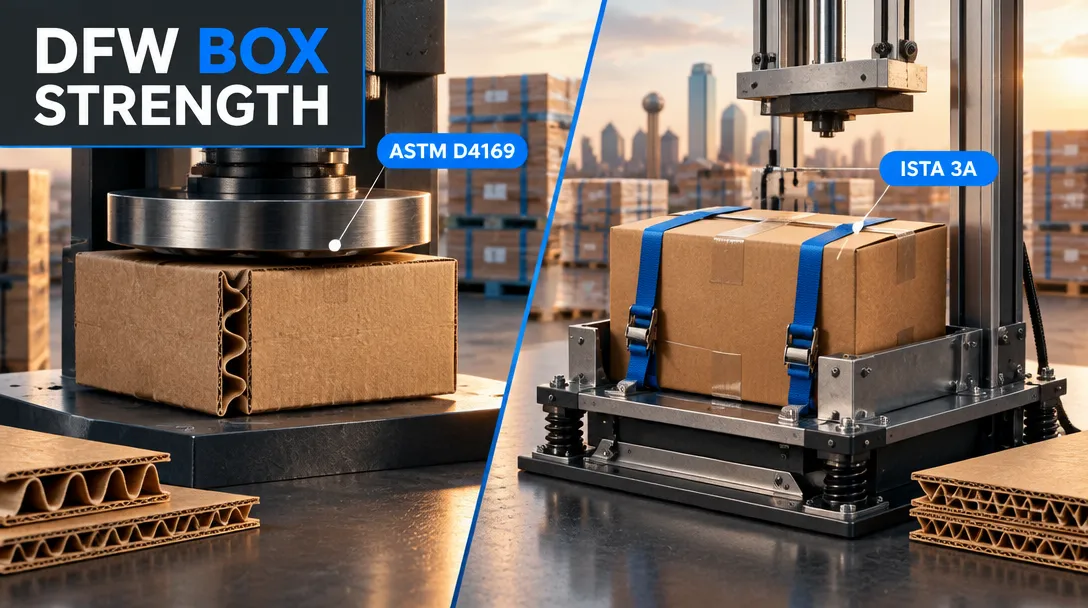
- ASTM D4169 evaluates shipping-unit performance through a selected distribution cycle and test sequence; ISTA 3A simulates parcel delivery conditions for packaged products.
- Neither standard converts directly into a required corrugated grade: ECT-32 and ECT-44 are board edge-crush ratings, not package-level pass criteria.
- For DFW distribution, use the parcel profile when individual cartons travel through parcel networks and a representative distribution cycle when the shipping unit and route warrant it.
- Confirm box compression, closure, product cushioning, moisture exposure, and actual stacking conditions; do not buy higher ECT as a substitute for package validation.
ASTM D4169 and ISTA 3A test different distribution questions
The selection question is not which standard is “stronger.” It is which test sequence better represents the shipment being purchased, manufactured, and delivered. ASTM D4169, Standard Practice for Performance Testing of Shipping Containers and Systems, provides a framework for evaluating shipping units under distribution hazards. The user selects a distribution cycle, assurance level, and applicable test schedule to represent the intended system. The protocol can include hazards such as handling, compression, and vibration; the appropriate sequence depends on the shipment and the selected cycle.
ISTA 3A is a general simulation performance test for packaged products shipped through a parcel delivery system. It addresses packaged-product configurations within its scope and applies a prescribed sequence of simulated hazards. It is particularly relevant when each carton is handled as an individual parcel, rather than protected within a stable palletized shipping unit for most of its journey. Confirm the current ISTA procedure and package eligibility with the laboratory before specifying a test.
Both standards assess the performance of a packaged system, not corrugated board in isolation. A test outcome depends on the carton dimensions, board construction, joints, closure, contents, cushioning, and conditioning, as well as the selected procedure. Passing a package test does not establish that every production box has a particular ECT value; specifying ECT alone does not demonstrate that a package will pass either protocol.
For DFW procurement, specify the distribution profile first and the board strength second. Describe whether cartons ship individually, in mixed parcel loads, or as palletized freight; state product mass, geometry, orientation, shipment configuration, and relevant handling or storage conditions. Then select the applicable test plan with the packaging engineer and test laboratory.
Corrugated strength needs to match the actual DFW shipping unit
ECT measures the edgewise compression resistance of corrugated board under a defined test method; it is commonly reported in pounds per inch. ECT-32 and ECT-44 identify nominal performance classes, not guaranteed box-compression loads. Finished-box compression also depends on perimeter, box style, dimensions, flute, board caliper, score lines, manufacturing quality, and environmental conditioning. A larger footprint or a tall, narrow carton can behave differently even when the board grade is unchanged.
For a preliminary screen, engineers may use a box-compression estimate such as the McKee relationship, which relates ECT and board caliper to approximate box compression. It is a design aid, not a substitute for testing: geometry, panel openings, print and converting damage, load distribution, and humidity can materially change performance. Specify ECT using the applicable board test method and verify the finished package using a relevant compression method, such as ASTM D642, when compression performance is a design requirement.
Flute selection adds another trade-off. E-flute is relatively thin and can support compact, printable cartons; B-flute generally provides more thickness and cushioning; C-flute is thicker and often used where cushioning or stacking geometry supports it. BC double-wall combines flute profiles for applications that need a heavier-duty structure, but it also adds material and dimensional volume. Actual caliper varies by construction and supplier; obtain the mill’s board specification rather than assigning a universal caliper to a flute name.
Do not select ECT-44 automatically for a DFW route simply because the carton may be stacked or handled repeatedly. Establish the maximum supported load, time under load, pallet or shelf configuration, and expected storage environment. If a single-parcel carton is exposed to repeated drops, a stronger board may not resolve an inadequately restrained product or a weak closure. Conversely, a palletized load can face sustained compression risks that a parcel test alone does not represent.
Moisture is a key uncertainty because paperboard can lose stiffness as its moisture content rises. Where water exposure is credible, assess the board, seams, and product barrier together. Cobb 60 is a water-absorption test method, not a universal acceptance threshold; define an application-specific limit through material evaluation rather than claiming one number prevents delamination in every case. For recyclable packaging goals, evaluate coatings and adhesives for compatibility with the intended recycling stream. PFAS-free barrier options may be considered where a barrier is needed, but substantiate performance and claims for the actual construction.
Choose the protocol around the shipment, not a strength label
For an individual carton moving through parcel delivery, ISTA 3A is a logical candidate for a general simulation test. It can help expose weaknesses in the combined package under the selected procedure, but it is not a universal guarantee for every carrier, route, or handling event. Use the protocol’s applicable package category and configuration; confirm details with the testing provider rather than assuming all parcel shipments are identical.
ASTM D4169 is a better fit when the team needs to construct a distribution simulation around a defined shipping unit and distribution cycle. It can be useful for evaluating palletized or otherwise configured units, provided the selected cycle and schedules reflect the real distribution system. DFW is a destination and logistics market, not a unique test protocol: the correct test depends on the path before, within, and after the regional distribution network, not on the city name alone.
For either route, document the complete test basis: package configuration, gross weight, dimensions, closure method, conditioning, distribution cycle or procedure, and acceptance criteria. Acceptance should address product damage and package integrity in terms relevant to the sale and operation—for example, functional product performance, carton rupture, closure failure, or unacceptable deformation. Agree on criteria before testing to avoid treating a subjective visual inspection as a pass/fail rule.
Use a representative production-intent package. A prototype with different board, adhesive, insert fit, or closure may not predict the production result. If test failures occur, diagnose the failure mode first: panel collapse points toward compression or geometry; product damage with an intact carton may indicate inadequate restraint or cushioning; opened seams suggest closure, joint, or converting issues. Change one design variable at a time where practical, then repeat the relevant validation.
Specify a testable box design and manage procurement risk
Write the purchase specification in layers. First identify the shipment configuration and governing test protocol. Next define the finished carton dimensions, board construction, ECT requirement and measurement basis, closure, and any print or converting constraints. Finally define the package-level acceptance criteria and the evidence required from the supplier. A board-grade certificate can support material verification; it cannot replace a package test when the commercial requirement is distribution performance.
For a hypothetical comparison, consider two otherwise identical cartons: one made with ECT-32 board and one with ECT-44 board. The higher ECT construction offers a higher nominal edge-crush rating, but the comparison alone does not establish a particular box-compression capacity or successful ISTA 3A or ASTM D4169 result. A change in box dimensions, flute, humidity, contents, or closure can shift the outcome. Have the supplier quote a production-intent sample and validate the configuration before locking a high-volume specification.
Procurement should compare total delivered cost, not board price alone. A heavier or thicker construction can increase material use and may affect carton dimensions, pallet patterns, and parcel dimensional-weight charges. In parcel operations, Amazon FBA dimensional freight charges are relevant only where the shipment uses applicable Amazon services and current rate rules; verify the live program requirements rather than treating them as a universal DFW cost. The practical objective is the lowest-cost validated package that meets the defined protection and handling requirements.
Recommended action: map the shipment, select ISTA 3A for an applicable parcel-delivery package or ASTM D4169 for a distribution-cycle evaluation, and specify ECT as one material control within that test plan. TadaPack can support custom structural packaging and prototyping to compare production-intent constructions. Use the TadaPack calculation tools at https://tadapack.com/tools for preliminary engineering checks, then confirm critical performance through appropriate physical testing. Calculators help screen designs; they do not certify compliance or replace a test laboratory.
Recommended Engineering Reading
[TOOLS] Featured Engineering & Calculation Tools
Explore 70+ Packaging Tools ➔CBM Volume & Freight Dim-Weight Calculator
Calculate cubic meters & dimensional weight to minimize freight costs and avoid FBA size tier penalties.Mailer Box Area & Dieline Size Calculator
Instant flat dieline dimensions, material consumption, and sheet nesting for custom D2C mailer boxes.
Frequently Asked Technical Questions (FAQ)
Does ASTM D4169 require ECT-32 or ECT-44 corrugated board?
When should a DFW shipper choose ISTA 3A instead of ASTM D4169?
Will ECT-44 guarantee a better result than ECT-32 in parcel testing?
Can a box-compression calculation replace package testing?
