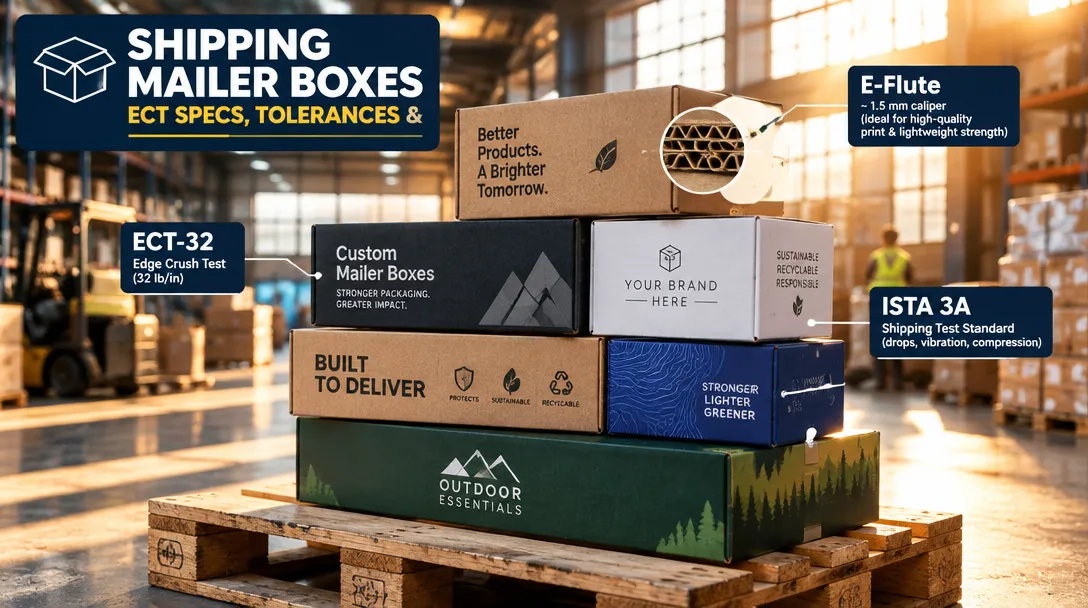
A shipping mailer box is a one-piece die-cut corrugated or paperboard container — typically E-flute (1.5 mm caliper) or B-flute (3.0 mm) with ECT-32 minimum — that converts on a single glue-flap fold and must survive ISTA 3A drop-and-vibration sequences without T-top or flap-gapping failure. This teardown of a benchmark DTC fulfillment mailer shows exactly where the engineering budget goes: board grade, die registration, and adhesive line width.
- Specify mailer strength by ECT, not board weight: ECT-32 kraft outperforms a heavier 350 gsm CCNB at equivalent freight cost because crush resistance lives in the flute column, not the liner mass.
- E-flute mailers (≈1.5 mm caliper) win on DIM-weight shipping for sub-2 lb parcels; B-flute (≈3.0 mm) is mandatory above ~4 lb or for palletized multi-unit packs.
- Die-cut registration tolerance of ±0.5 mm on slot depth and glue-flap width is the single most predictive control for flap-gapping claims.
- Under EU PPWR (Regulation 2025/40, phasing in through 2026), mailer recyclability claims must reference the actual flute/liner composition — no unverified ‘plastic-free’ copy without a compliant coating spec.
- A 12×9×4 in E-flute mailer at ECT-32 typically delivers a hypothetical BCT near 55–65 lbf — verify your own stack math with TadaPack’s free compression calculator at tadapack.com/tools.
Why This Mailer Earns a Teardown
DTC parcel volume across US and EU corridors in 2026 continues to compress carrier DIM divisors and tighten Amazon FBA damage-claim scrutiny, which pushes procurement teams to stop treating mailer boxes as print collateral and start treating them as engineered containers. The subject of this teardown is a representative 12 × 9 × 4 in e-commerce shipper — the highest-volume spec in the category — produced on single-wall E-flute kraft with a one-color flexo print, a configuration that dominates the sub-2-lb parcel segment in both inbound freight economics and ISTA 3A survival rates. We break down its structure and material stack first, then the converting process, then the elements any brand or engineer can borrow for their own BOM.
Structure and Material Teardown of a 12×9×4 E-Flute Mailer
The benchmark mailer uses a one-piece die-cut blank — the so-called ‘crash-lock’ or auto-bottom configuration with a single operator-applied glue line on the closure flap. Structural geometry matters as much as the board: the 90° corner scores are creased with a matrix system, not merely rule-crushed, because a sharp crease on E-flute preserves the liner’s tensile integrity across the fold. Per the McKee-type derivation used throughout the industry, estimated box compression is proportional to ECT multiplied by caliper raised to a fractional power — which is why the 1.5 mm E-flute caliper on this mailer, not the 200 gsm liner weight, is the true load-bearing variable.
| Parameter | E-Flute Kraft Mailer (Reference) | B-Flute Upgrade (Reference) | Governing Standard / Test Protocol |
|---|---|---|---|
| Caliper | 1.4–1.6 mm | 2.8–3.2 mm | TAPPI T411 (micrometer) |
| ECT rating | ECT-32 (typical) | ECT-44 (typical) | TAPPI T811 / ASTM D1164 family |
| Estimated BCT (12×9×4) | ~55–65 lbf (hypothetical) | ~90–110 lbf (hypothetical) | ASTM D642 (compression) |
| Transit validation | ISTA 3A pass target, ≤1% damage budget | ISTA 3A / ASTM D4169 DC-12 | ISTA 3A / ASTM D4169 |
| Glue flap & slot tolerance | ±0.5 mm die registration | ±0.5 mm die registration | ISO 21747 (process capability framework) |
| Moisture absorption limit | Cobb 60 ≤ 35 g/m² | Cobb 60 ≤ 35 g/m² | ISO 535 (Cobb method) |
All values are typical industry reference ranges for design purposes, not measured results from a specific production lot.
The material stack is deliberately simple: unbleached kraft liner (≈175–205 gsm per side is common on E-flute stock), starch-based corrugating adhesive, and — where moisture resistance is needed — a PFAS-free water-based barrier coating rather than a poly lamination. Under FTC Green Guides (16 CFR Part 260) substantiation rules and the EU PPWR recyclability design-for-recycling criteria, an uncoated or PFAS-free-coated kraft mailer retains a clean curbside recyclability claim; a plastic-laminated mailer does not. Per ISO 186, all board conditioning before test is 23°C ± 1°C and 50% ± 2% RH — require your supplier’s certificates to state it.
Q: If the McKee formula derives BCT from ECT, why do overseas enterprise POs still mandate Mullen burst testing on the board?
A: For a 200 lb/in² burst-class E-flute stock, burst and ECT correlate well enough that either usually suffices for the mailer body. The underlying mechanical reason: Mullen (per TAPPI T810) tests multi-directional tensile burst of the liner laminate, which predicts puncture and rough-handling resistance in a way ECT’s pure edge-column crush cannot — relevant when parcels face single-parcel courier sortation rather than palletized distribution. Practical recommendation: accept ECT as your primary stacking spec and concede burst only for rough-handling clauses; demanding both on the same PO usually buys you the supplier’s minimum grade on each, at cost.
Converting Process Highlights: Where the Mailer Actually Wins or Fails
Three process steps determine whether the specification survives to the customer’s doorstep. First, die-cutting: the benchmark mailer is produced on a flatbed die-cutter with a creasing matrix (not bare rule creasing), targeting ±0.5 mm registration between the slot depths and the glue flap; under-impression produces folding cracks on kraft liner, over-impression crushes the flute and silently erodes ECT. Second, glu-lap application: a cold PVA glue line of 2–3 mm width on the crash-lock flap, with open time controlled so flap pop-open under conveyor impact stays below the claim threshold. Third, flexo print: one color at 45–55 durometer anilox-appropriate plate hardness, registered inside a 0.5 mm band from the score so ink never bridges the crease (a leading cause of fiber tear on fold).
- Step 1 — Condition and caliper: Condition samples 24 h at 23°C ± 1°C, 50% ± 2% RH (per ISO 186); measure caliper at five points per blank per TAPPI T411; reject if any point deviates more than ±0.15 mm from nominal 1.5 mm.
- Step 2 — ECT spot check: Cut 2 × 1 in edge specimens and test per TAPPI T811; reject the lot if the mean falls below 90% of the ECT-32 spec.
- Step 3 — Fold-cycle audit: Hand-fold 10 blanks fully; inspect every score line at 45° raking light for liner cracking and confirm glue-flap dimensions against the dieline within ±0.5 mm.
- Step 4 — Compression confirmation: Run a full empty-box compression to ASTM D642 on 3 samples; accept if the mean meets or exceeds your derived BCT target (e.g., ~55 lbf reference for the 12×9×4 E-flute spec) with no premature panel bulge.
Assume a DTC brand ships 40,000 mailers/month at 12 × 9 × 4 in on E-flute kraft. Swapping from a 350 gsm CCNB solid board mailer to ECT-32 E-flute: the corrugated option saves roughly 18–25% on board cost per unit at typical 2026 reference pricing and drops the dimensional weight profile because 1.5 mm walls ship nested in a shorter stack. Conversely, adding 0.2 mm of unnecessary caliper on 40,000 units can add a full pallet position per container load — using TadaPack’s dimensional weight and stack-load calculators (tadapack.com/tools) before locking the dieline is the cheapest engineering decision in the whole BOM.
Failure Modes: Flap Gapping and Ocean-Transit Delamination
The two defect classes that dominate mailer claim files are flap pop-open and humidity-driven strength loss. Flap pop-open (the crash-lock flap springing open in carrier sortation) usually traces to either a slot cut too shallow (glue flap over-length beyond the +0.5 mm window, creating spring-back) or an adhesive with excessive open time on a hot summer line; the floor-level fix is re-knifing the slot to nominal and switching to a faster-tack PVA grade. Humidity strength loss follows container sweat on 30-day Pacific or Atlantic ocean legs: kraft liner regains moisture, Cobb 60 climbs, and BCT can derate 25–40% versus conditioned values — under ISO 535 testing, a Cobb 60 result exceeding ~35 g/m² is the standard early-warning flag. Mitigation is a PFAS-free barrier coating plus vented palletization at the receiving hub; for the Inland Empire FBA cluster (ONT8/LGB3) and Rotterdam rail-linked distribution, factor a 0.8–0.9 stacking derating coefficient for high-humidity coastal warehousing versus dry inland storage, and verify your stack height margin with the TadaPack calculator suite.
What Other Buyers Should Borrow From This Build
Steal four things from this teardown. First, the spec-by-function discipline: ECT-32 E-flute for sub-2 lb parcels, B-flute ECT-44 above ~4 lb or for multi-unit shippers — never buy board weight you cannot connect to a compression requirement. Second, the tolerance-gated dieline: write ±0.5 mm die registration and the Cobb 60 ≤ 35 g/m² ceiling directly into the PO so QC has rejection authority, not just targets. Third, the compliance-forward coating choice: PFAS-free barrier chemistry keeps the mailer on the right side of EU PPWR recyclability grading and FTC Green Guides substantiation in a single decision. Fourth, the prototyping gate: before committing tooling, run a short-run structural prototype through your own ISTA 3A drop-and-vibration sequence — TadaPack’s custom structural packaging and prototyping service exists precisely to compress that validation loop, and its free online calculators let procurement teams check DIM weight, BCT estimates, and pallet utilization in minutes rather than waiting on a supplier callback. Brands that adopt this engineering posture routinely cut damage claims to the sub-1% range while trimming board spend — because the mailer was finally specified as what it is: a load-bearing structure with a print surface, not the reverse.
Recommended Engineering Reading
[TOOLS] Featured Engineering & Calculation Tools
Explore 70+ Packaging Tools ➔CBM Volume & Freight Dim-Weight Calculator
Calculate cubic meters & dimensional weight to minimize freight costs and avoid FBA size tier penalties.Mailer Box Area & Dieline Size Calculator
Instant flat dieline dimensions, material consumption, and sheet nesting for custom D2C mailer boxes.
