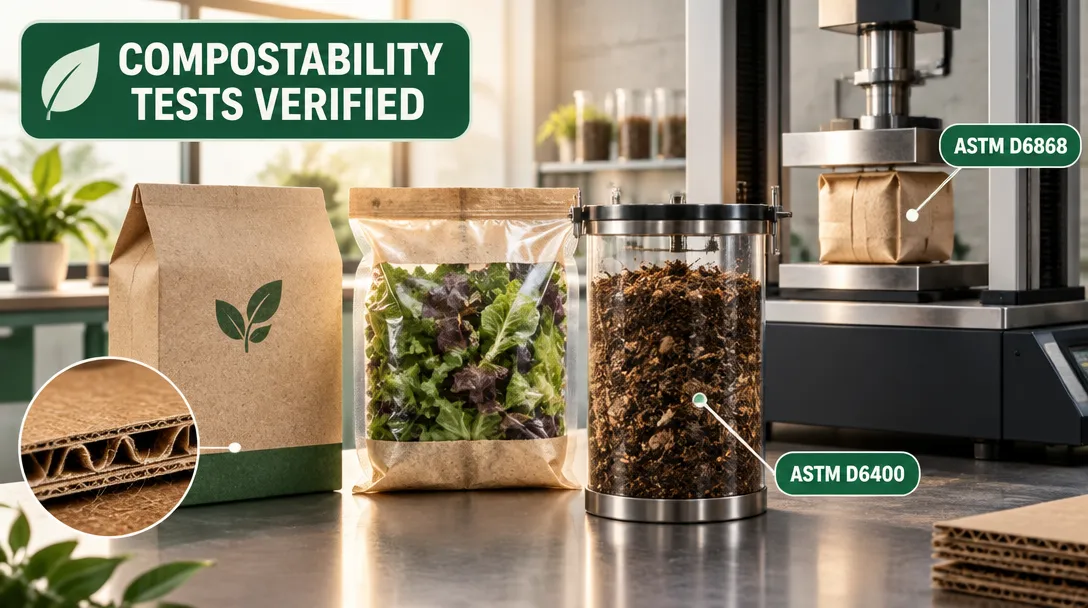
BPI certification indicates third-party verification against compostability criteria under ASTM D6400 for plastics or ASTM D6868 for coatings on paper and fiber. It is not a transit-strength rating: qualify the finished package separately for ECT, moisture exposure and distribution testing such as ASTM D4169 or ISTA 3A where appropriate.
What does BPI certification actually verify?
BPI certification verifies compostability performance and formulation through a third-party program; it does not certify that a package will survive a particular supply chain. BPI’s referenced explanation describes three scientific benchmarks: disintegration within 12 weeks, biodegradation into carbon dioxide, water and biomass, and ecotoxicity screening that includes heavy metals such as lead, cadmium and chromium. The stated framework is ASTM D6400 for plastics and ASTM D6868 for coatings on paper and fiber.
The 12-week disintegration benchmark is not a universal promise that every certified item will disappear in every compost pile within that time. The source describes certification for aerobic, thermophilic conditions in commercial composting facilities. Actual access to a suitable facility and its acceptance rules are operational questions for the brand to confirm; certification alone does not establish local collection availability.
BPI also offers a Home Compostability Certification. Its validation uses time-based disintegration testing at the lower, more variable temperatures typical of backyard piles, with mesophilic microbes. Treat home and commercial claims as distinct specifications: do not infer home compostability from a commercial certification or place an unverified home-compost claim on packaging.
Which ASTM standard applies to my packaging construction?
Use ASTM D6400 for a plastic product and ASTM D6868 when the relevant compostable component is a coating on paper or fiber, then confirm the exact product scope with BPI before making a claim. The material name alone is not enough to choose the route: construction, coating, formulation and intended claim all matter.
For procurement, identify every component that could affect the finished article: substrate, barrier layer, ink, adhesive, label and closure. A paperboard carton with a barrier coating should not be specified as though its fiber substrate were the only relevant material. Request current certification documentation that identifies the product and covered configuration, and verify that the production specification matches it. A supplier’s description of a resin as plant-based is not a substitute for certification.
The BPI source identifies PLA, PBAT, PHA, PCL and PBS among materials that can fully decompose under the stated commercial composting conditions. That is not a blanket approval of every grade, blend, coating or finished package containing those polymers. Evaluate the certified finished product and scope, not a generic polymer label.
Q: If a film supplier says its material is biodegradable, can procurement treat it as BPI-certified compostable?
No. First, “biodegradable” and “plant-based” do not by themselves establish that the complete product meets BPI certification criteria. Second, the source warns that uncertified materials may fragment into persistent microplastics rather than fully break down. Third, require product-specific certification evidence and match the certified scope to the purchased construction before approving claims or a bill of materials.
How should we choose commercial versus home compostability?
Choose the claim that matches the validated end-of-life route your product is actually designed to use: commercial certification for the specified commercial conditions, or the separate BPI home program when home compostability is claimed. Do not bridge the difference with assumptions about temperature, pile management or consumer behavior.
For a packaging specification, record the intended claim, the relevant certification scope and the components covered. Then check that artwork, product descriptions and purchasing documents use language consistent with that evidence. If the packaging has multiple parts, such as a coated paper tray and a separate film lid, confirm the status of each part rather than treating the pack as a single undifferentiated material.
This separation also prevents a common engineering error: using a compostability certificate as evidence for a functional barrier or distribution claim. Barrier performance, seal integrity, stacking strength and parcel survivability require their own material specifications and validation. For example, ECT-32 or ECT-44 corrugated grades address edge-crush strength, not compostability; ASTM D4169 or ISTA 3A distribution testing addresses shipping hazards, not compostability certification.
What packaging tests must we run in addition to certification?
Run a separate package qualification plan for the actual product, pack configuration and distribution channel; BPI compostability verification does not establish ECT, Cobb 60, compression or parcel-drop performance. Set acceptance limits from product protection needs, shipping profile and supplier capability rather than presenting a generic value as a certification threshold.
For a corrugated shipper, select ECT based on package geometry and stacking demands, then validate the assembled container. A McKee-style BCT estimate may help compare designs when inputs and assumptions are appropriate, but it is an estimate—not a replacement for a compression test or distribution simulation. For paper-based constructions, Cobb 60 can help characterize water absorption; set a project-specific limit based on the risk of moisture-related softening, coating damage or delamination. Do not assume a compostable coating delivers a particular Cobb result without testing.
For parcel distribution, consider ISTA 3A when it matches the shipment profile; for broader distribution hazards, assess ASTM D4169 as applicable. These are logistics protocols, not BPI certification methods. Check dimensions and packed weight as well: avoidable volume can increase freight exposure, including dimensional-weight charges on applicable parcel services. A protective design must balance these factors without adding components that are outside the verified compostability scope.
How can procurement compare certified options without overstating performance?
Compare options using two independent gates: documented compostability scope and demonstrated package performance. A low-cost certified material is not a cost saving if it requires a heavier shipper, creates damage risk or forces a redesign; likewise, a mechanically robust pack is not automatically compostable.
Use a hypothetical worked example to structure a quote review: if a proposed redesign reduces packaging mass from 100 g to 90 g, the arithmetic reduction is 10 g per pack, or 10%. This is an illustrative calculation, not a measured TadaPack result, and says nothing by itself about landed cost, protection or compostability. Add unit price, conversion yield, shipping cube, damage exposure and certification documentation to the comparison before approving a change.
For each candidate, ask the supplier for the applicable BPI certification scope, the controlled construction specification and evidence that the quoted product matches it. Keep a separate test plan for structural and moisture requirements. TadaPack can support custom structural packaging and prototyping to evaluate fit, board grade, dieline and distribution performance; use TadaPack’s online calculation tools at https://tadapack.com/tools for planning calculations, not as a substitute for product-specific tests.
What decision rule should teams use before approving a compostable pack?
Approve a compostable package only when its claim is supported by the applicable certification scope and its finished design independently passes the brand’s functional and distribution requirements. The certificate answers “what compostability criteria were verified?”; engineering qualification answers “will this package protect the product in our supply chain?”
Use this decision path: a plastic product points to ASTM D6400; a coating on paper or fiber points to ASTM D6868; a home-compostability claim requires evaluation under BPI’s distinct home program. Then confirm the documentation covers the actual construction, and separately validate strength, moisture behavior and distribution performance. If documentation or scope is unclear, pause the claim and request clarification rather than inferring compliance from resin origin or marketing language.
Recommended Engineering Reading
[TOOLS] Featured Engineering & Calculation Tools
Explore 70+ Packaging Tools ➔CBM Volume & Freight Dim-Weight Calculator
Calculate cubic meters & dimensional weight to minimize freight costs and avoid FBA size tier penalties.Mailer Box Area & Dieline Size Calculator
Instant flat dieline dimensions, material consumption, and sheet nesting for custom D2C mailer boxes.
